End of February Wine Sale

Get ready to cherry pick a big wine sale featuring 150 wines at 40-50% price reductions

And $5 case shipping. 

Highlights: 150 wines up for sale

The website: vintagewineestates.com 

On Tuesday the 28th, Vintage Wine Estates will offer 150 wines from its portfolio of wineries. 

The collection ranges from top notch wineries like Owen Roe, Qupe, Kunde, Laetitia, Clos Pegase and several others that are fully functional real wineries.

And, yes, the portfolio includes your basic supermarket brands like cherry pie and layer cake.

VWE as the company likes to be called, has so far encouraged many of its wineries to function as they always have.

It added a new brand “Bar Dog” that may appeal to some of you.

And I do like to fun/pun it created with the brand, “If You See Kay.” 

Here are the wineries to look for in this sale:

Owen Roe Cabernet Sauvignon, Cabernet Franc and other reds from Red Willow Vineyard

Tamarack  Firehouse Red for $12

Qupe Grenache $18

Laetitia Pinot Noir

Kunde Zinfandel

B.R. Cohn Chardonnay, Cabernet

Delectus Napa Valley

Can’t  find anything you like? Well then, just If You See Kay it!

3 Reasons to Shop Last Bottle

When it comes to rating the top online wine sellers today, the last word is Last Bottle.

I’ve been following it and another two dozen sites for several years now and, yes, I faithfully look at everyone’s daily deals, special offers, clearance sales and whatever else. 

Most sites are hyping the same wines after covid and are so predictable.

But not Last Bottle.

Wine.com is great in many ways, but it doesn’t list many of the small, hidden gems that Last Bottle uncovers.

I also think highly of winespies.com, reversewinesnob.com and wineaccess.com.

Last Bottle, however, is best at 3 key things:

  1. Big, real discounts!! Often over 50%.
  2.  Great selection, ever changing, not the usual fare.
  3.  Exciting, informative, and fun to read website and wine comments.

All of this along with a proven track record and yet there’s no personality behind it, no person by name.

And therefore no ego in evidence. No sommelier or wine expert showing off.

It is all done by teamwork, by wine competence, and by a crazy, noisy, got you by the throat style.

The question remains: who the heck are the people behind Last Bottle? 

I asked that and several other questions and was surprised at the quick and  informative response.

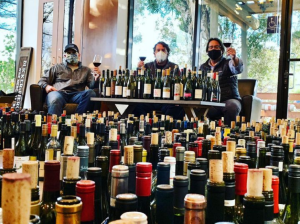
But I still don’t know that much about the people. The best I have is this photo:

What sets their sales approach apart from the others are the unusual and energized wine descriptions. Here’s a typical introduction to a featured Shiraz:

“Quick poll…who’s seen the video where the guy rescues his dog from the headlock of a big ol’ kangaroo and then squares off (you might want to Google it)!? Man, those Aussies are just the best. Speaking of BEST, how about 94 POINTS and THIRTEEN American dollars (that’s 18.60 Aussie dollars, by the by)??!! Mount Langi Ghiran SHIRAZ!!! Pure craziness.”

Or this one about a Barbaresco:

“WOOHOO!!! If you could make Burgundy with nebbiolo, this just might be it. Fine, elegant texture, no heaviness, but STACKED, simply soaring with beautifully fresh and dried roses, red cherry, orange pekoe tea, a dash of allspice and cinnamon, freshly turned earth, and shaved truffles, some toasted hazelnuts…my, oh my! SO GOOD! This will age like a champ, too – so get a few extra to save. We get all contemplative and nostalgic whenever we drink Rivetti. This is complex, thoughtful, fine, focused, and distinctly reaching for a higher level.”

These atypical wine comments keep on coming and may strike some as silly and irreverent, but their descriptions are clever, creative, and so unlike the mechanical writeups encountered elsewhere.  And the wines are top quality.

To learn more about these folks, see my article posted at http://www.winereviewonline.com

Here’s one question I asked that’s sure to tease you:

Q: You say your team tastes 40,000 wines a year, or roughly 800 a week. Really? Is that true or hype?

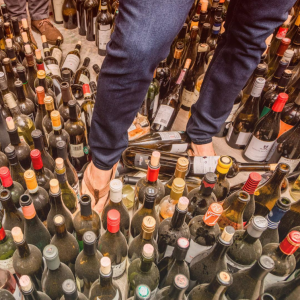
A: This is 100% true. When the tasting bar becomes too packed with bottles we set them on the floor, and have to carve little paths to get through. It can seem ridiculous, but it speaks to our commitment to assessing every wine to find the gems that make it into a daily offer. 

Here they are hard at work: the Chateau Les Feet of wine sellers:

A Year End Clearance Sale Not to be Missed

winespies.com has a wine sale unlike any other in my experience.

What a great opportunity to stock up on wines and wonderful way to ring in the New Year!!

The clearance consists of well-established, big names and recent cult-wine candidates like my most recent discovery, Giornata in Paso Robles.

There’s an added wrinkle as in each day the discounts are deeper, but the wines may disappear If you hesitate.

So, first go to the website, study the procedure for its “top secret Clearance” and go through the list to see what appeals to you.

Meanwhile, here’s the list with my suggestions highlighted in bold.

Excellent selection of Napa Cabs and Chateauneuf-du-Pape!!

I could say more, but time is critical.

The list:

Bodegas Corral 2017 ‘Altos’ Single Estate Crianza Rioja
Bodegas Orán 2017 ‘Soleá’ Valdebebas Rioja
The Vice 2020 ‘Carbone’ Single Vineyard Coombsville Cabernet Sauvignon
Paolo Manzone 2020 ‘Mirinè’ Nebbiolo d’Alba
Château Grand Moulin 2017 ‘Réserve Elysée’ Corbières
BoutenacXavier Vignon 2020 ‘Cuvée Anonyme’ Châteauneuf-du-Pape Blanc
Mazzei 2019 ‘Philip’ Toscana IGT Cabernet Sauvignon
Domaine du Grand Tinel 2019 ‘Classique’ Châteauneuf-du-Pape
Bodegas Manzanos 2001 ‘Vino de Autor’ Voché Rioja
The Vice 2020 ‘The Hostage’ Single Vineyard Napa Valley Cabernet Sauvignon
Viñedos de Páganos 2007 El Puntido Gran Reserva Rioja
Empress Vineyards 2019 Los Carneros Reserve Pinot Noir
Cuvée Wine Cellars 2014 Carneros Merlot
ALTA 2018 ‘NorCal’ Atlas Peak Napa Valley Cabernet Blend
Luca Bosio 2018 BaroloAveraen 2019 ‘Flood Line’
Chehalem Mountains Chardonnay
CVNE 2015 ‘Viña Real’ Gran Reserva Rioja
Giornata 2019 ‘Gemellaia’ Paso Robles Proprietary Red
Esk Valley 2016 ‘The Terraces’ Hawke’s Bay Proprietary Red
Kendric Vineyards 2018 Petaluma Gap Estate Pinot Noir
Château Magrez Fombrauge 2011 St.-Émilion Grand Cru
Bodegas Manzanos 2009 ‘125 Aniversario’ Reserva Rioja
Gorman Winery 2018 ‘The Devil You Don’t Know’ Columbia Valley Red
Palladian 2018 Napa Valley Reserve Cabernet Sauvignon
Diego Conterno 2017 BaroloTeso
la Monja 2018 ‘Victorino’ Toro
Domaine de Rosiers 2019 ‘Cuvée Drevon’ Côte-Rôtie
Château Lafleur du Roy 2019 ‘Les Lavandières’ Pomerol
Maison Champy 2017 Beaune 1er Cru
Luigi Vico 2017 Prapò Barolo
Galerie 2017 ‘Pleinair’ Napa Valley Cabernet Sauvignon
Le Clos du Caillou 2020 ‘Les Quartz’ Châteauneuf-du-Pape
Domaine Chanson 2018 Beaune Clos des Mouches Rouge 1er Cru
Château de Vaudieu 2019 ‘L’Avenue’ Châteauneuf-du-Pape
Xavier Vignon 2012 ‘Cuvée Anonyme’ Châteauneuf-du-Pape
Grattamacco 2018 ‘Grattamacco’ Bolgheri Superiore
Elvio Cogno 2017 Ravera Barolo
Shannon Family 2020 ‘Devil’s Well’ Napa Valley Cabernet Sauvignon
Bodegas Viyuela 2017 White Label Crianza Ribera del Duero
La Pitchoune 2019 Holder Vineyard Russian River Valley Pinot Noir
Rocca di Montegrossi 2016 ‘San Marcellino’ Gran Selezione
Charles Smith 2017 Substance ‘Cs’ Stoneridge Vineyard Cabernet Sauvignon
Frisson 2019 Napa Valley Cabernet Sauvignon
Domaine Chanson 2018 Beaune Clos des Mouches Blanc 1er Cru
Bodegas Breca 2018 ‘Brega’ Calatayud
Château Montlandrie 2012 Castillon Côtes de Bordeaux
GrapeHeart Vineyards 2016 ‘GHV’ Estate Cabernet Sauvignon
Caiarossa 2015 ‘Caiarossa’ IGT Toscana
Château Jean Faure 2019 St.-Émilion Grand Cru
Cantina di Negrar 2019 ‘Le Preare’ Ripasso della Valpolicella Superiore
Beau Vigne 2019 ‘Juliet’ Atlas Peak Cabernet Sauvignon
Roberto Cavalli 2018 Tenuta degli Dei Toscana IGT
Talley Vineyards 2019 Rincon Vineyard Estate Grenache
Domaine Bertagna 2016 Les Plantes Chambolle-Musigny 1er Cru
Domaine Bertagna 2016 Clos de la Perrière Monopole Vougeot 1er Cru
Domaine Raymond Usseglio 2019 ‘Cuvée Impériale’ Vignes CentenairesChâteauneuf-du-Pape
Domaine Chanson 2018 Corton-Vergennes Blanc Grand Cru
Tenet 2015 ‘GSM’ Columbia Valley Red
Shannon Family 2019 Giannecchini Vineyard Cabernet Blend
Wine Guerrilla 2018 Hemar Vineyard Alexander Valley Zinfandel
Saddleback Cellars 2017 Napa Valley Merlot
Markus Molitor 2019 Zeltinger Sonnenuhr Mosel Riesling GKA***
Domaine du Grand Tinel 2019 ‘Alexis Establet’ Châteauneuf-du-Pape
Warwick Estate 2018 ‘The Blue Lady’ Stellenbosch Estate Cabernet Sauvignon
Sanford 2015 ‘Fountain Hills’ Santa Barbara County Pinot Noir
Bibi Graetz 2019 ‘Testamatta 20 Anniversario’ Toscana IGT
Montevetrano 2018 Colli di Salerno IGT Cabernet Blend
Salvatore Molettieri 2012 ‘Vigna Cinque Querce’ Taurasi
Viñedos del Contino 2016 ‘Contino’ Reserva Rioja
Maison Passot Les Rampaux 2020 Régnié Cru Beaujolais
Gagliole 2018 ‘Valetta’ Colli della Toscana Centrale IGT
DAOU 2019 ‘Patrimony’ Adelaida District Cabernet Sauvignon
GAJA 2015 ‘Sorì San Lorenzo’ Barbaresco
Larkmead 2017 Napa Valley Cabernet Sauvignon
Ad Vivum 2018 Sleeping Lady Vineyard Yountville Cabernet Sauvignon
Apsara Cellars 2015 Amoenus Vineyard Napa Valley Cabernet Sauvignon
Maison Champy 2018 Chassagne-Montrachet

Tin City: The Other Side of Paso

Topping my to do list over the last two years has been to visit and explore Tin City. Although I researched it in advance, It was not at all what I had expected. In fact, Tin City is simply amazing, an original, creative concept enabling small wineries to get established and allowing winemakers who think out of the box a real opportunity to pursue their dreams.

Best of all,  either can be done without shelling out mega millions.

For those unfamiliar with it, Tin City is located in an industrial area southeast of downtown Paso Robles. With train tracks running along its eastern edge, it began around 2005 and is now home to 25 wineries, a brewery, a distiller, cider works and a market.

 Tin City is not your typical urban winery circuit, however.  It is not the same concept as Santa Barbara’s sprawling “Funk Zone ” with its converted warehouses found along a ten block trail. And it is unlike those wineries clustered in downtown Napa,  along the Sonoma plaza, or Walla Walla, all with tasting rooms lining their main streets. 

Tin City started from scratch. It is the wine world’s version of “if you build it, they will come.”And it is also home to small wineries actually making wines on site. That’s correct, these wineries are crushing, processing and bottling their wines in the area behind their tasting rooms. And they all appear to have forklifts which were quite active during my visit.

Making beer on site, the brewery was the first to settle in and it has been a popular destination with live music and special events ever since.

And soon the concept of onsite, small artisans began to take shape. If you want more background, there’s a documentary on YouTube  produced a few years ago. It demonstrates that Tin City wineries are involved in all of the hands on, messy winemaking stages. The amazing part is that somehow winery owners were able to work through the planning department and cut through the red tape and impact studies required in other wine regions.

One person interviewed in the documentary explains that Tin City’s wineries are owned and operated by “career changers and cellar rats.” My introduction to the wines coming out of Tin City was through Desparada, the creation of Vailia From, owner and winemaker. Described by some as a “rebel winemaker” and “free spirit,” she is definitely unconventional, but also wonderfully creative.  

Desparada

Here’s Vailia’s background: “I’ve seen every side of the industry, from winemaking to harvesting, to importing, cold calling for sales, to managing brokerages, to working on restaurant floors, and managing a mobile bottling line. There’s something in wine that kept me going. I’m a traveler by nature, and Desparada is what carries me.” 

She made one experimental barrel in 2008, and then made her first commercial wines at Tin City in 2009.

She likely designed the label artwork and prefers giving her wines proprietary names like “Soothsayer” and “Sackcloth & Ashes,” for a Bordeaux blend.  Three separate Sauvingnon Blancs are made, again bearing special names.  My first  Desparada wine was the  2018 “Fragment” Sauvignon Blanc which won me over with its ripe, expansive aroma, and leesy, slightly oaked and herbal personality.  The name Desparada is a play on a female outlaw type.  Yes, she is unusual.  

Here are her tasting notes for Soothsayer: “Calcareous acid trip, mezcal spanked blueberries, fire-roasted poblanos with creme fresh, country club ashtray, three legged cat, first date jitters.”   

She completes her bio with this note: “I spent two years living in a 1977 Royal International trailer on Pine Hawk Vineyard, where the idea of Desparada was born. I make my own deodorant.”

That says it all. 

 Always A Rhone 

 Another wine from Tin City that caught my attention about a year ago was from Nicora. Focusing on small batch Rhône wines, winemaker Nick Elliott works with vineyards on Paso’s Westside, and his lineup today consists of  an excellent Viognier from Denner Vineyard, 3 single vineyard Syrahs and a GSM.  His 2018,  65% Grenache, 30% Syrah and 5% Mourvedre, is a personal favorite.  My review of that wine noted “it offers plum, leather and spice aromatics in a smooth, savory medium bodied package.  It comes across as delicious and seamless, with light tannins.  More nuanced and layered than ripe and jammy.  Enjoy now and over the next few years.” 

Elliott comes across in his bio as the ultimate “cellar rat” working his way up, willing to do everything himself to learn the winemaking process from start to finish. All that one needed to know to run a small winery.  Here is how he introduces the winery:

“Nicora was started with little resources, and has been built from the ground up.  It truly began in the cellar, where I learned from mentors such as Scott Hawley (Torrin), Eric Jensen (Booker), and Bob Tillman (Alta Colina).  I worked for the funds to buy grapes and barrels, and spent many hours with purple hands and wet boots.  My dream was to hand craft wines that would be both a personal expression and a reflection of the unique vineyards found within Paso Robles, and beyond.”      

Syrah and Rhone wines are, of course, central to the Paso winescape, but in Tin City, you encounter those who go their own way. That leads me to Giornata Winery, my most recent discovery and what a story it comes with. Owned by Stephanie and Brian Terrizzi,  this winery makes nothing but wines from Italian varieties from vineyards in and around Paso. 

Cal-Ital, Again?

Now before you think that’s crazy, some of us remember that in the 1990s there was a mini trend underway in all parts of California in a movement dubbed  “Cal-Ital” which had dozens of wineries working with Babera and a range of Italian wines. It fizzled but that doesn’t mean it was a bad idea. Just bad timing.

Giornata focuses on more than Barbera and Sangiovese. The Italian varieties they work with include Sangiovese, Aglianico, Barbera, Vermentino, Fiano, Ramato, Gemellaia, and Nebbiolo.  Brian’s first vintage was one barrel of Nebbiolo made in the shed in his yard in Fresno.

Today, Brian Terrizzi makes wine from sites his wife Stephanie farms.  They met at Fresno State where he was enrolled in enology, she in viticulture.  One of her research projects was clones of Nebbiolo. She is also a vineyard manager where she gets to work with Nebbiolo, the winery’s flagship wine. She has done a lot of studies on physical ripeness’, Brian explains. “When it comes to vinification, ‘when to pick’ is the biggest decision that we make. We want the purity of Nebbiolo. Picking at the right time, when there is still acidity and that varietal character is essential for us.’ What’s key in the Terrizzi’s approach is their attention to the specifics of the variety.

In 2012, Giornata moved to Tin City into their own facility right next to Field Recordings. “There were no winery signs and only a couple visitors a month,” Brian remembers. Before then, they had moved production around, and earlier had developed the Broadside Winery in Paso. Eventually he sold his share in Broadside to focus on Gionarta. 

 During 2022, Giornata will release around 20 wines. Production ranges from only 35 cases for some handmade wines to 500 cases per varietal. The total annual production will remain in the range of 4,000 to 5,000 cases per year. Among the early proponents of amphora in winemaking, the winery offers several orange wines.

I was lucky to make my way through quite a few wines during my visit, though not 20. I’ve singled out a few for a detailed review. By the time the Aglianco appeared, I decided to just enjoy the wine without writing notes. The Aglianico French Camp Vineyard in Paso Robles is one of two bottlings of this rare varietal that Giornata produces. This is their cooler site, as the vines sit at 1600 feet of elevation. The grapes were originally planted for one of Bonny Doon’s bottlings and only four-tenths of a hectare remains of Aglianico in this vineyard.

 I drove  away with respect for the way the entire roster consists of wines to be ideal food companions, not hedonistic, high scoring super stars. Even the Sangiovese Rose was a surprising, snappy rendition that would show best with food. It is bottled under the “Etto” label, which is also the name of a line of hand made pasta sold at the Tin City market.

I can’t wait to return to Tin City, maybe to check out the wines from Sans Liege or Brian Benson, or all of the others. And then again hand-made ice cream from Negranti Creamery looked good.

Anyone contemplating a visit should set aside at least 3 days. Here are 4 good reasons to include a stop at Giornata. These reviews were first posted on www.winereviewonline.com 

Giornata “El Pomar” Paso Robles, Barbera 2021 $25

A relatively cool AVA, El Pomar, which benefits from the Templeton Gap’s marine air influence, contains about 2,000 acres of vines, mostly red varieties. Giornata offers one of the few Barberas from the district and has the food-friendly Piedmonte style in mind. The winemaker’s goal is to make “a light-bodied wine that is at once pleasurable but also intriguing.”  Stainless steel fermented and aged in neutral French and Slovenian oak, the wine is bottled a few months after harvest. Very dark in color and medium-bodied, it emphasizes bright berry fruit with light spices in the background. On the palate it delivers assertive black cherry and strawberry flavors and remains highly energized in its flavors and finish thanks to persistent acidity. With little evidence of tannin or oak, it begs to be paired with hearty main courses.  352 cases

90

Giornata Adelaida District Paso Robles, Nebbiolo 2019 $50

Located in the northwestern corner of Paso, Adelaida was “discovered” in the 1970s and singled out for its rolling hills and calcareous, limestone soils. Early on it seemed suited to Pinot Noir, but today Its reputation rests with the success of both Bordeaux and rhone varieties. Nowadays Giornata is making a strong case for Italian grapes. Nebbiolo was the winery’s debut wine in 2005 and the learning curve has been steady. This 2019 is sleek and impressive. Fermented with native yeasts, it was aged for two years in neutral oak.  It was also given a lengthy post-fermentation maceration on its skins. As it opens in the glass, this wine shows dark fruit and licorice aromas with a touch of  leather. Medium bodied, it remains lively on the palate and has cherry fruit, light chalky tannins and definite acidity. Overall, it is youthfully tight but beautifully balanced. 

94

Giornata, Adelaida District  Paso Robles, Sangiovese 2019 $40

Relying on the Brunello clone, Giornata’s Sangiovese is aged 22 months in neutral French oak and keeps its focus on the grape’s vitality. The winemaker remarks that “foot-stomping and extended maceration facilitate the gentle extraction of color and tannin from the small berried Sangiovese clones that comprise this lot.” Its color is a dark garnet and the aroma is a charming mix of ripe black fruit, tea leaf and dried herbs. On the plate it comes alive with fresh strawberry and savory fruit flavors and the texture is plush. With some tannin poking through in the finish, it remains bright with its balancing acidity. Its lingering finish gets you thinking about food companions.

 92

Giornata Wines Paso Robles “Gemella”  2019  $65

A Super Tuscan style blend, “Gemella” brings together 64% Sangiovese from the Adelaida District with 30% Merlot from Santa Margarita and a splash of Petit Verdot also from Santa Margarita. Aging was in French oak, 50% new. The Merlot portion “undergoes lengthy extended macerations to refine tannins.” With a hint of violets, the aroma shows lots of black plum fruit and baking spice. On the palate the wine’s texture is rich and smooth with flavors of spice, light oak and a little earthy/gamey.  Balanced and ready to enjoy now, it has the depth to age well for several years.  211 cases produced.

93

7 Best Online Wine Sites for Labor Day Sales

Let the Countdown Begin!

As we head into Labor Day Weekend, we all should prepare for major sales and special deals coming at us from all sides. 

And wine will be right there with every major online website aiming in our direction.

That means you’ll encounter plenty of hyped up wine descriptions, a good amount of bs, and messages to act fast or miss the deal.

In other words, same as every other day in the crazy-paced online wine world.

As most of you know, I’m not a fan of subscription boxes since you can find better wines at better prices if you do a little research. Nakedwine, Vinesse, Winc, and Firstleaf seem to make many people content. Good for them. But those are not in my targeted wine-loving audience.

The following recommendations are based upon tracking the major websites every day and over the last five years. I should emphasize that many so-called experts  and self-appointed influencers providing lists of the top wine websites are often “affiliates,” meaning they get a commission.  Not me!

The 7 top websites make this list for several key reasons:

  1. They reflect serious and intelligent selection, aka “curation.”
  2. They include a range of imports as well as US wines
  3. They cover the full price range, from under $10 a bottle, not just expensive stuff
  4. They don’t totally rely on 90+ point scores which today are meaningless and unreliable
  5. They offer decent discounts which mean at least 20% off the verifiable retail price.

And, now with a little drumroll, here are the top 7

http://www.lastbottlewines. com

http://www.napacabs.com

www.invino.com 

www.winelibrary.com 

www.reversewinesnob.com

http://www.wineaccess.com

www.wiredforwine.com

Surprised? Didn’t see your favorite? Well, first of all, you owe it to yourself to first check out these top 7 sellers.  In a follow-up post, we’ll explain what sets them apart from the others.

And we’ll also say why some of the more obvious, seemingly successful sites such as wine.com, vivino.com and wtso.com fell short this time around.

Stay tuned!

Wine Steal of the Day

2019 Omen Syrah-Viognier Element 79 Single Vineyard Limited Edition Fairplay El Dorado

Offered by http://www.wineaccess.com

2019 Element 79 Omen Syrah-Viognier, El Dorado $19.99

Lovers of Syrah and Rhone wines should take advantage of this great offer. Omen is a label of Atlas Wine Company, and this wine was made by Alex Remy.

Alex is one of California’s rising star winemakers.

He has been working with grapes grown by Element 79 over the last several vintages.

Element 79 Vineyards, family owned, has also been making outstanding Rhone wines in recent vintages.

This is a classic Rhone red, made from 82% Syrah, 18% Viognier.

The vineyard sits at high elevation in El Dorado, part of the Sierra Foothills. 

The site is ideal for Syrah and other Rhones.

I absolutely love Element 79’s 2017 Syrah. See my detailed review and rating at winereviewonline.com

While there, read the article about El Dorado wines.

Wineaccess.com is offering it at $19.99, half off. 60% off by the case.

I’ve reviewed wineaccess and purchased from them.

 They are reliable. But they tend to over-hype. 

But this wine deserves all the accolades.

For the Record: I’m doing this for fun. 

Nobody’s paying or bribing me.

Act fast and

Thank me later.

also check out the winery at

http://www.element79vineyards.com

The Rogue Valley’s Diverse Wines

Exploring the Diverse Wines of the Rogue Valley 

Seeking out unusual wine regions for their great diversity seems to be high on the must-do lists for today’s sommeliers. At least, the hard working SOMMS.  Makes sense because discovering new wines and/new regions pretty much validates their jobs. Recently the head of sommselect.com singled out the Santa Cruz Mountains AVA for its success with Pinot Noir and Syrah among others. He ended by praising Santa Cruz as “one of the few regions anywhere in the world hospitable to such a diverse range of varieties.” 

Really? Now that “diverse range of varieties” phrase struck a chord. Coincidentally over the last 2 years, I’ve been interested in the same subject.  Well, as much as I enjoy wines from Santa Cruz, there are other regions working with a far wider range of varieties that make Santa Cruz seem normal. 

Santa Clara County, for example, has all of the mainstays, all of the Rhones, and, thanks to Guglielmo,  some unusual Italian varieties. An even wider range of varieties was encountered during my visit to the Okanagan Valley. Not just a few remaining hybrids, but there’s an exciting diversity there including many obscure vinifera grapes like Chasselas and Pinot Auxerrois, both made into impressive wines.

What also ties these two regions together is neither has what could be called a signature wine. A wine that consumers automatically equate with that place, like Napa Cabs or Amador Zins.

So this lack of a signature wine leads us to another region where winemakers actually seem to enjoy working with a diverse range of varieties: the Rogue Valley in Southern Oregon. Because it has so little in common with the Willamette Valley, winemakers get a little touchy if you refer to it as “The other Oregon” wine region. 

Yes, Pinot Noir and Chardonnay are grown here, but so too are Cabernet, Zinfandel along with Spanish, Italian, and the full range of French grapes. And one or two Portuguese.

How Do you Define Diverse?

 In the Rogue Valley, it is common to grow a dozen or more varieties within a small estate. Established in 2004, Quady North has 15 acres under vine and grows 12 different varieties. Most are Rhone grapes, but it also farms Cabernet and Cabernet Franc. On its 40 acre estate vineyards, Schmidt Family Vineyards in Applegate Valley grows 14 varieties, and produces 6,700 cases a year. It also makes 25 different wines in a given year.

Its neighbor, Wooldridge Creek, one of the oldest wineries, has 56 acres planted to twelve varieties: Cabernet Sauvignon, Merlot, Cabernet Franc, Syrah, Chardonnay, Pinot Noir, Viognier, Sangiovese, Zinfandel, Malbec, Petit Verdot and Tempranillo. And a similar wild assortment is seen in many, many other wineries across the entire Rogue Valley. The Weisinger Family, on the eastern edge in Ashland is said to specialize in Tempranillo, Pinot Noir, Rhone and Bordeaux varietals, as well as proprietary blends. Quite diverse for a 3,000 case annual output.

But are these wineries growing a dozen or more varieties like the proverbial jack of all trades, master of none? It seems crazy for small vineyards to grow grapes from Bordeaux and Burgundy, along with the Rhones. Then add a few from Spain and Italy and it seems way beyond normal. 

At Belle Fiore Winery, where 56 acres are planted to such a wide mix which includes many unusual Italian varieties, the owners have identified what they call “16 micro-blocks” based upon soil types and elevation. Two-Hawks’ winemaker, Kiley Evans, has singled out several blocks based on soil types led by a Darow Series of wine grown in one predominant soil. So the soils and sites are indeed diverse.

NOT THE WILLAMETTE VALLEY

Taking its name from the Rogue River, the Rogue Valley wine region wears that rogue title well. Approved as an AVA in 1991, the Rogue Valley is the southernmost growing wine region of Oregon and the Valley is 70 miles wide by 60 miles long. The area runs from Ashland in the southeast through the north and south sides of Medford and stretches to Grants Pass in the west. 

Today, this high elevation (1,000-2,300 foot level) generally mountainous growing area is home to 100 wineries. While most of these wineries started after 2000, the Rogue Valley is Oregon’s oldest wine region, with first vineyards planted in the 1850s. And it is home to the State’s first operating winery opened in 1873. 

Vineyards have been expanding recently and now cover around 5,000 acres, growing no fewer than 70 varieties. Yes, from Albarino to Zinfandel, the roster includes the obligatory Chardonnay and Cabernet and, no surprise, Pinot Noir. But with vineyards planted at different elevations with different aspects, the Rogue is no Willamette.

Because most of today’s vineyards were developed after 2000, many wines, Rhones, Spanish, or Italian, are likely made from relatively new vines. Typically, vineyards are densely planted and organically grown with “sustainable” a popular theme.

Dancin is one of a handful on wineries making a Pinot Noir, but as owner Dan Marca explains,

“ Our site was created for Pinot Noir and Chardonnay with its north, northeast facing aspect, 1800 foot average elevation and shade occurring beginning at 5:45pm (depending on the Block) throughout the growing season. We are finding that we can produce delicious Pinot Noir with great flavors and balance at alcohol levels in the mid to upper 12’s to the very low 13’s. Our wide diurnal swings allow for flavors and ripeness to occur during the day with acids retained during the overnight hours. We can see daytime highs to overnight lows vary by 40 degrees!” 

And he adds that the same Pinot Noir clones ripen later at his site than they do in McMinnville or Dundee.

Dancin’s vineyards are in the mid-section of the Rogue Valley, just outside Jacksonville. Far to the west is the The Applegate Valley AVA which was established in 2000 as a sub-region within the Rogue. With over 700 acres under vine, the Applegate Valley “has a warm-summer Mediterranean climate, like much of coastal California. However, it has four very distinct seasons, a relatively short growing season, and fog is not a factor. Winter is cold, with occasional snow. That allows the vines to go into full hibernation. Half of the area’s annual 20-30” of precipitation arrives in winter.”

Because the growing season is on the short side and features cold nights and wide diurnal swings, the Applegate Valley AVA is best-suited to  grapes which ripen quickly or are pleasing at low levels of ripeness. Here, veteran viticulturist Herb Quady who manages many vineyards in addition to his own for Quady North, is a strong advocate of Rhone varieties. He is joined by the founders of Cowhorn Vineyard who planted 25 acres to the Rhones.  He explained his choice this way:“While our latitude is a bit lower than the Rhône, and our growing season is shorter, other qualities are similar, especially to Châteauneuf-du-Pape: river-side bench-land with little rain, hot summers, and rocky soils that don’t hold much water.”

But even in this corner, the Rogue Valley is not the exclusive Rhone Zone. A few miles away from Cowhorn, Red Lily Vineyards has emphasized Tempranillo planted along benchlands of the Applegate River and has vines located on three distinct sites.  Winemaker/owner Rachael Martin tells us her “newest vineyard site planted to Tempranillo “has a predominantly northern aspect on a varying slope surrounding a knoll, and sits at an average elevation of 1500 feet.” And another vineyard site “has a predominantly western aspect on a 12% average slope that rises to an elevation of 1630 feet.” She makes Tempranillo in three styles, including a Rose.

As specialists, Dancin and Red Lily are rare in this region where it is more common to grow a dozen or more varieties within an estate.  But, looking closer, Dancin makes 4 distinct Chardonnays, 4 Pinots from different blocks or different clones. It also makes a Syrah and a Barbera. Its kindred spirit near Ashland is Irvine & Robert Vineyards. Also specializing in Chardonnay and Pinot Noir, it typically bottles 3 of each varietal, all small batches identified by clone or vineyard block. And, no surprise, makes a rare Pinot Meunier.

However they go about it, Rogue Valley winemakers are making most wines in small batches based upon some unique condition, be it soil, micro-climate, clone, or block by block. 

And this is how I read the situation after talking to winemakers at Peter William, Weisinger, 2-Hawk, Quady North, Goldback, and Schmidt Family: winemakers revel in the diversity. Making a wide variety of small batch wine is what being a winemaker is all about. Hands on winemakers: they can be creative and make decisions that they were trained to do. They dont have to be told what to make and how to make it from the sales team, the bosses, and the market or some focus group.

 But since consumers naturally like to have reliable information and advice, the question of what is the Rogue Valley’s signature wine needs to be addressed. Not long ago, W. Blake Gray writing for winesearcher.com made a case for Malbec as the region’s best. He included wines from the Umpqua Valley but highlighted the Malbecs from Weisinger Family and 2-Hawk. 

Though I share his enthusiasm for those Malbecs, his argument largely based upon grape prices failed to convince Malbec is it. On my first few visits,  I thought the star was Syrah, but then I tasted a stunning Grenache from 2-Hawk, a beautiful Viognier from Quady North, Cabernet Franc from several wineries, and more recently Tempranillo from Peter William Vineyard and others. And then there are creative blends such as Tempranillo and Syrah.

In fact one could easily argue that the standout Rogue Valley wine is Cabernet Franc. While admittedly being on the Cab Franc bandwagon, I draw support from the excellent medium bodied versions made in Applegate by Quady North, Schmidt Family, and Wooldridge Cellars and then head south east to Ashland and add Cab Francs from Belle Fiore and Weisinger Family. Here’s a tip: when released in the Spring of ‘22, Weisinger’s 2019 Cabernet Franc will rank as one of the best made in the West Coast. 

Tempranillo, the third most widely planted variety in the world, has not yet established a beachhead anywhere in the USA. Given the Spanish heritage, that’s odd.  But there’s more new acreage being developed in the Rogue Valley.  Today, close to 100 wineries offer one in their tasting room. 


Winemakers, Not Rock Stars

Giving the great diversity of varieties that can be successfully grown, the Rogue Valley is attracting young, creative winemakers. Goldback is a new winery launched in 2016 by Andy Myer. In an interview, he explains: 

“Wine had always been of some interest to me, but the big moment happened after I moved to Oregon from Pennsylvania in 2006.  I was transferring to Willamette University in Salem and was looking for a summer job.  I answered a craigslist ad for a tasting room job for the summer, which just happened to be for Cristom Vineyards.  Within 15 minutes of driving up the driveway for the interview, a lightning bolt struck.  I knew that working in wine was what I wanted to do for the rest of my life.”

From there, he gained experience by working at William Selyem and Hirsh in Sonoma, Felton Road in New Zealand, back up to Wahington at Mark Ryan and then to Cape Mentelle in Western Australia.

From these experiences, he came to favor “a minimalist approach to winemaking and aims to preserve natural acidity in whites and tannin integration in reds.” After wandering the wine globe, his search for a region took him to the Rogue Valley. 

The region’s diversity fits in perfectly with Myer’s view of wine:

“Wine itself is irreducibly complex.  The fact that you could spend your entire life working one piece of land with one type of grape and never quite figure it all out, because there are thousands of variables every year in growing grapes, and about the same in making wine.  That it’s impossible to make the same wine twice… and that every vintage everywhere is completely different.”  

For detailed reviews of Goldback and other Rogue Valley wineries, see my reviews at

winereviewonline.com 

Best Winery Direct Holiday Sale

Winery Direct Holiday Sale

The Clos LaChance End of the Year Sale is HERE! Enjoy amazing prices on delicious wines – no coupon code required, simply shop online, or visit the Tasting Room. Supplies are limited, so don’t wait to take advantage of these great deals!

Truly, this is an amazing opportunity to stock up on wines for the holidays.

Check this out: 50% off of solid, high quality wines.

The deal is on for the month of December.

I’ve visited the winery on numerous occasions when living in the area.

It is family owned and managed. No corporate bs.

Authentic wines made from their own vineyards. Not private labels.

My favs are the Sauvignon Blanc and the Cabernet.

Clos LaChance has vineyards in the Santa Clara Valley, and Cabernet Sauvignon has thrived here for decades. Insider truth: the Cabs are every bit as good as Napa Valley’s. Honest!

Clos LaChance is a favorite hangout of the Silicon Valley crowd. 

Here’s a little more background:

Clos LaChance Vineyards

www.clos.com

Family owned, now in the hands of the second Murphy generation. Clos LaChance began in 1982. The family vineyard gradually grew to its current 150 acres. Today, it is a vastly popular wine destination with a very active and loyal wine club membership. The tasting room overlooks the valley and a private golf course, and has a well deserved reputation for both its food and its many musical events. 

Cabernet and Chardonnay are the mainstays, but I’m also a big fan of the Sauvignon Blanc and the red blend, Pirates 22.

Dont hesitate.

You can thank me later.

Today’s Best Wine Deals

2 Super Deals on Classic Vineyard Designated Red Wines

1. http://www.winespies.com

2017 Steele Zinfandel Pacini Vineyards, Mendocino $17

Super old vine zin that’s a field blend with a touch of Carignane and mixed reds. Made by

Zin master, Jed Steele, before the winery was sold.

2. reversewinesnob.com 

2017 Winesmith Cellars Grenache, Bates Vineyard Santa Cruz Mountains

A 3-bottle pack for $54.99

This is a great version of Grenache which happens to be a perfect choice for

Traditional holiday meals. Only 212 cases were made.

Black Friday Wine Sales: Jumping the Gun

Fittingly, an exciting early Black Friday wine sale comes from one of my favorite recent discoveries: Tooth & Nail from Paso Robles. 

  • service@toothandnailwine.com

The Black Friday deal: 30% off all wines until November 28th

BTW: for a small limited production winery, a 30% discount is a BFD.

Here are my favorites that were reviewed at winereviewonline.com

2020 Destinata by Tooth & Nail, Santa Barbara County Syrah 

When opening a Syrah in a clear bottle, you instinctively brace for something unusual.  Destinata is the latest addition to the Tooth & Nail family, and it represents wines made for present enjoyment without fanfare.  “Inspired by the experience of Beaujolais Nouveau” this cool climate Syrah was made with native yeasts and bottled unfined and unfiltered.  The lush, black fruited aroma is backed by hints of black pepper and the flavors display solid Syrah character throughout.  Smooth and vibrant with good acid balance, it is harmonious from start to finish.  The winemaker’s motto is: “Pour now.  Live for today.”  So, yes, it can be served chilled.    And with the discount, the price is close to $20 a bottle!!  

91 Norm Roby 

2018 Amor Fati, Santa Maria Valley Santa Barbara County Grenache Murmur Vineyard 

 “Wow” is the first impression and the amazement continues as the wine unfolds.  Darker than most, this Grenache displays aromas of ripe dark fruits, spice, and hints of lavender, thyme and earthiness.  Medium-bodied and loaded with lush, dark fruit, currants and spice flavors, it is plush and has soft tannins that bring it to a strong finish.  Powerful, but not over-done with oak in the background, it should age well for 4 to 5 years, but it is lovely now.  This cool-climate Grenache is easily one of the top five I’ve ever tasted.      

97 Norm Roby 

2018 Amor Fati, Santa Maria Valley (Santa Barbara County, California) Syrah Murmur Vineyard 

From the same vineyard used for the winery’s Grenache, this is exciting cool-climate Syrah.  Amor Fati, which means “love of one’s fate,” is made by the Tooth & Nail Wine Co. based in Paso Robles.  For their Syrah, they source fruit from the Murmur Vineyard, which is located about 12 miles from the Pacific.  Minimally handled, the wine was aged for 18 months in French oak, 30% of it new.  Dark, opaque in color, it is a concentrated, brooding wine that needs time to unfold.  With aeration, it displays deep blackberry and black pepper fragrances with some olive and earthiness in the background.  Medium full, but no monster, it is well-balanced, with secondary flavors of tobacco and plum.  Needs time to unwind, but has all the right stuff.     

94 Norm Roby 

Love Paso Robles Cabernet? Of course you do.

Well, this following wine could be the best deal of all Paso Cabs for less than $20:

2020 Tooth & Nail Cabernet Sauvignon, Paso Robles

Don’t delay. Go to the website for the discount code.

You can, as always, thank me later