Thinking Outside the Bottle
Recently a friend joined us for a long-anticipated reunion at the Ladera Grill in Morgan Hill. Though both she and my wife are experienced wine professionals and know their wines, they let me select a wine. My eyes went to a white I recently tasted and favorably reviewed. But it was followed by the words, “On Tap,” available by the glass and bottle. They encouraged a bottle.
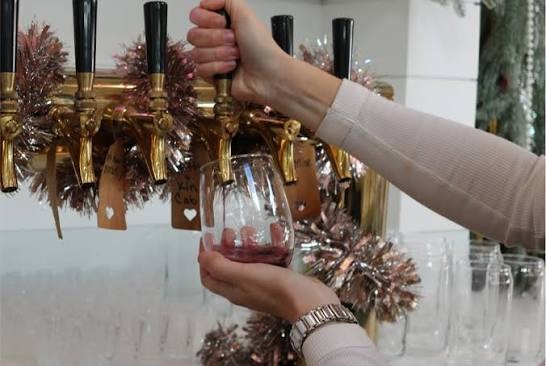
For the three of us, a bottle of “wine on tap” was a first. It actually arrived in a carafe. The waiter poured a glass and disappeared. Well, we all loved it… the wine and the experience.
No cork sniffing ritual, no hushed moment of swirling and tasting as the wait person waits for a sign. The experience turned out to be fun, uncomplicated, untraditional and maybe signaling the wave of the future to fully enjoy wines in a restaurant.
The wine was Tablas Creek Vineyard’s 2024 Patelin de Tablas Blanc, a Rhone blend. Although I have been following this winery closely, I didn’t know it has been “kegging wines since 2013.” I also didn’t know ‘kegging’ was a verb.
Kegging
Kegs may be the answer to several questions facing the wine world today. It’s time for all of us to think outside the bottle. Yes the glass bottle, not the proverbial box.
Let’s remember that screw caps were associated with cheap jug wine until 2001 or thereabouts. Back then New Zealand wineries banded together to promote the use of screw caps for their bread and butter Sauvignon Blancs. That was called the” Screw Cap Initiative,” but it was a long battle to get others to join in. Eventually, the wine drinking public accepted them as sensible and friendly replacements for corks.
Now that screw caps have set a precedent challenging traditional wine thinking, maybe this is the time to say “screw it” to glass bottles and start a Wine Keg Initiative.
Kegs in Tasting Rooms
When visiting Tablas Creek a few days later, Jason Hass told me “Kegs accounted for 9% of the volume Tablas Creek sold last year, totaling 430 kegs sold to restaurants and wine bars.”
Now we all know dealing with restaurants is never simple, but 430 kegs is a lot of wine. But then, in our conversation he added this:
“For our tasting room, kegs have worked every bit as well as we hoped. Last year, we poured 330 kegs in our tasting room. That’s 8,580 glass bottles (plus the corks, labels, capsules, cardboard, etc) that never needed to be made and shipped to us. We figure that it is the ROI (return on investment) on the kegs and the keg infrastructure in our tasting room was about 9 months, plus additional benefits in keeping wine fresher and reducing waste.
It does require a little more planning, and we do occasionally realize that we made too many kegs (or not enough) of a particular wine based on the pace at which it sells, but that’s fairly minor.”
After doing a little math, I figured from Jason’s numbers that a keg holds 25-26 cases of wine. That is about the same amount that a standard barrel holds which is probably no coincidence.
Other than being a good return on investment for a winery, what are the advantages, the good points, about offering wines from kegs? Here are the three primary ones, says Jason:
1.Sustainability: Think about everything that goes into a bottle—glass, cork, capsule, label—all of which is discarded after a single use. Kegs eliminate all of that unnecessary waste. Plus, reusable stainless steel kegs slash the carbon footprint of wine packaging by 76%, according to our friends at Free Flow Wines.
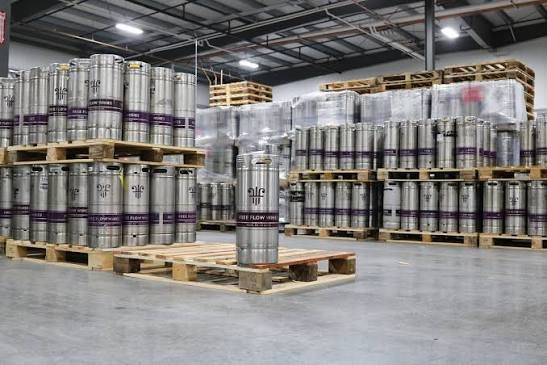
A photo from free flow, a napa based company servicing the wine keg business
2. Why kegs in our tasting room? Because bottles account for half the carbon footprint of the average winery, and there is no bottle less worth the resource cost than one that holds wine that will never leave the building.
3. Less Waste: “Restaurants and tasting rooms waste a significant amount of wine from opened bottles—sometimes as much as 25%! Kegs solve this problem by keeping wine fresh until the very last drop, meaning less wasted wine.”
Everyone benefits, it seems. And the key point is lowering the carbon footprint for the environment.
Kegging in Restaurants: A Winemaker’s First Hand Experiences
Concerns about the environment and the carbon footprint are top priorities with many winemakers these days. But how can wineries deal with restaurant owners and their wine servers who may or may not be of the same mind?
Remembering a conversation about recycling bottles I had with Herb Quady two months ago, I contacted him to see where his winery, Quady North, was on kegs. His winery is in Jacksonville, part of Oregon’s Rogue Valley. At present he offers these wines in kegs:
2025 PIstoleta
2024 Syrah 4,2-a
2025 Rose’ GSM
2024 Sauvignon Blanc
BTW: all four of these wines are excellent. The Pistoleta is a lovely white Rhone blend.Quady North’s Syrah is always rated high, and my ratings have been in the 92-95 range. The Cab Franc is another fav. Take a look to see these and others at http://www.quadynorth.com
Herb Quady is truly committed to kegs and, oh my, here’s how our conversation began:
“I love kegs. I’m all in, but it’s been a 15 year journey to get us to where we are, and I’ve been purchasing additional kegs all along the way and cultivating accounts, so it’s not a simple option for most.
From an environmental perspective, it’s probably the best way to deliver wine. The restrictions are that the winery needs to keep a lot of kegs on hand and the restaurant needs some special equipment. This requires some investment, but that’s not different from a lot of things in the winery and restaurant business.
From a marketing perspective, it gets a winery a by the glass placement at a reasonable price, for both restaurant and winery. BTG (by the glass) placements are a form of marketing for the winery, so this is really important.”
Now Moving on the the Logistics
Herb continues:
“Outside of the expense of kegs, the limitations have to do with logistics. From a practical perspective, unless you really specialize in keg wines, wineries can only offer a few options for kegs, since you need to maintain inventory and arrange placements.
New kegs are around $100 each, last time I checked. Used kegs are out there for less. However, they last forever, with little maintenance. Glass and packaging costs for the equivalent wine would be around $30-$40, not including bottling, so it’s cheaper than bottling after just three fills.”
At this juncture, it seems that going with kegs in winery tasting rooms makes sense and will gradually be expanded. Afterall, wineries will still have the same wine in bottles and can have bottles ready for display.
Restaurants, however, present far more issues and problems. Like many wine writers, I routinely vent that many by the glass wine prices are outrageous. And restaurants can’t simply convert the beer kegging system to wine. They have to commit to the program to some degree.
But to return to finding out if kegs are a real option for wine by the glass programs. Quady now owns over 100 kegs and since I had his ear, I asked Herb Quady a follow up series of questions related to his first hand experience with restaurants.
NR: What are the downsides, if any?
HQ: “As far as problems go, initially I prepared the wines as I would for bottling. However, I learned that the keg environment is really reductive, like no O2. This means you need little to no SO2 at kegging. Once I realized that, I haven’t had any issues. Wines keep really well in kegs. This is good in case you’re not selling them as fast as you would like.”
NR: Do you own each keg to begin with or is there some outside service supplying them?
HQ: “We own all of our own kegs. We have about 150 stainless steel kegs. We started selling kegs to restaurants around 2010. We were one of the first wineries to sell kegs at Britt,(a popular outdoor musical event in Jacksonville) for example, and that really got us started. We also had some direct sale programs to some restaurants in Portland like Irving Street Kitchen (who had an all keg wine program) and Cooper’s Hall, which really went big into keg wines.
NR: What’s involved in starting a keg program?
“Getting into kegs isn’t that expensive. You need to purchase a keg filler. You’ll fill them with a pump and, as needed, use a sterile filter in-line. We don’t have a keg washer. We send them to another winery that does and pay them to wash them.”
NR: And what have you encountered when dealing with restaurants?
HQ: “The motive was, as always, selling wine, and meeting restaurants where they were.
From both the restaurant and winery perspective, if you want to sell a very good wine by the glass, it needs to be affordable. This means cutting out packaging and middlemen. We worked with these accounts to sell wines’ by the barrel,’ which means filling 11 kegs and selling them to those restaurants.
It worked well for us, but it’s a big ask for a restaurant. 11 kegs is like 25 cases of wine.
Now, restaurants will “commit” to a keg program, but won’t purchase more than 1 or 2 kegs at a time. This does create some logistical issues for a winery. The winery has to fill kegs speculatively and have them on hand to sell to the restaurants when they need them.
This is the same as bottled wine, but the difference is that a winery can’t sell kegs to anyone other than restaurants. They also have to be stored, and that’s less efficient than stacking cases.
For red wines, you could fill kegs from barrels, emptying a barrel into 11 kegs at a time. So, if you wanted to have a red wine keg program, maybe you have 22 kegs, and when you get the first 11 back, you can fill them again from a barrel. However, from a white wine perspective, the wine is made bottle ready, (filtered and stabilized) and needs to be kegged or bottled all at once.”
Kegging Wines in the Cellar: The Inside Story
“So, a winery has to fill a year’s worth of kegs, sterile filtered, all at once. Again, this isn’t different from cases, but it’s a tricky planning issue. If you have some good accounts and you just need to keep them in stock, maybe you can plan accordingly. However, if you want to go out and get accounts, you really don’t know if you can sell all those, or, if you’ll sell out. If it’s bottled, you can sell it in a number of ways. In kegs, you only have one option.
In the greater Rogue Valley area, I can only think of about 8-10 accounts that are offering wines by the keg. Each of those only sell about 4-5 wines by the keg at a time. It becomes a tricky thing.
Can you get the placement first and then fill the kegs? Or, do you need to fill the kegs first, so then you can get placements? If there’s only 30-40 placements available, what are the odds that you’ll get one of these placements?
There’s also recovery. If you’re selling kegs to restaurants directly, you can keep an eye on the kegs and quickly pick up the empties when you deliver a full one. If you’re selling them to a distributor. They’ll recover them for you and keep them. You then need to arrange to pick them up and ship them back. With shipping costs, you want to do that when you have enough to ship back. So, you need a lot of kegs, or, you’re driving up and getting them. “
Transitioning to Kegs
While I was trying to digest this information based on real experiences, Herb mentioned a possible stepping stone to kegs.
“Another good option is the PET one-way keg. These are cheaper, around $40, and can be recycled in most systems, especially in metro areas like Portland and Seattle. This gets around the recovery issue. If you think you can market them in other areas, you can fill 50 and ship them to a distributor. The carbon footprint is still better than single use glass bottles.”
And bag-in-box wines which are becoming increasingly visible in supermarkets, are now being taken seriously by small, quality-minded wineries. Bedrock’s Morgan Twain-Peterson is on record as saying recently: “Bag-in-Box (BiB) represents a nearly 80% reduction in overall carbon footprint due to less weight, recyclable materials (the lining, though plastic, is made from predominately post-recyclable material and is recyclable, as is the box itself), and ease of shipping.”
So there you have it. I’m not suggesting that the glass wine bottle will disappear since it is part of the aging process. But we all know only a small percentage of wines improve with bottle aging. So maybe, as happened with screw caps, kegs will gain wide acceptance as an important part of the ever-changing world of wine.

