A new approach to wine clubs and wine education.
The Wine Atlas Collective is the name of a new wine club that every wine lover should know about. Even if you have never ever been interested in wine club membership, this one might be a game changer.
Over the last 2-3 years, along with the decline in overall sales and wine tourism, wine clubs have suffered some setbacks. A recent report from Sovos ShipCompliant and WineBusiness Analytics confirms that in 2025 there was a significant drop in new club sign ups.The report noted that wine clubs are “the backbone of DTC (direct to consumer sales), accounting for about 75% of total revenue.”
As stories continue to surface in 2026 about winery tasting rooms being closed and staff layoffs, many wineries are looking at ways to reinvent and reinvigorate their clubs.
While wineries are adding an event or changing the membership categories, The Wine Atlas Collective came up with a different concept of a wine club.
Established in 2025, it is an association of eight independently operated, family-owned wineries from 5 states. Yes, you heard right: 8 wineries from 5 states. Coast to coast…buckle up.
The Wine Atlas Collective has a very simple underlying core: reciprocity. If you are a member of one club, you are automatically an equal member of all others. When you visit in person or online, show your membership ID in any of them and enjoy full membership perks at all eight. Like complementary tastings, discounts, special events and members’ only wines. And yes, merch is included.
Here are a few other things that define this wine collective. Their stated shared goal is “to bring our wine club member communities together and give them a passport to explore the diversity of American wine regions, varieties, and styles.”
Sharing and a sense of community, not competition, is what sets this club apart from the mainstream. The eight wineries are also “united by a shared commitment to sustainable farming, innovative winemaking, and authentic hospitality.”
Introducing The Team
Here they are:
Blenheim Vineyards, Virginia
Brooks Estate, Willamette Valley, Oregon
William Chris Vineyards, High PlainsTexas
Frog’s Leap, Napa Valley
L’Ecole #41, Washington
Ridge Vineyards, Santa Cruz
Tablas Creek, Paso Robles
Red Tail Ridge Winery, Finger Lakes, New York
When looking over this odd team, several thoughts come to mind. Is it possible for sharing and a sense of community to unite California and Texas in anything? And why would Frog’s Leap and Ridge, both Zinfandel driven, want to share members?
Jason Hass of Tablas Creek, who turned me on to this collective, suggested that he was approached by Jen Cossey of Brooks Estate about sharing membership. That would unite Oregon’s Brooks of Riesling and Pinot Noir fame with Paso’s Tablas Creek, which produces everything but Riesling and Pinot Noir.
Not only do these two combine to offer a great range of wines, but they also happen to have very successful wine clubs on their own. Not familiar with Brooks Estate? Check out its website to learn about its wine club program at brookswine.com
When you look a little closer at the entire team, you realize each brings a lot to the group. Each winery is located in a historically important wine region. The wineries are all well-established with a solid track record and over the last three or four decades have had an impact on the history and reputation of wine within their respective area.
More importantly, each remains a key player on the wine stage today.
To return to my opening paragraph referencing people who aren’t wine club prospects, what really sets this “club” apart from the crowd is the sheer variety of wines offered. When you factor in regional styles with numerous varietals and blends, then the fun and educational opportunities multiply.
Are We Having Fun Yet?
Let’s start with Ridge Vineyards of Zinfandel and Monte Bello Cabernet fame: it currently offers 56 wines to club members. The lineup includes a Falanghia, Grenache Blanc, and a “Historic” white wine. That one is made from 52% Palomino, 41% Muscadelle, 3% Semillon, 2% Chenin Blanc, 2% Burger. To that I say,”sign me up.”
Tablas Creek also lists over 50 wines. Its members have access to a dozen or so rare varietals from Bourboulenc to Vaccarèse. BTW: Both were highly rated at http://www.winereviewonline.com
And Brooks Estate, to cite another example, currently offers 12 different Rieslings and 12 or more Pinot Noirs. William Chris from Texas is definitely in the game offering close to 50 wines, including several styles of Mourvedre and Tannat.
Interested in Chenin Blanc? Well, L’Ecole #41 offers three different bottlings. Frog’s Leap offers two styles of Sauvignon Blanc. Or compare those with Blenheim’s no oak Sauvignon Blanc from Virginia.
If, as I’ve heard, one of the main reasons why wine lovers drop out of wine clubs is that boredom sets in after a year or two, that’s not gonna happen with this club.
My best guess is that it offers 300 or so different wines made from at least 50 different varieties. Members get to try small batch experimental wines along with the prime time players. There should also be many new wines offered to members every new vintage.
How It Works
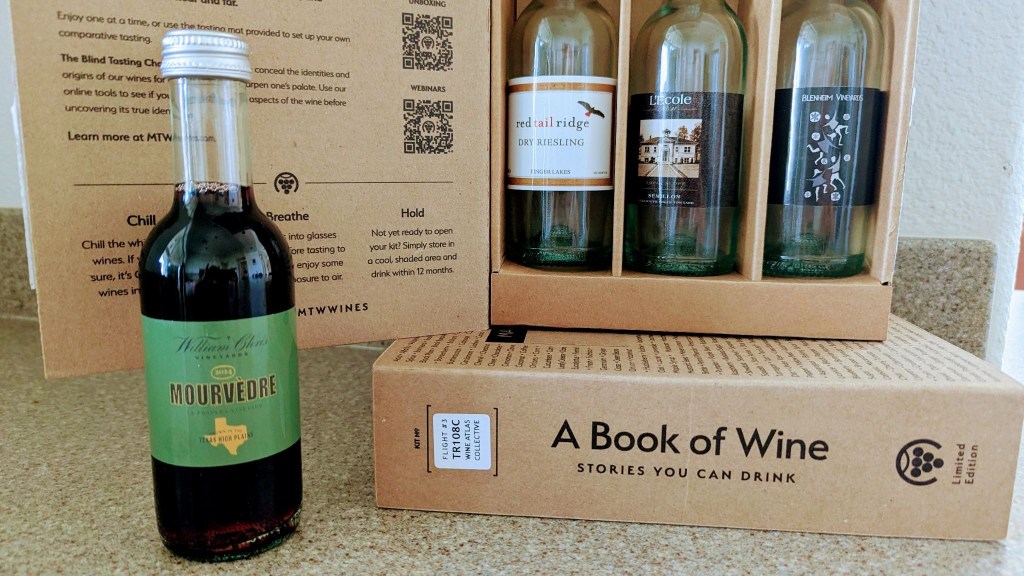
It all begins with tasting eight samples in your own home. The bottles are shipped in small boxes, each looking like a book and labeled A Book of Wine. The subtitle is “stories you can drink.” That may seem way out there, but it gets the educational message across. The fee was $120 which included shipping. For more info, check them out at www.wineatlascollective.com
Key to The Wine Atlas Collective and other programs are these wine kits, samples of the wines in mini-bottles, not like the stuff offered by airlines. Each bottle holds 180ml, better known to many of us as about 6 oz. That’s handy for 2 tasting pours, for those who like to share.
I recently participated in the 2026 Spring Release. It began with Rieslings from New York’s Finger Lakes and the Willamette Valley and concluded with a Mourvedre from Texas. The flight consisted of eight wines and a date was set for a live webinar during which each wine was to be presented by the winemaker and/or owner.
This tasting webinar and discussions were lively and well-paced, finishing about 90 minutes later. The presentations were relaxed and informative, and the audience participation was lively.
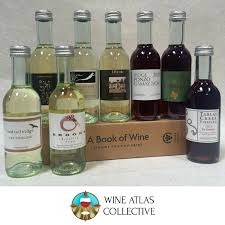
Limeng Stroh, who moderated the tasting, is from Silicon Valley and she has worked on a special production method for these mini-bottles.The bottles fit snugly inside shipping packages that are so environmentally friendly.
Wine Atlas Collective is part of Master the World which offers several wine education programs. Master the World was developed in 2017 by EO Limeng Stroh and Master Sommelier Evan Goldstein.
You can learn more about Master the World and these special bottles at MTWwines.com
A Deep Dive Inside the Spring Tasting Webinar
There were three flights, so let’s look at them one at a time.
Fight #1
2024 Red Tail Ridge Dry Riesling, Finger Lakes, NY $22.97
2024 Brooks Estate Vineyard Riesling, Eola-Amity Hills, Willamette Valley $40
Nancy Irelan of Red Tail, co-owner and winemaker for some 35 vintages, talked about the history of the Finger Lakes District and why Riesling performs so well there. Jen Cossey with Brooks Estate went into the winery’s fascination with Riesling (it makes 14, including a sparkler) and explained how acidity is so crucial to Riesling.
Both winemakers answered questions about alcohol levels and the typical descriptors of Riesling.They also exchanged thoughts about “stone fruit” and “petrol” as descriptors often used for Riesling.
A great start with excellent comments.
Flight #2
2024 Frog’s Leap, Napa Valley Sauvignon Blanc $20
2024 L’Ecole #41, Washington Semillon $25
2024 Blenheim Vineyards, Virginia Painted White $26
After 46 vintages in Napa, John Williams of Frog’s Leap shared a lot about the early years when there were 28 Napa wineries and then explained why he went with Sauvignon Blanc as the signature wine. Toward the end, he emphasized that “no wine should smell of oak.”
With 37 vintages under his belt, Marty Clubb provides the inside story of the Stillwater Creek Vineyard and L’Ecole 41’s focus on barrel-fermented Semillon. If you ever want the inside story about Walla Walla, start with L’Ecole.
Blenheim’s Tracy Love is part of the all-female winery in historic Virginia. She led the group discussion on ABV in today’s wines. Her blended white was surprisingly elegant and fresh, a subtle blend of Chardonnay, Viognier, Roussanne and 9% Pinot Noir. The later grape rarely develops color there.
More super wines and inside stories
Flight #3
2025 Ridge Vineyards, Gamay Noir, Ponzo Vineyard Russian River Valley $39
2023 Tablas Creek, “En Gobelet” Adelaida District $65
2024 William Chris Vineyards, Mourvedre Texas High Plains $54
Gamay Noir seemed like a strange choice but we soon learned it was typical of Ridge in many ways. From 40 year old vines in a vineyard neighboring the famous Zinfandel Lytton Springs Vineyard, the wine was all stainless and made with minimal intervention. As lively and fascinating as this wine was, the discussion led by Shauna Rosenblum went off the charts. At least to me.
Her personal journey from growing up in a winemaker family (Rosenblum Cellars), venturing out on her own and returning to Sonoma as Ridge’s winemaker was spell-binding. The background story of the wine, the First Napa Gamay from Ridge, led to thoughts and comments around climate change.
Not too surprising, with Tablas Creek it all begins with vines, farming, and viticultural practices. The winery’s 2023 “En Gobelet” is a unique blend of five estate-grown varietals, selected from head-trained, dry-farmed sections of its certified organic vineyard. It is a blend of wines from head pruned Grenache, Syrah, Mourvedre,Counoise, and Tannat.
Winemaker and vineyard manager, Neil Collins, who was there from the winery’s beginning working in the vine nursery, developing vineyards, and monitoring vineyard experiments and wine blends, led the discussion.
Great stories, unpretentious, but fascinating.
Compared to other GSM blends from Tablas, the wine was different in subtle ways with its lively, elegant style. Lesson learned: farming does make an impact on wine style for sure.
Reece Johnson gave some background about the Texas High Plains region and went on to talk about the winery’s focus on making varietals from single vineyards. With Mourvedre, as a participant remarked, the color is not very deep and dark for the varietal. Part of the reason for that, he suggested, might be that the fruit is machine harvested. But his Mourvedre is different in other ways, leaning more toward the aromatic, less meaty, earthy side. It is typical of the La Pradera Vineyard which he favors for Mourvedre.
To me, it offered lots of cranberry and plum aromatics and was round and rich with light tannin. Youthful but will age well. A different, enjoyable take on Mourvedre.
I also found the “story” made me want to learn more about wines from Texas.
Overall, the educational presentations were excellent. Attention to detail is apparent everywhere in the Wine Atlas Collective program. The basic printed material for the wine flights has a QR code to order full bottles of each wine. And it is valid for the entire year. How cool is that?
OTHER PROGRAMS
The Wine Atlas Collective, as mentioned earlier, is part of Master the World which offers several different wine education programs. Limeng Stroh collaborates today with a diverse group of Master Sommeliers, Masters of Wine, and Wine Experts to select MasterThe World’s wine kits and programs.
In addition to Goldstein,Tim Gaiser and Madeline Triffon offer special programs. Paul Wagner, head of the Napa Valley College Wine programs, works with Gaiser to offer a class on wine history.
There is also a WSET certification program complete with tasting kits and webinars. So there’s something for everyone into wine.


