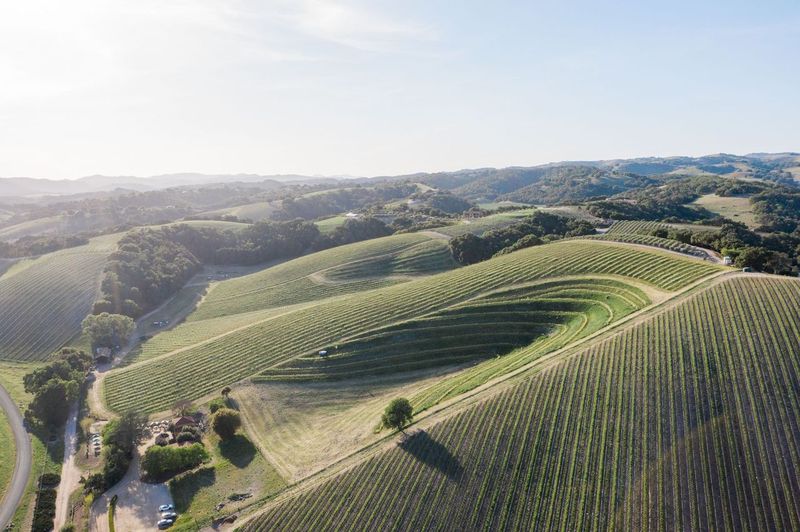
Alouette: A Fresh Take on Grenache You Need to Try

“The Ambassador of terroir” is how Kermit Lynch introduced a selection of Grenache-based French wines. Kermit Lynch, one of the most respected wine importing companies, then added: “Grenache yields an astounding range of experiences, from dense and soulful to bright and ethereal.” Leave it to Kermit and his crew to come up with such a brilliant description.

“Grenache is the new Pinot Noir” was the best I could come up with a few months back. As someone who came to wine during the sticky sweet Grenache Rose heyday, my admiration for Grenache had to overcome a few bad experiences. But now I’m a big fan.

A new Grenache just recently encountered offered yet another reason to appreciate Grenache: it is a red wine that can be chilled and enjoyed without compromises:. 

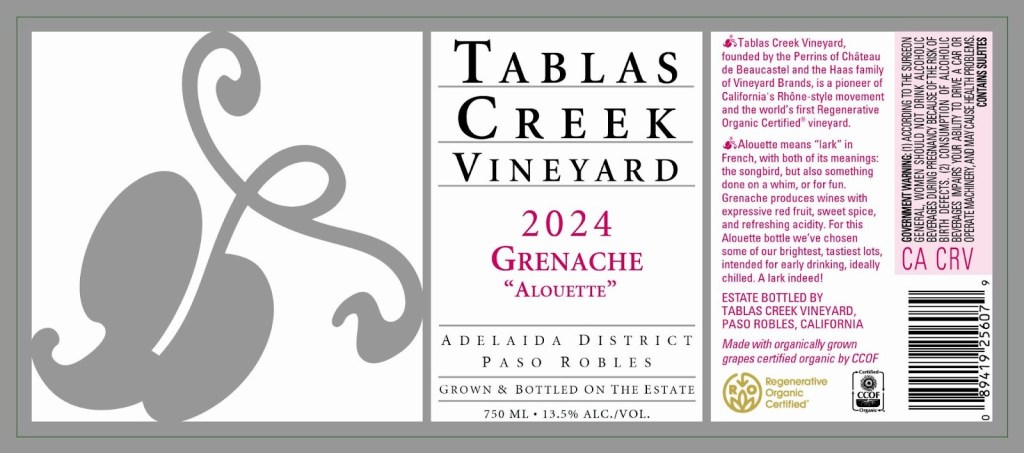
“Alouette” is the name of this Grenache made by Tablas Creek Vineyards. The back label says it is “intended for early drinking, ideally served chilled.” The name “Alouette” was chosen for this wine because it conveys a sense of fun. 

Suggesting chilling a red wine is not totally unprecedented, but the wine usually mentioned is a Beaujolais, especially Beaujolais Nouveau. And today, there are low alcohol, pet nat or other light wines like the latest “Blouge”arriving on the scene trying to capture a new wine market. But the difference is that Alouette is a solid wine with normal alcohol (over 13%), has authentic Grenache character and has an affinity for food. 

So listen up you wine snobs with your vintage charts who talk down to anyone putting an ice cube in a glass of red or keeping the bottle in the fridge. You may have something to do with the lack of interest the young generation has for wine.Too many rules and rituals when what is needed is for many to chill out so to speak.

Tablas Creek Vineyards has scored so many “firsts” since it arrived in Paso Robles that it wasn’t a total surprise to see it break the ice (sorry about that pun) on chilling red wines. Afterall, under the direction of Jason Hass, Tablas Creek has made a single varietal wine from each of the permitted varieties allowed in Chateauneuf-du-Pape. I’ve been lucky to have tasted many of them  and am now a fan of Bourboulenc, Clairette Blanche, Terret Noir…and, sorry, I wandered off course.

Back to Alouette the wine. Being quite vigorous, Grenache yields a big crop in some years. 2024 was one of those vintages and as Jason explains: “We decided to make two wines: our traditional varietal bottling of Grenache, from the more classic, structured, deeper lots, and a new wine from the highest-toned, palest, and juiciest lots that we’re calling Alouette.”  

The year before  the winery offered the wine in boxes and kegs. But as Jason explained, the feedback they got was that the wine needed to be in bottles. And so the 2024 Alouette is presented in a clear bottle which leaves no doubt it is a red wine. Jason concludes,”This year we’re expanding it to national scale and reducing the price to $30 SRP so it can be a viable wine by the glass candidate for restaurants (at $35 it was just a little too expensive).”

My note for the 2024 Alouette is that it is a medium red in color, and the aroma is very assertive with cranberry and strawberry to it along with a hint of licorice. Feels smooth on the palate with balancing acidity and flavors that fan out featuring cranberry. Pleasing bright fruit in the finish with no hint of tannin, oak, or alcohol coming through when served chilled.

Overall, it is different yet attractive and seems like a perfect wine by the glass candidate. 

Perhaps Kermit Lynch’s “bright and ethereal” is a little too poetic, but “Alouette” by Tablas Creek is a refreshing new take on Grenache. And a tasty, chillable red!

Re-Discovering the Authentic Wines of Roussillon

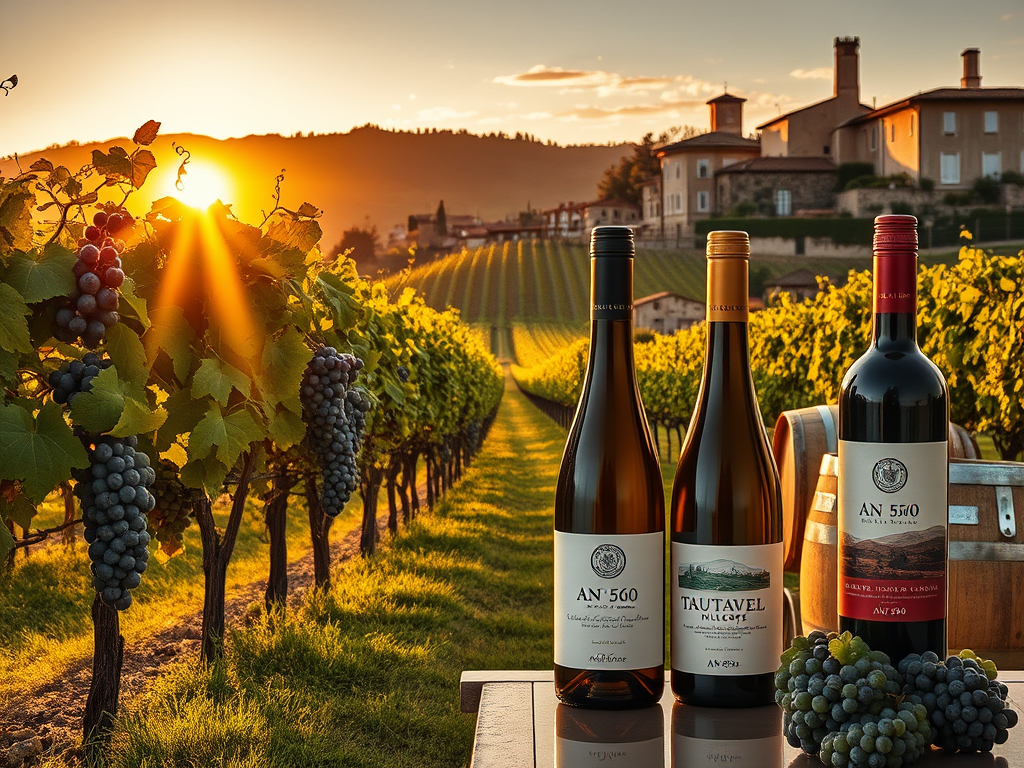
Gerard Bertrand, the ex rugby star who led the revival of Rose wines currently offers a wide array of wines from the South of France. From sparkling to orange wines, you name it and there’s probably one under his label. No, this is not another article about Bertrand who has apparently charmed the media. But one wine under his Heritage Group, the 2022 Cotes du Roussillon-Villages, Tautavel “An 560,”caught my eye and got me thinking.

When writing for Decanter Magazine a couple of decades ago, I visited Tautavel and other villages within Roussillon. After tasting wines at a dozen or so wineries that week, I found the wines to be truly unusual and exciting. The article that resulted was absolutely brilliant, of course, and dripping with enthusiasm. 

Many of the owner-winemakers visited were young and enthusiastic, and were committed to sustainable farming. Here are those that whose wines were the most memorable: Domaine Gauby, Força Réal, Domaine Mas Cremat, Domaine Fontanel, Domaine Gardies, Domaine Piquemal, Domaine Joliette, Domaine des Schistes and Domaine Mounie. But what really unified these young winemakers is summarized by Gerard Gauby:

‘From selected sites within Roussillon, we can offer wines that are modern but authentic. If you are passionate about wine, you want authenticity. Without it, or when you try to make wines in the international style, you lose your identity as a region and as a winemaker.”

“Authentic” wines, as opposed to those made in the international style, too often fly under the radar these days.  My visit took place when Robert Parker was extremely influential. And for any region or single winemaker to opt for a pass and not court him was unusual. 

Places & Rules

In 1997, when the appellations, Cotes du Roussillon and Cotes du Roussillon-Villages were officially defined and all the guidelines worked out, the emphasis fell on maintaining traditional approaches.  Basically, single variety wines were ruled out. For red wines, five varieties were permitted – Grenache, Carignan, Syrah, Mourvèdre and the rare Lladoner. To qualify for either AOC, winemakers were required to use a minimum of three varieties, with the two most significant used not to exceed 90%. Whenever Carignan was included, the law stipulated that at least 50% be made by carbonic maceration. Whites were similarly regulated and had to be blends.

Also In 1997 after a lengthy wait, AC status was given to four stand-alone communes: Tautavel, Lesquerde, Caramany and Latour de France. But today, only Tautavel merits special status. 

In 2023, the AOC regulations were modified and the Carignan requirement was modified. But still the rules work to preserve the historic identity of the appellations. Both reds and whites must be made from at least two varieties. For reds, no one variety can exceed 80%, and for whites, Grenache Blanc and two other varieties must make up 50% of the blend. 

Of the two appellations, Côtes du Roussillon extends over more territory and includes more low-lying vineyards. The area covers 6,300ha in and around 118 towns. As a rule of thumb, red wines from this appellation are still likely to contain more Carignan and are less likely to have been oak aged.

Confined to the northern sector, Côtes du Roussillon-Villages covers 2,500ha and is for red wine only. It includes some of the oldest and steepest vineyards – many of these must be terraced. Here are some old vine Grenache and Carignan, but also the push to plant Syrah was obviously felt here. Starting in the 1990s, many of the cuvees began including some Syrah. 

If winemakers want to stray from the strict rules, say, by making a single varietal or using varieties like Cabernet Sauvignon or Chardonnay, the wine can then be labeled “GP Côtes Catalanes.”

 Back to the Present

Recently my enthusiasm for traditional Roussillon wines was revived after tasting an unusual white wine.That wine, a 2021 from the Domaine de Clos des Fee is a Côtes du Roussillon blend under the Les Sorcières” moniker. The winemaker is Herve Bizeul who back in 1995 acquired 8 hectares, including a large parcel of old vine Grenache Blanc. Herve at the time was a bit of a celebrity in France having been named Sommelier of the Year. 

Though he had no intention to quit his day job, his first wine named “La Petite Sibérie” was an instant hit so he turned to winemaking full time. Over the next few years his vineyards were expanded parcel by parcel and now consist of 30 hectares.  He offers a red and white under “Les Sorcieres,” both intended as entry level wines, not collectibles.

This 2021 Les Sorcieres is 40% Grenache Blanc, 10% Macabeo, 30% Vermentino, and 20% Roussanne, the last two planted on limestone soils in 2011. The Grenache Blanc vines date back to 1945. 

The wine is a bright light yellow in color and offers a fresh pear and chalky aroma with light citrus accents.  On the palate it is a big, round mouthfilling wine with lively white fruit flavors that won’t quit. Finishes with good length and ends on a palate cleansing, long lasting note.  The main takeaway is that the wine is unusual in an extremely pleasing way. Probably the best descriptor is “authentic.” 

Back In the Day

In my Decanter Magazine article,  I singled out his 2001 Les Sorcières red, with just a hint of oak, and the 2000 Vieilles Vignes with more oak which was intense, complex and a long ager. Even more impressive was Bizeul’s high-end cuvée Le Clos des Fées, from equal parts Syrah, Grenache, Carignan and Mourvèdre. My review ended with “Aged in oak for 18 months, this incredible wine is hard to top.” 

Domaine Gauby, founded in 1985, may have inspired Bizeul to settle into Roussillon. In early 1985 Gerard Gauby convinced his family to leave the Coop and make wines from their vineyards. Arguably among the first to abandon chemicals and move toward biodynamic farming, Gerard Gauby won over the British trade with his early vintages and was heralded as an authentic garageist by the 2000 vintage. High praise was heaped upon his Syrah-driven cuvée, La Muntada, that in both 2000 and 2001 went way off the charts. 

Working with partners from the UK, Gauby added wines under the Domaine Soula name. A blend of Marsanne, Grenache Blanc, Sauvignon Blanc and Chenin Blanc from late-maturing hillside sites, Soula’s 2001 Blanc struck me as an amazing, vibrant wine. The Soula 2000 Rouge, predominantly old-vine Grenache aged in new oak, was concentrated and garrigue scented. Though Gauby is no longer involved, Soula maintains the same goal of regional authenticity.

While the Brits strongly suggested a visit to Gauby would be crucial to my article, my favorite wine merchant in St. Foy La Grande, pointed me toward another voice, Domaine Gardies and its young winemaker, Jean-François Carrel. His was the third garigiste type winery to be established in the mid 1990s. 

“Since putting his signature style on the 1996 vintage, he has become one of the top winemakers here. His wines are also having a profound impact on the future direction of Roussillon: intricate, structured and harmonious, they show the kind of restraint often tagged feminine with regard to ripeness, oak level and flavour complexity.”

With the 2000 vintage, Domaine Gardies hit full stride. With half of the cuvée aged in oak, the 2000 Gardies, Les Millères (50% Syrah and equal parts Mourvèdre and Grenache) is finely balanced. With fine tannins and perfect balance, Domaine Gardies 2000 La Torre, (Mourvèdre, old-vine Grenache and old-vine Carignan) is an outstanding example of the heights that can be reached with a traditional cuvée.”

Acknowledging the difficulties winemakers face in this warm climate, he feels that knowing when to harvest is the key to success. “Picking a day late or a day early can spell the difference between a balanced wine and overripe jam.” 

 Back to the Future

Along with the three early pioneers mentioned here, Roussillon has attracted several bigtime players. Michel Chapoutier offers both red and white Cotes du Roussillon under the Bila Haut brand. Domaine Lafarge includes wines from this region in its ever-expanding portfolio. 

Current vintages from these two share a style that is at once rich, lively and unctuous: 

Bila-Haut Michel Chapoutier Côtes du Roussillon (Languedoc, France) 2022 $15

Grenache Blanc and Grenache Gris with a dollop of Macabeo, this is full-flavored and lively. Yellow with a hint of green, it offers lots of spice, fennel and mineral notes. Smooth, round and gentle on the palate, it has some bright citrus taking it to a pleasing finish.

Domaine Lafage Cuvee Centenaire Blanc Vieilles Vignes Cotes du Roussillon (France)  2021 $18.00

From vines a century old, this white brings together Grenache Blanc and Grenache Gris and adds younger Roussanne in a full bodied package.  Peach and citrus along with light floral notes on the nose.  Rich, unctuous palate with broad flavors of stone fruit and some chalky back favors.

Let’s not forget  Gerard Bertrand. He ended his 10-year rugby career in 1987, following the death of his father, a well-known winemaker in Languedoc. He inherited Domaine de Villemajou, which is based in Corbieres. That’s where the Rose Clos du Temple is made today. 

 And now Gerard Betrand is a major player in Roussillon. He focuses on Cotes du Roussillon-Villages from Tautavel. His wine named “Heritage An-560” brings together Grenache, Carignan and Syrah, with a portion blended in oak for 9 months. Another Tautavel is the 2021 Gerard Bertrand Tautavel “Grand Terroir.” 

And what does that “An-560” mean in the name? Well, like so many who were born and raised in the area, Bertrand is ever mindful of the region’s place in history. It was once the home to the Cathars, a fascinating religious group living in several villages. But they annoyed certain people and the Cathars were wiped out during the Crusades.

But Roussillon’s  historical impact goes way, way back. In 1971 around the village of Tautavel, some of the oldest indicators of human life were uncovered.  Known as “Tautavel Man,” these remains date  back to 450,000-560,000 years ago, so that’s the “560” reference. Basically, the Roussillon area is thought to be one of the cradles of civilization. 

We can suspect that Tautavel Man who was found in a limestone cave probably engaged in a little winemaking. What do you think? Did he make a blend of Grenache and Carignan?  Mostly new vines probably.

Embracing Higher ABV Wines in 2026

Dry January is almost finished and has gotten lots of media attention so far. And, no, this is not another diatribe against Dry January. About all I need to know is that it began in the UK in 2012 and became an annual event the following year. If people want to avoid any alcoholic drink for a month there’s no harm done and it’s their prerogative. So no judgment. 

For those people enjoying wine without pausing, this is a good opportunity to come to terms with the fact that the alcohol content of wines from most regions is trending higher. It is not just a California thing. Nor a West Coast thing. 

Time to Reboot and Re-Set

So while others re-set or pause their lives this month,  the rest of us, writers, educators, and wine lovers, all need to re-set or re-think how we are going to approach the new norm of high alcohol wines. Especially red wines.

The trend has been well-documented. Kathleen Wilcox, reporting  in Liquor.com summarizes things this way: 

“A study of alcohol levels over the past 30 years by Liv-ex (The London International Vintners Exchange) revealed that wines from California, Piedmont, Tuscany and Bordeaux had higher levels on average for the decade between 2010–2019 than they did in the 1990s. 

Bordeaux increased, on average, from 12.5–13% ABV in the ‘90s to 13.5–14% in the 2010s. California rose from around 13.5% to more than 14.5%.”

Based on vintages since 2019, the averages today are likely higher. Red wines, in particular Cabernet Sauvignon and Zinfandel are the most obvious wines trending higher. Need more proof? Sorry about the use of “proof.” The best-selling Rombauer Carneros Chardonnay 2023, from a cool-climate, is 14.6 % abv. A popular red wine is the 2023 The Prisoner which clocks in at 15.2% abv.

Here’s my review posted at the end of 2025 that got me thinking:

2022 Justin Vineyards Cabernet Sauvignon Reserve, Paso Robles $60

“Here is a big, powerful Cabernet that pushes the envelope. The 2022 vintage was another drought year, and Paso Robles experienced late season heat waves. Made from 100% Cabernet that was aged for 21 months in French oak, 50% of it new, it clocks in at 15.5 % alcohol. However, when tasted blind, it offers an aroma of ultra-ripe black berries, chocolate, and spices that by the final swirl is absolutely gorgeous. Full-bodied with very juicy black fruit flavors and spice backed up by toasty oak, it all holds together seamlessly thanks to integrated tannins. The finish ends on a light toasty oak note. The real challenge is to pair it with a comparably robust main course.

Obviously, I loved the wine. But why in retrospect, did I feel duty-bound to note the alcohol content? 

Old habits do die hard. Wine writing in the USA began with the coming of age of The Wine Spectator, the Wine Enthusiast, and the Wine Advocate. Writers back then shared, yes including Robert Parker, the fundamental belief that if wine has a purpose, it is to complement food. And maybe spark a little conversation around the dinner table. Bring people together and be enjoyed. Or all of the above. 

As wine writing in the US expanded from the 1990s onward, most of us never lost sight of the wine and food affinity or marriage because we didn’t dare want to encourage drinking an alcoholic beverage. Anti-alcohol campaigns never totally disappeared, so we aimed for a balanced approach. 

The federal government, in its infinite wisdom,  assumed long ago for tax purposes that table wine is defined as having between 7% to 14% ABV. So long as the wine was under 14, wineries had a 1.5% leeway and didn’t have to be precise. A wine under 14% can simply state  on the label that it is “Table Wine.”  For those wineries preferring to provide a number, the majority often use 12.5% for any wine below 14%.

The point is that it was almost like a punishment for any producer not playing by the rules. Then you add the required Surgeon General’s warning about drinking wines during pregnancy or operating machinery on the back label, and it’s easy to understand why the food message continues. Oh, and let’s not forget the sulfites.

And just now, when the industry is dealing with weakening consumer markets, the anti-alcohol message was back and loud even before Dry January.  One day there’s a report that drinking any wine is bad for you; the next day a glass or two is ok. No wonder we are now seeing de-alcoholized wines or low-alcohol wines and gentle pet-nat beverages.

With climate change on the minds of most intelligent wine industry leaders, maybe they have to accept as part of the change that wines today, reds and whites, are made from riper grapes and are generally high in alcohol on average. Along with climate change, the science of winemaking has advanced to the point where yeast strains are specially selected for each wine and often are stronger, meaning they convert more sugar into alcohol during fermentation.

So What!

Wine, unlike other beverages, changes over time. Even Bordeaux wines are not the same as they were 25 years ago. Heat waves in 2003 and 2005 were not aberrations, but served to wake producers up to the reality of climate change. The benchmarks writers used 25 years ago to rare new Bordeaux vintages should be rejected or at least modified. A wine today doesn’t have to have an aging potential of 1o or 20 years to be “great.” 

Along the way as everyone adjusts to the new normal, we’ll have to revise many of the classic wine and food combinations. The big, bold Cabernet-based wines don’t have the youthful tannins and grip that were part of the under 13% ABV profile. Savory seems to have emerged as a flavor description. Textures are often said to be velvety and plush, which again might change the food compatibility. Best of all, you don’t need to cellar them and refer to a vintage chart from a wine expert. 

Moving on

For my part, as sort of a New Year’s resolution, I’ll stop making reference to a wine’s ABV when reviewing a wine. So here goes:

The Big, Red Monster Paso Robles, Central Coast (California) Zinfandel Lot #2 $20

Yes, here’s a Paso red wine that boasts about being big. Now owned by War Room Cellars based in San Luis Obispo, this brand began in 2005 as a partnership between winemakers Bob Pepi (formerly of Robert Pepi winery) and Jeff Booth (formerly of Conn Creek). The brand was relaunched in 2019 and aimed at a market that loves big and powerful wines. 

Promoted as a “savage beast,” this Lot #2 is Zinfandel blended with Petite Sirah and Tannat. After an extended maceration “for bigger extraction,” it was aged in French and American oak, 20% new. While definitely big and ripe, it offers an attractive aroma of blackberry and pepper with some spiciness. On the palate it is round but ultra soft and has enough fruitiness to keep the tannin and ripeness in check. 

Lava Cap Winery El Dorado, Sierra Foothills (California)  Barbera 2023 $40

From the winery’s Tectonic Series” highlighting barrel selections from vineyards planted in young volcanic soils at high elevation sites. Bold and concentrated,  this is a unique expression of Barbera. It has an opulent nose of spicy dark plum with some anise and black currants. Big and round on the palate, it delivers lots of ripe fruit and an earthy undercurrent. Plush with integrated tannin and good balancing acidity, it tasted bright and youthful a day after being opened. Dense and concentrated, it was aged in neutral French oak.

You pretty much know a wine labeled Big Red Monster will be unusual, but the Lava Cap Barbera introduces us to the new normal. It does not remind you of a Barbera from Asti or Alba except for the color. Everything else is atypical of Barbera.  

But it also is a great wine that for me ushers in the new normal in 2026.

The Unique Flavors of El Dorado’s Mountain Wines

The “Tectonic Series” by Lava Cap showcases unique wines from El Dorado County, emphasizing their distinct mountain soils and high elevations. Winemaker Nolan Jones highlights the benefits of volcanic soils and how they enhance wine purity and flavor. The series aims to present exceptional red wines, starting with a standout Barbera.

“Tectonic Series” may sound like some new Netflix series, but it refers to  wines that every  curious wine lover should know about. Placing myself in that group, when Nolan Jones of Lava Cap in El Dorado County wondered if I might be interested in his Tectonic Series”  I was all in. 

Nolan explains the background this way:  “Every year, certain lots stand out for their ability to capture the essence of our mountain soils and high-elevation vineyards. The “Tectonic Series “is my way of bottling these rare wines not defined by vineyard or variety but by their fascinating and one-of-a-kind expression of El Dorado red wines.” 

 So he had me at “rare,” but then added one of a kind, really? The key ingredients here obviously are mountain soils and high-elevation sites. Mountainous wine regions can be found in Napa, Lake County, Mendocino, and Santa Cruz. And from the 1990s on, Argentinian winemakers have made high elevations their key message. 

But the closer I looked into the Lava Cap story, the more I learned or re-learned about high elevation vineyards and volcanic soils and what they bring to the winemaker.  And, better yet, how they expand the wine tasting experience. 

El Dorado County wines today are some of the most exciting  and diverse that somehow still fly  under the radar. Three years ago my enthusiasm was evident in an article posted at winereviewonline.  Three wines were singled out—a Barbera, Viognier, and a Rhone GSM–and all were distinct and way above the ordinary. Shortly thereafter a Cinsaut from Holly’s Hill and a Malbec made by Miraflores also won me over for their unusual depth and liveliness.

Other than rating them all highly, I never stopped to explore what they had in common beyond being from El Dorado. Now, having tasted the Tectonic Series and after Nolan answered a few questions,  I’ve learned a lot. And am happy to share.

Mountain High

Though no one can  top Argentina for elevation, El Dorado is probably the highest on the West Coast, and with his experience there Nolan provides a crash course on the advantages of high-elevation sites:

“El Dorado is unusual in that the AVA is largely defined by elevation, roughly 1,200 to 3,500 feet, and our estate sits about 2,400 to 2,750 feet. As air moves up the Sierra Nevada it is forced upward through orographic uplift, and it cools through the adiabatic process at roughly 4 degrees Fahrenheit per 1,000 feet of elevation gain. Practically, that means ambient temperatures here run meaningfully cooler than the Central Valley below and, importantly, our daytime highs are often moderated during heat spikes.”

He continues adding this: “We typically see more sunshine hours during the growing season. At the same time, higher elevation increases UV intensity, which acts as an environmental signal in the skins and is associated with phenolic development. That combination of sunlight hours and intensity can support skin-derived compounds while still preserving freshness because the air temperatures are cooler than many lower sites.”

Now for the Dirt on Volcanic Soils

Soil types and their impact on wine have attracted considerable attention, especially with the now trending descriptor, “minerality.”  Limestone soils remain center stage thanks to France’s Bourgogne, Chablis and Sancerre. Wine historians remind us how an exhaustive search for limestone soil in California to grow Pinot Noir led Josh Jensen to develop Calera in Hollister.

 I should mention limestone has been found in the southern end of Paso Robles. 

But otherwise, there’s probably more volcanic soils in California than limestone. Oregon, especially in the Willamette Valley ranks right up there with its Jory soil series being heavily volcanic. And not to be forgotten, many of the wine regions of Chile are also distinguished to some degree by volcanic soils.

Lava Cap is owned by the Jones family, and as the winery’s name implies the owners probably know a thing or two about volcanos. Back in 1979, U.C. Berkeley Geology Professor David and his wife, Jean Jones, purchased the property in El Dorado County and established their winery in 1981. The winery is run today by  their children, Emmet, Kevin, and Nolan.

David Jones, was a geologist who played a significant role in advancing the theory of plate tectonics. He was attracted to that site in El Dorado because of its volcanic soils, specifically the Miocene Mehrten Formation. After admitting my ignorance here, Nolan kindly helped me understand why these soils are distinct:

“Volcanic soils” can mean many things, but at Lava Cap a large portion of our estate is derived from the Miocene Mehrten Formation. In simple terms, we’re farming on roughly 10 million year old andesitic volcanic and volcaniclastic material laid down as ash flows and volcanic debris, compacted over time, then weathered into a thin topsoil over deep volcanic parent material. In the vineyard, that typically presents as very coarse, rock rich profiles with high macroporosity, rapid infiltration, and generally low inherent fertility compared to heavier valley soils.”

“From a viticulture standpoint, our Mehrten derived soils naturally moderate vine vigor because both plant available water and nitrogen availability are constrained. The canopy is easier to balance, there is less lateral growth pressure, and we typically get better light distribution with less internal shading without extreme intervention. Where the effective rooting zone is shallow or the profile is especially rock dominated, we often see smaller berries and a higher skin to juice ratio, which increases color, tannin, and flavor concentration.”

As a quick summary of the above: The grapevines grow in a thin layer of porous soil over hard, fractured, rock. So drainage is high and the vines are stressed from minimal access to water. Or, as I heard from a noted winemaker many years ago, “vines don’t like wet feet.” 

As the winemaker, Nolan works closely with his brother, Emmet, educated as a geologist, who is now in charge of the family’s high-elevation vineyards.  

From that background, it was time to focus on the wines from the Tectonic Series. For the two 2023 wines in this series, Barbera and Zinfandel, fruit from the Camino vineyard at 3,000 feet elevation was combined with fruit from another in Fairplay at 2,400 feet. The organically farmed Camino vineyard, is rooted in deep volcanic soil, …and the Fairplay Vineyard is ‘characterized by warmer temperatures and well-draining granitic soils.” 

Now the Wines

But when pressed on why these wines are different from other wines from high elevation sites, he said, “when combined with naturally moderated vigor on rocky Mehrten profiles, you tend to get wines that show clarity, energy, and freshness with structure without heaviness. In reds, that often reads as tighter, more defined fruit and a more compact, savory structural feel rather than purely plush or jammy.”

That description was unexpected, since others working with volcanic soils have mentioned the wines acquire an earthy, smoky, or mineral character. In other words, from the geologist’s perspective, the wines don’t acquire an aroma and flavor profile that can be traced to volcanic soil. 

While my questions and the responses were going back and fourth, the wines were tasted. 

First up was the 2023 Barbera, and here are my notes from a review posted at winereviewonline.com 

 “Bold and concentrated, this is a unique expression of Barbera. It has an opulent nose of spicy dark plum with some anise and black currants. Big and round on the palate, it delivers lots of ripe fruit and an earthy undercurrent. Plush with integrated tannin and good balancing acidity, it tasted bright and youthful a day after being opened. Dense and concentrated, it was aged in neutral French oak.” 

It definitely was different from some of my favorite Barberas from Asti and Alba which tend to be middle weight, tannic and often a bit rustic in the good, bring on the pizza sense. 

Three years ago my posted review of another El Dorado Barbera, the 2019 by Boeger, went this way:

“It is a big mouthful of a wine that has an amazing structure and somehow remains vibrant and refreshing.  With a little airing, it displays the lovely blackcurrant, dark berry and spice side of Barbera with nicely layered flavors that are surrounded by fine grained tannins.  It can be aged for many years, but I found it appealing now with its solid core of fruit and rich texture.”

Without knowing it, I happened upon an unusual style of Barbera. While the Lava Cap and Boeger versions are not identical, they share many similarities. Too many to be a coincidence.

So with his Tectonic Series, Nolan set out to showcase the distinctive red wines of El Dorado. With Barbera, he makes a convincing case. It may not be to everyone’s taste, but it definitely is worth checking out.

We will leave the discussion of the Tectonic Series Zinfandel for another time.

McBride Sisters: Affordable Luxury in Bubbly

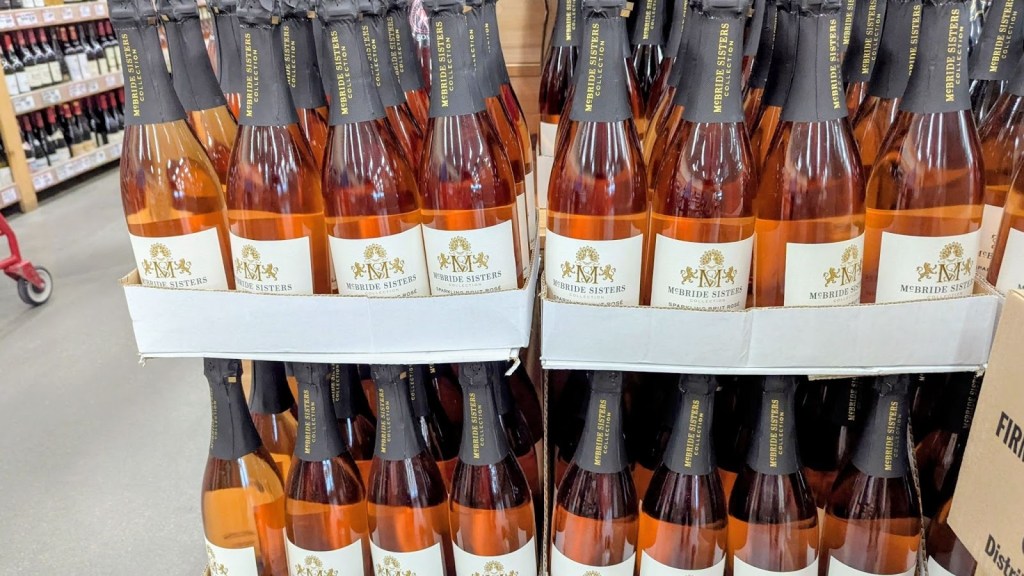
While others are popping vintage Champagne and a select few are pouring Dom, I’ll be enjoying a lovely sparkling wine, maybe two. $3.99 was the price paid. Yep, that was no typo. I found the deal of the year, if not the century!

I may be frugal and a compulsive bargain hunter, but this is a dramatic way to kick off what looks to me to be the year of wine bargains. 

One caveat, and this might not go over well with Prime shoppers, and those who shop online at wine.com. buywines.com and WTSO.com.  And that is you need to shop like in stores. Real stores. Like Trader Joe’s, Grocery Outlet and wine bars. Places with real windows and people moving around.

The McBride Sisters special collection Brut Rose was piled high at my local Trader Joe’s. It was made in New Zealand ‘s Craggy Range region. It was a deep copper-pink in color with tiny bubbles and a fresh strawberry aroma. Big and smooth, it delivers fun flavors, and  is the real deal.

The McBride Sisters, as wine producers, are also the real deal. You should read their story on their website. I’ve liked their Chardonnay, Sauvignon Blanc and blended red wine. They also offer wines in a can under the “Can Do” label. 

Various Grocery Outlets have their wines under the McBride Sisters and also under the “Black Girl Magic” label which offers an outstanding  Riesling.

Back to the $3.99 McBride Sisters bubbly…its regular price is $24.00. And it is not just me flipping over it; the Wine Spectator rated it 92 points. 

Before you rush out, remember when shopping at real stores like Grocery Outlet and Trader Joe’s, if you want to fit in as a shopper, it’s wise to bring your own bags.  Just saying.

Reviving San Francisco’s Wine Scene: A Fresh Perspective

San Francisco, contrary to negative rumors, is thriving with a vibrant wine scene. From lively restaurants like Golden Sardine and Cafe Meuse to the elegant Sprezzatura, the city showcases a diverse array of wines and experiences, signifying a strong rebound as venues embrace celebration and community once again.

While the news media thrives on bad news, I’m happy to report that rumors of the death of San Francisco are greatly exaggerated. After enjoying a week getting reacquainted with my favorite city and old haunts, I was amazed to witness how things have improved since my visit two years ago. Nay sayers might cast a doubt because this was during early December when people were just beginning to get into the holiday spirit. 

But every section of the city, from Union Square, the Financial District to North Beach and outer areas was alive.

When lines start forming an hour before my favorite seafood restaurant opens on a Monday, when tourists are in line for the hop on, hop off buses at Union Square, and when Pink Martini plays to a sold out crowd, San Fran is definitely on the rebound. 

So inbound and outbound traffic is still a mess and parking is, well, forget it. That was true before covid. Only now there are Waymo taxis everywhere.  Way too many Waymos?

As for wine, which is how I  check the pulse of a city, San Francisco has historically been the heart of California wine and often in the forefront of trends. The wine biz has also been mired in negative news with declining consumption and vineyard abandonment and removal. So if the San Francisco wine scene is not happening when the city itself is on the rebound, then that’s truly bad news.

 My assignment was clear: check out the wine scene in San Francisco. Visiting a wine bar and/or a restaurant known for its wines each day during my visit, I was amazed to see how the wine scene was back to its upbeat rhythm and wine bars and restaurants were again celebrating wine. 

While artisan beers are now quite visible, wine remains top priority. Even the Ferry Plaza Wine Merchant, a local icon, has a makeshift blackboard saying:  “Beer Merchant.” I saddled up to the bar there, and selected a South African Syrah by the glass, while my neighbors had a beer. But the list of wines by the glass is impressive, and there was plenty of buzz in the wine section.The Ferry Plaza Wine Merchant, I’m happy to report, is still holding wine classes and events, so this was a good place to start.

Fish, Wine and Poetry

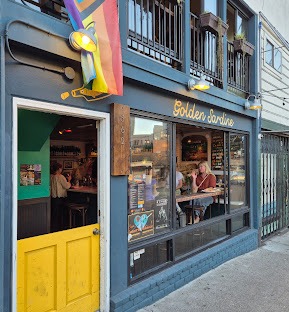
What do sardines, poetry and wines have in common? Believe it or not but an exciting and very odd wine bar new to the scene is  named “Golden Sardine.” Located in North Beach, not far from City Lights bookstore made famous as home to Ferlinghetti and other poets, the Golden Sardine offers 50 wines by the glass and stocks a few hundred bottles for sale. Rieslings and wines from Germany and Austria lead the way, but California, France and Italy are well-represented. 

Yes, the place is tiny and both floors joined by a creaky, narrow stairway make you feel crammed in  like a …sardine? The wine selections are eclectic and only a few are recognizable brands like Mayacamas Vineyards and Arnot-Roberts. But the opportunity here is to select a wine by the glass and try something new. Prices start at $9 a glass, and the pour is generous. A Negrette from Fronton was one of the best, but the Montepulciano d’ Abruzzo was the real deal for $9 and merited a second glass.

Golden Sardine is a wine bar and shop, but it also emphasizes that it is in a “poetry bookshop.”  There’s no reference here to the “wine is bottled poetry” line by Robert Louis Stevenson. But the wine selection seems to favor names with a poetic touch. There’s the “In Love with a Memory” Sauvignon Blanc, the “You’re Lucky You’re So Cute” Zinfandel, and a “Flurries on the Riverbank” Oregon Grenache to cite just a few. 

Golden Sardine is starting its third year in 2026, so it is the real deal inviting you to stop by for a glass of vino or to attend one of its poetry readings on First Fridays. We didn’t check out the sardines but the cheeses were also excellent.

Cozy, charming, classic

Remember “Cheers” Where Everybody Knows Your Name?  

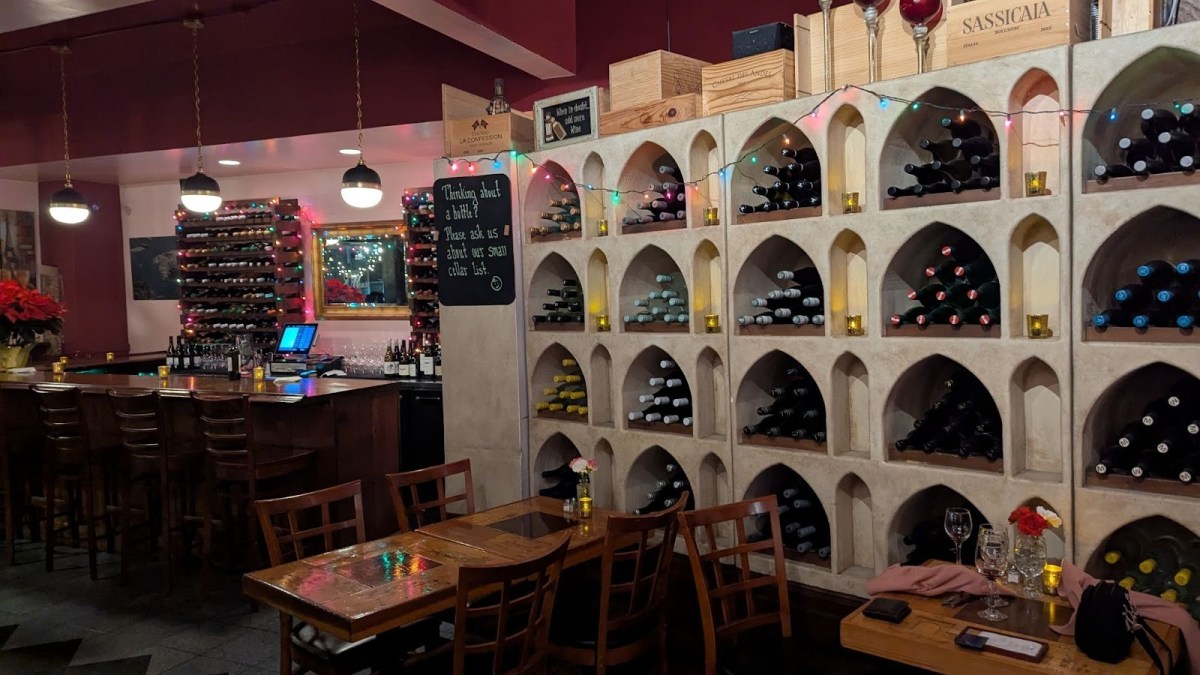
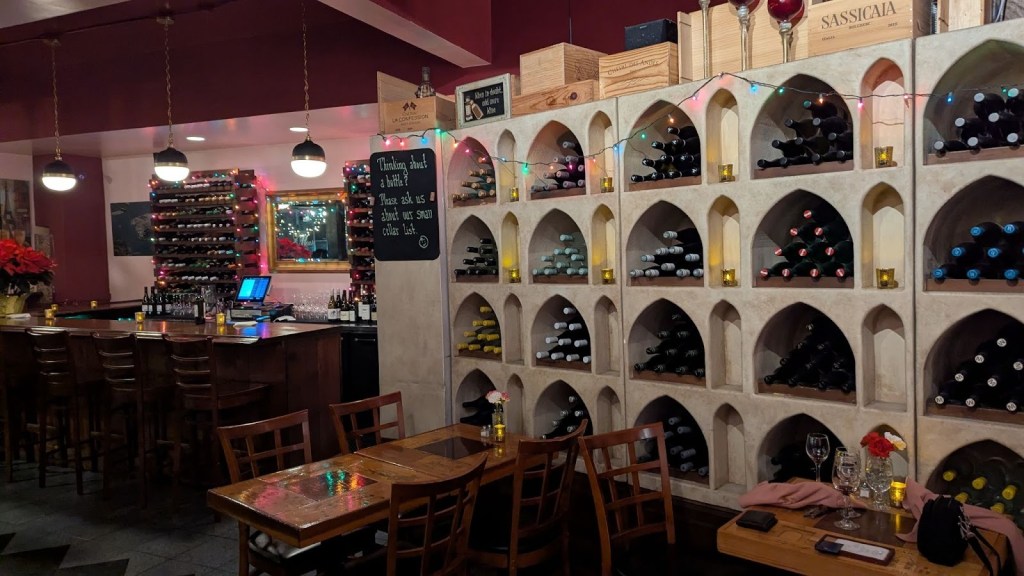
Cafe Meuse, a wine bar on the corner of a well-trafficked Nob Hill neighborhood was another big hit and brought back memories of “Cheers.”  No sardines here, but the setting is romantic, quiet, and classic. It was opened in 2006 by Erik Meuse who set it up with hand made tables and a custom made bar. There’s even a wine rack with the wine bottles actually lying on their sides. 

With over 30 wines offered by the glass, Cafe Meuse is unusual in the way it also encourages visitors to sample wines. 

We arrived early, and there were several young people enjoying a glass of wine and conversation at the bar. For $20, you can choose 3 wines to sample, and for $25, you can select 4 and can mix whites and reds if you want to. When the wines we selected were brought to the table, the pours were at least 3 ounces, actually closer to 4. Allen, our young server, said a few words, kept it simple but showed he is passionate about wine. A transplant from Austin, Texas, he doesn’t hide his slight accept but loves learning and talking about wine. 

Cafe Meuse wines by the glass are a mix of established brands and tiny newcomers to the scene. A Napa Valley Sauvignon Blanc from Cultivar was new and exciting. Another standout was the Cabernet Sauvignon from Woodside Vineyards, a Santa Cruz Mountain pioneer. Imports were well-represented by a Petra Unger Gruner-Veltliner.  

Also offering a full menu, Cafe Meuse gets rave reviews for its food. We enjoyed  two small plates and the charcuterie plate, all excellent.

The day after visiting Cafe Meuse I began planning to return. It is definitely inviting, as a neighborhood bar should be.

High End, Extensive List, Understated Elegance

Sprezzatura, located in the Financial District, is a busy luncheon restaurant that turns into a classy, high-end restaurant and wine bar after 4:00. “Barsprez” is how locals refer to it and the wine bar features a wide range of Italian wines. East Coast readers may be familiar with its sister restaurant and bar in Manhattan. 

Bar Sprezzatura is a partnership with notable mixologist Carlo Splendorini and TableOne Hospitality. Danny Mastropierro is credited with assembling the wine list. He is a sommelier who rose to fame in San Francisco restaurant circles with the Mina Group. The extensive list covers the diverse regions of Italy, with special emphasis on the coastal regions. 

Close to 20 wines are offered by the glass, but the full  list here is worth studying. Arranged by Italian regions, the wine list begins with over a dozen Spumante offerings which set the stage. Heavy in wines from Piedmont and Tuscany, Barsprez lists over 20 Nebbiolo wines as well as 20 Sangiovese-based wines. But there are wines from Puglia, Sicily, Sardinia. Abruzza, and Umbria. 

While lengthy wine lists are not unusual and often are linked with snobby service, our experience can be defined in one word: “memorable.”  As soon as we arrived, the staff made us feel comfortable and we were not hurried in any way. Fortunately, we had made a reservation and it wasn’t long after being seated that the place began to fill up. Still, the vibe was chill. 

“Chill” came to mind but I later discovered the appropriate word is “Sprezzatura.” As Gemini explained:

 “Sprezzatura is a quintessentially Italian concept meaning studied nonchalance or the art of making something difficult look effortless, concealing all art and labor to appear natural, graceful, and unstudied, often seen in fashion, art, and behavior. It’s about performing complex tasks with such ease that it seems effortless, embodying confidence and understated elegance without arrogance.”

Our dining experience, especially the wine service, was precisely that, something never before encountered in a fancy restaurant. Hunter Harris was the sommelier who worked the room, checked in with every table and still found time to talk about the wines we were served. The house wines by the glass are all Italian of course, and will set you back $8.  Other wines by the glass hover around $20 but that’s for a 5-ounce pour.  An excellent Vermentino from Sardinia was a pleasant surprise at $18.

At this wine bar, the wines share top spot with the cuisine. And the first and main course dishes are authentic, beautifully presented, and delicious.

The takeaway from our experience here was all about the service, both the wine and the food service. To us this was like a therapy session to get over having had a bad experience with poor  and inattentive service. We have had a few of those recently, but who hasn’t.

So there you have it: a totally unscientific survey of the San Francisco wine scene.  By luck we happened upon three totally different wine bars. 

Holiday Wine Sales: Budget-Friendly Tips for Shoppers

Now with the crazy days of holiday shopping hype coming at us from every direction, the major online wine retailers and wine merchants are also doing their best to get our attention. 

Although these Prime, Cyber, Black Friday and what have you holiday sales are now an annual event, lots of circumstances have changed over the last 2 years. People in general are much more focused on soaring prices of eggs and gasoline, or whatever their reference point may be. 

The phrase “sticking to a budget” is now heard in so many circles.

Because wine sales have trailed off over the last 2 years or so, these holiday sales will be closely watched. As of now, wine prices haven’t spiraled because tariffs haven’t made an impact on prices. 

The fact is that there is a glut or over-supply of wines and we have seen the number of wine producers entering the discount world increase as many once solid wineries feel the need to reduce prices to move inventory.

Wine is different from eggs and gas because it is a discretionary product, meaning not vital or necessary. Well, to all but a few of us. If there has been a lesson those in the wine biz should have learned over the last two years as wine sales dipped, it is that non-snobby wine lovers are really no different than other consumers and now realize a need to be extra careful about sticking to a  wine budget. That often means having a target maximum price or price point when buying wine. 

What’s Going on in Online Wine Sales

When previewing t several of the Black Friday deals, I can’t help but notice the many luxury or cult wines that are over $100 a bottle are now being offered at deep discounts. Online seller winespies.com offered the 2020 Caymus Special Selection at $147 ($225 regular price), vivino.com announced a culty Chardonnay for $34.99, regular price $90, while lastbottle.com featured a Pouilly-Fuise for $34, regularly $100.  Another site had the 2018 Beringer Reserve Cabernet at $87.50, roughly 50% off. Earlier this week there was a “sale” of the 2022 Joseph Phelps Insignia, which retails for $350-$400 at $195 a bottle. 

Don’t know about you, but to me even these discounted prices still are not budget-friendly. High ratings and non-stop hype are behind so many of these exorbitant prices.  Some might argue that many wines priced in the 3 digit range are on allocation or enjoy a cult following. Then one wonders why some are offered online to begin with and often at deep discounts. We’ll probably never get a consistent explanation, but that shouldn’t stop us from shopping the sales.

Insider Tips for Savvy Wine Shoppers

One great website to find truly fine and reasonably priced wines is wtso.com  What stood out to me is that its Black Friday sales on November 28-29 has an end of the year Clearance Sale. While it continues with its daily flash sale, wtso has many attractive, highly rated wines in its clearance sale. With a few bottles priced at $11.99, the list is heavy in Italian wines but also has something for every wine drinker. At $19.99 a bottle, you can buy the 2024 Calculated Risk Cabernet, the 2021 Havens Cellars Red Blend, and the 2022 Left Coast Cellars Willamette Valley Pinot Noir. An Old Vine Lodi Zinfandel topped the list of the $11.99  specials.

Wine Access is another website that has dozens of great wines for the budget minded Black Friday shopper. At wineaccess.com  the sale works by knocking an extra 20% off their already discounted prices. For example the 2022 Zinfandel from Marietta Cellars is listed for $25, but with the added discount sells for $20 a bottle.THe extra discount is applied at check out.

 Those wines that stood out to me before the discounts are the Three Wine Company Old Vine Field Blend ($28), Meeker 2022 Grenache ($22), 2023 Lang & Reed Cabernet Franc ($29), 2022 La Vigne Paso Robles Merlot ($21) and a San Luis Obispo Chardonnay from Oceano Vineyards( $18). Others are the Pinot Noir and Chardonnay from Oregon’s Solena Estate. And if you like wines from Australia, Argentina, and France, wineaccess.com has something for you at Black Friday prices.

Another site pushing its Black Friday sales also with a large inventory is wineexpress.com A few caught my attention, especially the J. Dusi Cabernet “The Don” from Paso at $22.49. J. Dusi is a favorite of mine. Also, there’s the Rutherford Ranch Chardonnay for $13.47 and a Reverdy 2021 Cotes du Rhone for $7.47. 

The California Wine Club, one of the oldest, has announced its Black Friday 50% off sale. The sale will continue through Sunday. At $12.50 the 2022 Armida Zinfandel from Dry Creek and the Eden Rift Sauvignon Blanc, also at $12.50 are excellent deals. The full list is worth checking out at cawineclub.com 

When the Dust Settles

These holiday sales will likely be extended way beyond the holidays, but they will end. Most of these are flash sales, daily deals or one-time only sales which not everyone is comfortable with because of the need to act quickly.

Budget-Friendly Paso Robles Wines Under $25

With the crazy days of holiday shopping hype coming at us from every direction, all the major online wine retailers and wine merchants are also doing their best to get our attention. If there has been a lesson learned over the last two years as wine sales dipped, it is that wine lovers are really no different than other consumers and now realize they need to be extra careful about sticking to a budget. 

 When word got out that the average price of a Napa Valley wine was $108 a bottle, normal people probably explored alternatives. If you count yourself among the budget minded, normal people then let me share my latest wine shopping discovery. Though I’ve been following it for years, Paso Robles has emerged as a leader when it comes to quality for the price.

Paso Robles remains one of the most energized and dynamic wine regions even in these difficult times. At least it is to me. Paso Robles came alive back in 1998 when the Rhone Rangers began holding their annual event there which was followed up in 2010 by the annual Garigists wine festival. Though once just a lonely way station midway between San Francisco and LA, Paso has also come on strong as a tourist destination. And here in 2025 there’s lots of excitement in the hotel and culinary scenes.

 With so many possible story angles staring at me, one that caught my eye during a recent trip to the SoCal Coast was the way so many Paso Robles wines are beginning to dominate wine lists and special deals in wine shops. We’re talking high end restaurants, sommelier-managed wine lists.

Que Pasa Paso?

Why? Beyond quality and availability, the one pattern that emerged is that the trend setting wineries in Paso know how to hit today’s magic price point. When looking back over my recent tasting notes, it was amazing to see so many of my Paso favorites selling for around $25 a bottle or less. My gut feeling is that today’s savvy wine shoppers see $25 as the top price that fits their budget. Maybe $29.99 if a wine strikes them as exceptional. 

The Paso Players

The Paso wineries I see as major players in this trend are a mix of well-established names like Ancient Peaks and J. Lohr and newcomers. A few others belong to major marketing companies, and many are your Mom & Pop family folks. Most of the wines are red which is no big surprise. Overall, when you visit the Tin City wineries or many others, the energy level and enthusiasm is reminiscent of Napa before 2000. Paso has become a magnet for creative maverick winemakers and outliers. Just recently Napa’s Tank Garage Winery joined the Paso scene. Check it out and you’ll get my point.

As for wines, Paso was noted early on for Petite Sirah, Zinfandel and the Rhones, and these are all included in the price point $25 club. But Cabernets, Bordeaux blends and other creative blends are well-represented and seem to be replacing Napa wines on many wine lists and also in the minds of many wine lovers.

So now that we’ve plugged in the destination on our map, “let’s go” to the top Paso wines hovering around the  $25 price point. 

First Stop: Petite Sirah and Zinfandel

Peachy Canyon Paso Robles (California) Petite Sirah 2021 $20

Best known for its bold Zinfandels, Peachy Canyon also has a good track record for Petites in a rich but supple style. Deep dark in color, this 2021 offers an aroma of sweet black fruit and fig along with some dried herbs. It turns plush and smooth on the palate driven by a solid core of blackberry flavors and light oak. It finishes long and seamless. With its lovely silky texture and subtle oak notes, it is well-knit and ready to drink now.  90

Brady Vineyards Paso Robles Petite Sirah 2021  $20

 After honing his winemaking skills in Texas, Don Brady went West to work for Robert Hall in Paso Robles. In 2006 he acquired a 24 acre vineyard and began focusing on Paso red wines.

If you like Paso Petite, Brady checks all of the boxes. His 2021 was aged in French oak for 18 months. Dark in color, it has that  intense, ripe blackberry aroma with some black pepper that sets the varietal apart. Full-bodied with concentrated flavors of blackberries, boysenberries and some vanilla bean, it is tight and concentrated on the palate with light tannin and oak.  More powerful than nuanced, but fairly well-mannered, it could benefit from a little cellaring to soften. But with decanting, it would serve you well as a complement to most smoked meats and, to me, especially with osso buco. Also, a good value. 90

The Big, Red Monster Lot #2 Paso Robles, Zinfandel $20

Yes, here’s a Paso red wine that boasts about being big. Now owned by War Room Cellars based in San Luis Obispo, this brand began in 2005 as a partnership between winemakers Bob Pepi (formerly of Robert Pepi winery) and Jeff Booth (formerly of Conn Creek). The brand was relaunched in 2019 and aimed at a market that loves big and powerful wines. Promoted as a “savage beast,” this Lot #2 is Zinfandel blended with Petite Sirah and Tannat. After an extended maceration “for bigger extraction,” it was aged in French and American oak, 20% new. While definitely big, ripe and juicy, it offers an attractive aroma of blackberry and pepper with some spiciness. On the palate it is round but ultra soft and has enough fruitiness to keep the tannin and alcohol at bay. 91

Next, let’s move on to Syrah

McPrice Myers Central Coast (California) Right Hand Man Syrah 2023 $ 20

Headquartered in Paso Robles, this winery enjoyed a cult-like following for its red wines. They usually are given unusual names like “High on the Hog” and “Right Hand Man.”  Blending Central Coast fruit, winemaker Mac Myers crafts this well-rendered Syrah that offers depth and approachability at a very attractive price.  Aged 10 months in neutral oak, it has a lovely aroma of ripe plum with secondary fragrances of pepper, spice and leather. Nothing overdone or funky here, this Syrah is rich and smooth on the palate delivering savory flavors of fresh berries, plums and spice. The tannins are soft and add roundness to the texture. Syrah lovers should keep a bottle of this “Right Hand Man” close at hand. Wine lovers should check out this winery. 92

Ancient Peaks Winery Paso Robles, Santa Margarita Ranch Renegade 2020 $26

With its “Renegade” blend, Ancient Peaks has been successful in working with Paso Syrah to come up with an attractive drink now red.  I like the way it tones down the gamey, meaty side of Syrah but still emphasizes its fruit. In 2020 the final blend was 67% Syrah, 27% Petit Verdot and 5% Malbec.  The individual components are cold soaked and after fermentation they are aged for 20 months in French and American oak, 20% new.  Dark in color, the wine shows a pleasing mix of Syrah’s dark fruit along with subtle fresh berries. It continues with this combination and adds some coffee and oak toast and spice in the flavors. Nicely structured with modest tannins, it finishes with simple fruit and good length. Excellent all-purpose red. 90

Turning to The Main Event: Cabernets

 Daou Vineyards Cabernet Sauvignon Paso Robles 2021 $25

This dark, ripe and juicy Cabernet is made for those who like it plump and chunky. The aroma of dark, ripe fruit with hints of anise and dried herbs sets you up for a big, rich mouthfilling wine with light toasty oak and tannins providing structure. With some airing the flavors open to reveal nuances of black tea and berry fruit before the youthful tannins are picked up to carry this to its rugged, sturdy finish.This full-bodied Cab is a blend of 83% Cabernet with 9% Petite Verdot and a splash of Merlot and it was aged for 10 months in 50% new French oak. It is a lot of wine for the money. 91

Groundwork Wine Co. Paso Robles (California) Cabernet Sauvignon, 2023 $23

Groundwork Wine is a new line of wines from Curt Schalchin of Sans Liege which is noted for its high-end Rhone blends. With Groundwork, he focuses on good value varietal wines from Paso Robles and this 2023 Cabernet confirms that Paso Robles is the real deal for great value Cabs. This 2023 is made from three vineyards within Paso, and the wine, blended with 12% Petit Verdot, was aged in neutral oak for 18 months. Bottled unfined and unfiltered, it delivers plenty of ripe black fruit with hints of black pepper and bay leaf. With light tannin, it is firmly structured and has an aftertaste of black cherry and spice. Enjoy now through 2028.  92

The Fableist Wine Co. Paso Robles (Central Coast) “373” Cabernet Sauvignon 2022 $25

Andrew Jones, winemaker for Field Recordings and Curt Schalchlin, owner of Sans Liege combine their talents for the Fableist collection of wines. The names are based on Aesop’s Fables, and apparently, judging from the label, fable #373 is about ants and bugs. Or whatever! Moving on to the wine, in the 2022 vintage the fruit was picked earlier than usual due to the heat wave. Fermented in tanks and aged in American oak barrels, 10% new, the final blend was 85% Cabernet filled out by Merlot, Malbec, Petit Verdot and Petite Sirah. Once poured, this wine shows fresh blackberry and currant aromas and flavors with youthful tannin poking through. With aeration, it slowly opens and adds a little spice and cedar to accompany the  juicy dark fruits. Needs time to settle down and should be decanted.  A good value for a Paso Cab. 90

Maddalena Paso Robles Estate Reserve Cabernet Sauvignon  2021 $24.

Part of the Riboli family’s expanding portfolio, Maddalena offers white wines from Monterey and reds from the estate vineyards in Paso Robles. Blended with 5% Petit Verdot and 5% Cabernet Franc, this Cabernet was partially aged (45%) in small oak. It is all about ultra ripe black fruit such as black cherry and plum in aroma and flavor. Medium full bodied, it comes across as plush on the palate with plenty of tannin and oak spice. It finishes on a slight tannic note.

Overall this is an attractive fruit-forward Cabernet for current drinking.  89

Paso D’Oro Wines Paso Robles Cabernet Sauvignon 2023 $23

Paso D’Oro is a relatively new brand created by the Terlato family which owns prime properties like Chimney Rock, Rutherford Hill, Sanford among others. This 2023 was sourced from 4 AVAs within Paso, and the wine was aged in neutral oak and blended with 24% Petite Sirah. Deep and dark in the glass,  it opens quickly with attractive black fruit with accents of clove and spice. Quite full bodied with rich flavors supported by velvety tannins. Smooth finish. With loads of terrific ripe fruit, pleasing texture, and some complexity, this is a great choice for current enjoyment.  91

Tooth & Nail Wine Co. Paso Robles, Cabernet Sauvignon 2020 $26

This is an old review, but it is from the winery that ignited my interest in Paso Cabernets.This vintage was presented in a unique bottle that requires a detailed background explanation and an APP to download.  But the wine inside is first-rate and a wonderful example of Paso Cabernet. Saying it “reinvented the wine label,” the winery created an augmented reality label that with the app will sing to you. Literally sing, honest. From its deep purple color to its rich, ripe aromatics, this wine sings on its own. Initial aromas of chocolate and spice give way to ripe blackberry and oak spice. It is big-bodied with a smooth unctuous texture. The flavors remain focused on ripe black fruit with dusty oak tannin in the background. The finish is long with good acidity keeping it balanced throughout. The current vintage is 2022 and sells for $28. 

Quest Austin Hope Winemaker, Paso Robles Cabernet Franc 2023 $23

The “Quest”  label is the Hope family’s long-term  commitment to Paso Cabernet Franc, and prior vintages contained some % of Cab Sauvignon. This is the first vintage made entirely from Cab Franc. The majority of the fruit sourced for the 2023 Quest Cabernet Franc was from the Creston District, Future vintages will also incorporate fruit from the Highlands District and Adelaida District.  You don’t need a SOMM course to recognize this is Cab Franc. The aroma is a textbook combination of plums, dried herbs and tobacco leaf. Medium bodied and solid, it is lively with plum and licorice flavors. Some briary tannins give a little push to the finish. Sort of like a footballer’s “tush push.”  A red to enjoy with grilled meats and rich pastas. 90

J Lohr Wines Paso Robles Los Osos Merlot 2022  $15

This Merlot is hard to beat at this price. J.Lohr’s Merlot is planted in the relatively cool El Pomar District. Blended with a big splash of Malbec (10%) and a dash of Cabernet Franc (5%), this 2022 was aged for 12 months in American oak. In an approachable and lively style, it opens with an aroma of fresh plums and light spice. Medium bodied and balanced, it offers plum and cherry flavors in a smooth package. Not flashy, just easy to enjoy.

WHITES

Sans Liege Wines Central Coast Cotes du Coast 2023 $20

Based in Paso Robles, winemaker Curt Schalchlin is a noted Rhone wine specialist. But as evidenced by his artsy labels and unconventional wine descriptions, he does things differently. Sourcing from some of the best known vineyards in Santa Barbara and elsewhere, he assembled this blend of 36% Viognier, 32% Marsanne, 17% Clairette, 11% Roussanne, and 4% Grenache Blanc. All but the Grenache are barrel fermented by native yeasts and lees aged in French oak. But the wine is, surprisingly given its composition, a smooth, subtle and lively ready to drink white. It immediately gets your attention with fresh peach, lemon and honeysuckle aromas. Medium bodied, nicely textured and vibrant, it offers stone fruit flavors and has a long finish that is neither bitter nor acidic. Charming and fun to drink and nicely priced to boot.

92

Ancient Peaks Winery Paso Robles Santa Margarita Ranch Sauvignon Blanc 2023 $18 

Made from the coolest blocks within the family’s estate vineyard, this 2023 also benefited from the relatively cool growing season. It is pale straw in color and shows plenty of vibrant fruit such as melon and pear along with light ginger and flintiness. Medium bodied, it continues with flavors of melon and lemongrass. In the crisp but lengthy finish, I pick up subtle hints of ginger and  apple. Aged for 6 months in stainless, it makes a good case for unoaked Sauvignon Blanc and pairs well with a wide range of entrees. 91

One Stone Cellars Central Coast Rose of Pinot Noir 2024 $18

One Stone is a brand created by Ancient Peaks Winery in Paso to support mentoring programs for women venturing into the wine business. The label’s image projects moving mountains one stone at a time. From the estate vineyard in Paso and others in the Central Coast, this Rose is made 100% from Pinot Noir that was grown and harvested solely for Rose production. Aged 4 months in stainless steel, it is a big friendly wine that is all about fresh strawberry and juicy watermelon aromas and flavors. Smooth and round on the palate, it finishes with a touch of acidity to sustain its lively personality. 90

Wait, There’s More

The wines mentioned so far are good examples of the great deals from Paso Robles, but they are just a solid beginning. 

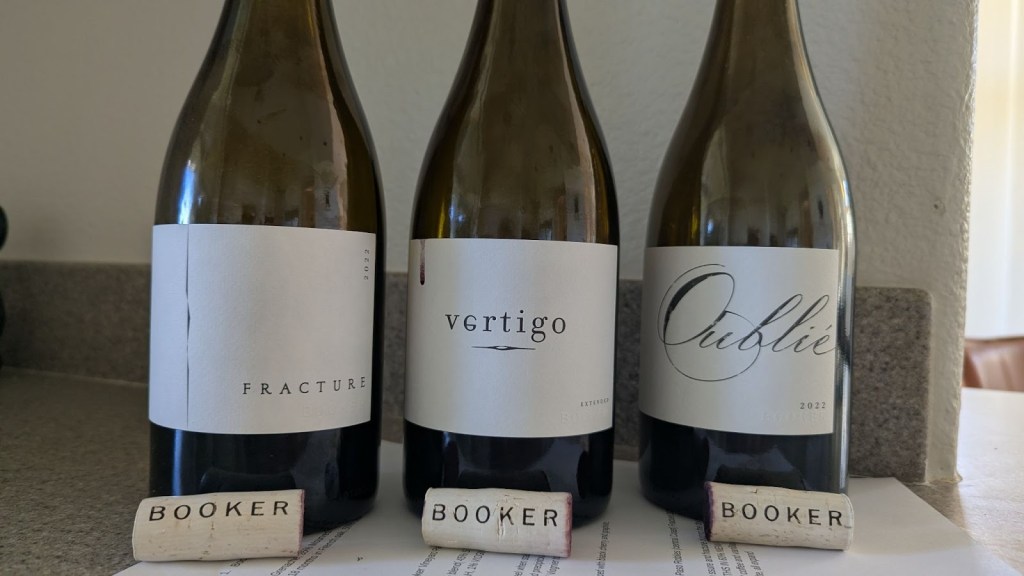
The Harvey & Harriet label, associated with Booker Vineyards, offers an attractive Red Blend from Paso and a White Blend from San Luis Obispo. Both are priced below $25.

Another wine to check out is named Big, Bold Red. It is a blend of 50% Merlot, 30% Cabernet Sauvignon, 20% Syrah. 

Highlands 41 is a new brand from the Riboli Family. Among the first to hit the market is its 2017 “Darkness,” Estate Reserve selling for $15.00  

So, that’s for now. Many of the reviews you see here are available at www.winereviewonline.com 

Go to the sight, and specify Paso Robles to see a lot more reviews of good value wines.

Making Wine Fun Again

Wine is fun.  Fun is learning about new wines and new wine regions, discovering a great wine and food combination, and sharing tasting experiences with others. We recently formed a wine tasting group which my wife innocently began describing as WTF, meaning wine tasting friends.

Many friends both in and outside the group have been wondering WTF is going on with all the bad news about the wine business. There is a worldwide downturn in the wine market. Sales are in a nosedive, including winery direct sales. Vineyards are being removed, and in the 2025 harvest, many vineyards in France and the West Coast were not harvested. The wine news is all so negative and for many in the business it has to be depressing for sure.

Unfortunately, the way most people in the wine biz are dealing with the downturn is to play the blame game. Gen-Zers, Millennials, fancy cocktails, anti-alcohol messages, inflation, stagnation, tariffs…the list goes on. All of this finger pointing does not change the fact that wine consumption is on a serious downward path. 

Rather than looking for excuses and blaming outsiders, maybe the wine industry should look inward. 

 Looking Inward

In an open letter to his wine industry colleagues, Oded Shakked of Longboard Vineyards does just that and begins with this plea:

“Can we please stop blaming Millennials for not drinking enough wine?” He then says: “Millennials aren’t dumb” and goes on to make a case in some detail. His main point, one I agree with 100% is this:

“Maybe they don’t need a somm-certification; maybe they just need wine that doesn’t come with a lecture and a superiority complex.”  

He concludes: Millennials aren’t killing wine. They’re killing the nonsense around it and they are not buying the “exclusivity” BS we have been selling for years.” You can read his entire letter on his Facebook page and on linkedin.

Now for the message that really resonated with me. Oded adds: “ Here’s a wild idea: maybe wine should go back to being enjoyable.” 

 Making Wine Fun Again

What a crazy idea which also happens to be another one I totally agree with. The reasons behind the downturn in wine sales are complicated for sure. Expanding on Oded’s thoughts, I think the perception of wine as a luxury item promoted by the corporate thinkers was a mistake. Restaurants happily went along with that and upped the price to often absurd levels, led by wine by the glass prices. $25 for a glass of Rombauer Chardonnay? No thanks, I’ll have a martini.

So how can wineries make wine fun again? Obviously, by getting off the high-minded exclusivity message and offering wines at reasonable prices. And then keep it simple by pushing the having fun message in marketing and promoting. 

Face the Music and Dance

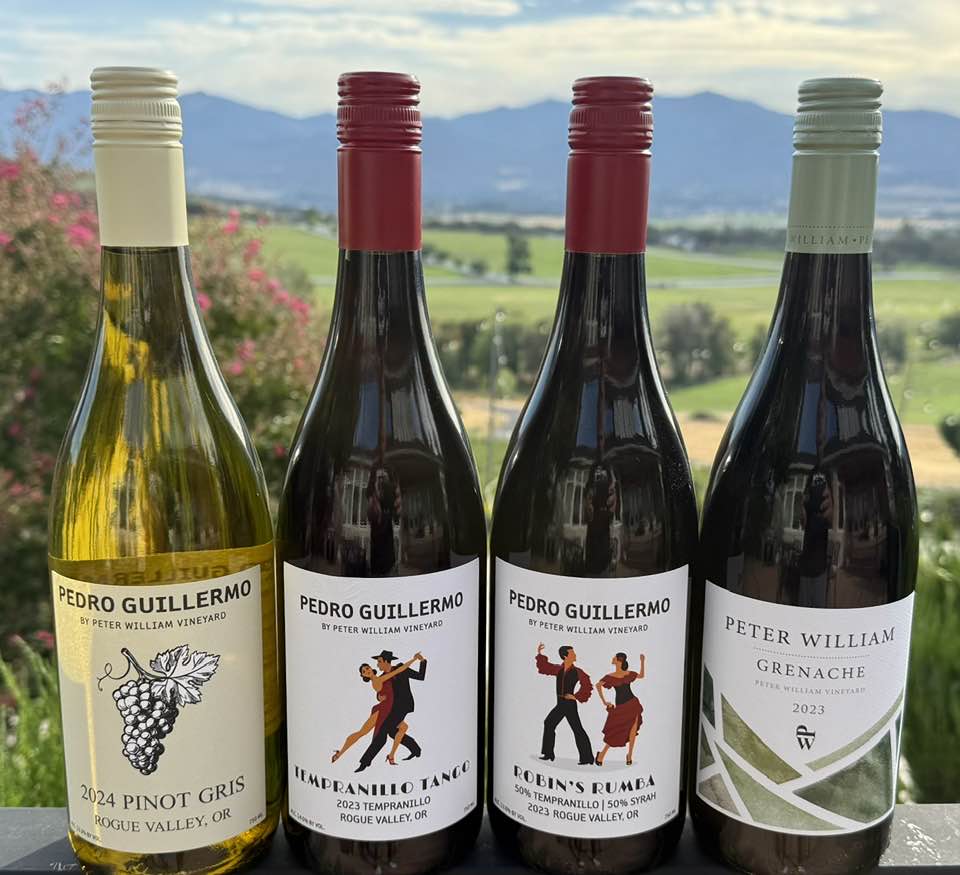
Exhibit A for me is a small winery that is expanding its “value line” of wines that focus on dancing:

Pedro Guillermo by Peter William “Syrah-Cha-Cha” Rogue Valley (Oregon) Syrah 2023 $19.50

This Cha-Cha wine joins the dance group kicked off by the “Tempranillo Tango.” The dance troupe includes “Robin’s Rumba.” All three wines are priced the same and convey the message that wine is fun and to be shared.  It is a healthy message that needs to be re-affirmed. Thanks to Dr. Peter Adesman and his wife, Dr. Robin Miller, who is the inspiration behind these wines. That fun message comes through loud and clear with their dance-inspired line of wines.

As for the Cha-Cha wine, it is delicious. Made from the estate vineyard and blended with a splash of Tempranillo, it is an approachable Syrah, ready to be enjoyed now. The color is dark and the dark fruit and spicy aroma emerges quickly with a little swirling. It is smooth and plush on the palate with lively flavors and good balance.  Yes, “swirling” is a hard word to avoid using here and good balance is key to success for both a wine and a dancer. 90

 Pedro Guillermo by Peter William Rogue Valley (Oregon) Sauvignon Blanc 2024 $15

Though it doesn’t have a dance theme, this Sauvignon Blanc glides nicely across the palate. 

With a little swirling, the aroma offers up citrus, green apple and a hint of grassiness. It is smooth and round on the palate and delivers plenty of ripe melon and apple flavors. Overall, this offers genuine Sauvignon Blanc character at an appealing price point. 88

Under the Peter William label, the winery offers a range of Rhone wines that are excellent values.

Peter William Vineyard Rogue Valley (Oregon) GSM 2023 $30

This is an attractive, vibrant GSM ready to be enjoyed now. Made from 37% Grenache, 42% Syrah, and 21% Mourvedre, it was aged 20 months in neutral french oak. The three components work seamlessly together as a team with the Grenache contributing raspberry and cherry aromatics, the Syrah adding depth and light pepper and spicy flavors, and the Mourvedre holding it all together while adding an earthy note. With soft tannins in the background, the lengthy finish is all about vibrant, delicious fruit.

91

Peter William Vineyard Rogue Valley (Oregon) Daisy Creek Vineyard Viognier 2024 $30

Another successful Viognier from the Daisy Creek Vineyard that captures all of the good things about Viognier and none of its excesses. This 2024 was fermented in neutral oak and aged on the lees for 4 months, and the lovely aroma combines lychee, honeysuckle with a hint of ginger. 

Rich and smooth on the palate, the flavors charm you with their youthful melon and spice accents. The finish is crisp and mouthwatering.

92

A Wake-Up Call for Wine Shoppers!

Wait. Are any wine drinkers actually shopping these days or did Amazon train us all to stay home and let others think for us? Then there was Covid  and now there’s Doordash delivering wines in some states. And subscription wine clubs are happy to deliver a box of unknown wines to your door. Oh well!

As 2025 winds down and the wine market faces a serious oversupply of wines, there’s never been a better time to shop around.  Sure, the online retailers hustling wines at WTSO.com, lastbottle.com and the rest of the gang are now offering a wider range of wines. On November 11th, winelibrary.com is set to offer a variety of wines at the $11.11 a bottle price point. By then Trader Joe’s and Costco will surely have come up with some deals for the holidays.

But the most exciting sale this week is at Grocery Outlet which has about 500 stores across the country. Yes stores, as in places you drive to, check out the shelves, load up a cart, and pay at the registers. Sounds old fashioned to many of you, but  most of us who love a wine bargain can adjust to it.

Yesterday, in a Grocery Outlet in Southern California, the shelves were practically falling over into the aisles. Piled high were wines from Cosentino, reds and whites. The 2023 Cosentino Sauvignon Blanc was excellent and sells for $11.99 a bottle. The winery’s website says that wine retails for $30 but is “out of stock.”  But Grocery Outlet has it along with Cosentino’s Merlot, Cabernet Sauvignon, Rose and others.  It also has the Reserve Cabernet Sauvignon for $19.99 which you can buy direct from the winery for …$82.

Cosentino Vineyards developed a following for its Zinfandel,Merlot,  Cabernet Franc and Sangiovese, but founder, Mitch Cosentino, sold the winery and is no longer involved. It is now part of the Foley Family portfolio, but the overall quality is still better than that of other once-famous brands now  under corporate owners.

Back to my recent shopping adventure, Pinot Noir lovers should check their local Grocery Outlet to see if it stocks the 2021 Diora Pinot Noir from Monterey County. If you prefer Cabernet blends, then the 2019 Red Blend made by Lake Sonoma Vineyards is quite attractive. A few stores carry Napa Cabernet from Monticello Vineyards.

Yes, the offerings vary from store to store with Grocery Outlet. When it comes to bargain priced Bordeaux wines, I find Grocery Outlet is on a par with Trader Joe’s.  Decent, everyday wines from Firestone and Sebastiani are sold at many Grocery Outlets. 

Also, the end of the year is a good time to shop for Rose wines because wines from the most recent  vintage are about to hit the market. Right now, Bonny Doon 2023 Rose, the Central Coast bottling, not the Vin Gris, is a safe bet.