Exploring the Rhones Less Traveled

Having long been intrigued by Rhone wines, I regularly check out theTablas Creek Vineyards blog. A recent post mentioning the availability of Terret Noir and Bourboulenc stopped me in my tracks. Of all the varieties permitted to grow in Chateauneuf-du-Pape these two were total mysteries to me.

Never one to pass up an opportunity to try a new wine and maybe learn something along the way, I reached out to Jason Hass.  As always, he was helpful and informative and kindly made it possible for me to taste these two new Tablas Creek wines. 

 In wildly different ways, both the Bourboulenc and the Terret Noir were exciting new experiences. That set me off on a mission to explore other lesser known Rhone varieties, those usually dismissed or ignored as blenders, to see what they might offer as varietal wines.

But first, here are my notes on those two amazing wines that had me saddling up for this journey:

Tablas Creek Vineyard Adelaida Hills District Paso Robles Bourboulenc 2022 $40

From 2/3rd of an acre, this is the winery’s 4th Bourboulenc and it is wonderfully unusual. Medium straw in color, it offers an intriguing aromatic mix of orange rind, apricot and lychee nut. Surprisingly rich and round on the palate, it combines orange and citrus flavors with a hint of stone fruit. The texture is rich, and then it finishes with a rush of lemony flavors and bright acidity. All of this is to be enjoyed in a refreshing wine with only 12% alcohol. To summarize: lovely aromas, terrific texture, mouthwatering flavors and youthful acidity holding it together. A great food wine. What’s not to like?  94

Tablas Creek Vineyard Adelaida Hills District Paso Robles Terret Noir 2021 $40

Originally from the Languedoc, Terret Noir has seldom been made on its own, most often blended with Grenache or its fellow family members,Terret Gris and Terret Blanche. Tablas Creek bottled 70 cases in 2021 and offers it at the winery.  Once poured, it has an unusual light red color that sets it apart from most red wines. The aroma is also strikingly unusual, neither berry-ish nor overtly fruity, it offers a pretty floral nose of roses and orange blossom. While light medium bodied at best, it delivers refreshing flavors reminiscent of red currants that are sustained and persistent. Gentle, fresh and lively in the finish, it is all together pleasant and refreshing. It is a fun party or aperitif style red. Fun is good, right? 92

My takeaway after trying these two unusual wines was a suspicion that there probably are other lesser-known Rhone blending varieties that might be worthwhile looking into. And sure enough, by continuing along the Rhone road less traveled, I encountered four other Rhone varieties that also have much to offer as stand alone wines and, best of all, these four are being made by several key California winemakers, a few original Rhone Rangers and some new, younger folks dedicated to Rhone wines.

The four wines are two whites, Marsanne and Roussanne and two reds, Cinsaut and Counoise. Grenache Gris was on my list, but not many are available. Picpoul wines are enjoying a well-deserved surge, but are not as unusual as are Roussanne and Marsanne.

 Marsanne is hardly a newcomer since Bob Lindquist who founded Qupe, made California’s first back in 1987. But it is still usually downplayed as part of a blend with Viognier or Roussanne. And while there are many attractive blends now coming from Australia and Santa Barbera, on its own, Marsanne is still not that common. 

And from what I’ve experienced at this early stage, I can only wonder why. Marsanne is, afterall, the white grape of Hermitage fame. The 2022 Marsanne from Starfield Vineyards in El Dorado is a fantastic, complex and stunning version and it was a great wine to begin the journey. 

Starfield Vineyards El Dorado Marsanne 2022 $34

Aged for 6 months in neutral French oak, this Marsanne is attractive now but has all it needs to age long and well. On the nose it comes across with ripe peach and nectarine fruitiness with citrus as well. Then on the palate which is plush and round, it has vibrant flavors of orange rind

and cloves with minerality as well. Solid and well-integrated, it continues the ripe peach, apricot theme in its lengthy finish. Overall, it is concentrated but so lively it invites a second glass. 165 cases made. 94

After that re-introduction to Marsanne, I reached out to Bob Lindquist who sold Qupe in 2018 but has never stopped making Marsanne. As he explains,”Marsanne and Roussanne are near and dear to me, and I continue to make both of them under my Lindquist Family label.”  He adds, “In 1986 I got Marsanne budwood from Randall Grahm and grafted over some own-rooted Cabernet vines at a small vineyard just outside of Los Olivos called the Ibarra-Young Vineyard.”

Marsanne ages well, Lindquist noted, and his vintages from the early 90s are still showing well he added. As for style, he explains:” I make Marsanne in a lighter, fresher style, all in neutral barrels and bottled after about 8-9 months.”

“Lighter” it may be, but his current release is most attractive:

Lindquist Family Vineyard Edna Valley, Sawyer Lindquist Vineyard Marsanne 2020 $38

All of the fruit is grown in this the Demeter certified biodynamic vineyard.  Yellow with green tint, this wine is medium bodied with lots of youthful character. Aromatically, it combines nectarine and white peach fruit along with some almond and lemony accents. Smooth and refreshing on the palate, it has good acidity for a balanced impression and concludes with lively fruit and a crisp finish. 92

At the end of our conversation, Lindquist added this zinger:”I think Roussanne makes the more important and complex wine…I make mine very much in the same style as Chardonnay.”  

 It turns out Roussanne is a favorite of many other winemakers. Bill Easton of Terre Rouge who makes exquisite Syrah and Viognier chimes in with this: “Roussanne is the most serious white Rhône grape. It reaches its apex with age – slow oxidation.. But it is not easy to grow.” The team at Truchard in Napa simply say “it is a challenge.” And then John Alban the unchallenged champion of Viognier adds this: “There are legions of whites that one can make for all kinds of commercial reasons, even if the resulting wines are less than compelling, but Roussanne is for people you love.”

After tasting the latest from Terre Rouge and Lindquist, I can understand the appeal. Easton offers a perfect summary of what a newcomer will encounter:  “American palates are not accustomed to classic Roussanne characteristics: Straw golden color; with exquisite quince, honey-nut, and beeswax aromas.”  To that I’d add exotic pineapple fragrances, rich viscosity, and depth unique among white wines. It is definitely a white on steroids. The Terre Rouge Roussanne is given several extra years of bottle aging before being released to the market.

The name “Roussanne” relates to the French word for russet which explains the wine’s dark color. In the early phase of the Rhone Ranger period, what was thought to be Roussanne turned out to be Viognier. The true Roussanne was eventually introduced by Tablas Creek, so most of the current plantings began in the late 1990s. 

There’s one major exception: Terre Rouge. Its Roussanne clone is unique, originating from a Chave family parcel on the hill at Hermitage. It is the real deal and you can get a good feel for what Roussanne is capable of if you are fortunate, as I was, to taste the 2011 Terre Rouge and the 2021 Lindquist Family. See the tasting notes at the end. 

Cinsaut is another Rhone that was misidentified and that’s one likely reason why it was long overlooked. It turns out that in Lodi the Bechthold Vineyard which was planted in 1886 is actually the oldest Cinsaut vineyard in the world. Until 2003 when UC Davis proved by DNA testing that it was Cinsaut, the grape was believed to be Black Malvoisie. And it was sold to home winemakers.

Often spelled Cinsault, the grape is used these days to produce Roses or in blends. It is well-represented in South Africa likely due to its parenting role in Pinotage. It was not planted at Tablas Creek until  2017, and for now the winery suggests “it will be a useful blending partner to higher-alcohol, more tannic red grapes, and it makes for delicious lighter reds on its own.”  

Thanks to Holly’s Hill Vineyard in El Dorado, my most recent encounter with a varietal Cinsaut is highly memorable and is a delicious red. Here is my note:

Holly’s Hill Vineyard El Dorado Cinsaut 2020

Based on its color and the initial sniff, my instinct says this could be a Cotes du Rhone Villages. A real good one. But then after the initial taste, it comes across with subtle, but charming flavors that don’t match anything in my experience. Though Cinsaut is classified as a lightweight, this is no such thing. Its bright, fresh cranberry aroma mingles with spices and black tea, and the flavors are full of fresh picked dark cherries and an earthy, leathery back note.  Balanced, with light tannin it finishes on a slightly tart note along with lingering berries. Lovely! 93

Starfield Vineyards, also based in the Sierra Foothills, impressed me earlier with its 2019 Cinsaut. It turns out one of Randall Grahm’s most recent obsessions is with Cinsaut, so he had lots to say when approached.

“But let me tell you why I’m so enamored of Cinsault…. By restricting yields aggressively – via water restriction, bunch and cluster thinning – one can actually produce a very elegant wine of heady fragrance and beautiful color.  For me, this is the classical  (you will forgive the expression) conundrum of how to produce an elegant, complex, let’s call it “continental” wine in a warm and dry Mediterranean climate.”

While Cinsaut seems to be gaining in traction as a Rose and as a red wine in South Africa, that leaves Counoise as the ultimate, unwanted red grape on the Chateauneuf-du-Pape team. It ripens late in the season which makes it unappealing in Southern France. Only 60 acres are planted in California today. 

 But like the last player drafted in pro football, it too could become the next star. Tablas Creek has 6 acres and bottles it as a single varietal from time to time.  Fess Parker offers an excellent Counoise under its Epiphany label which impressed me a few years back. Others now on my radar are the new Counoise from Frick in Dry Creek Valley, Adelaida from Paso Robles and the 2019 Prie Cellars in Lodi. 

 However, in my most recent experience,  Counoise was well-represented by Holly’s Hill and that winery seems ready for stardom based on its 2020. As winemakers Carrie and Josh Bendick explain, when their various new wines were tasted every January, the Counoise lot always stood out. Eventually, the winery converted some Syrah to Counoise. It is difficult to grow, though, they add, because it ripens unevenly and you always have to focus on its color. 

Holly’s Hill Vineyard El Dorado Counoise 2020

Excellent, deep color with an aroma of raspberries, lovely baking spices and floral notes. On the palate it offers vibrant flavors of spices and berries. The subtle floral component adds intrigue and there’s plenty of crisp acidity keeping it nicely woven together. Tannins are light and smooth. And the finish is fresh and long with spices such as cinnamon and clove. 

It is reminiscent of a Moulin-A-Vent in weight and direct appeal but it offers more layers as a result of the floral note and baking spices. 94

As I begin wrapping this journey up, it hits me that this Counoise like the other three wines is a food-friendly wine. Both the new and older Roussanne reviewed here were definitely serious food wines.

Lindquist Family Vineyards Santa Maria Valley Bien Nacido Hillside Roussanne 2021 

From 5 acres on a west facing hillside,planted to the Tablas Creek clone between 1997-2000, Lindquist has made Roussanne from this block since 2000. It is aged on the lees in one year-old barrels for a year and then in neutral oak for 6 months. Bottled unfined and unfiltered, it is light yellow and with aeration, opens up to show pineapple, beeswax, and honey aromas with some oak. Big, generous palate, silky texture with deep flavors of ripe apples, hazelnuts and honey.

A little leesy, creamy texture and a long aftertaste of lemon curd and oak toast. 94

Domaine de la Terre Rouge Sierra Foothills  Monarch Mine Vineyard Roussanne 2011

In 2011, the crop ran into mildew problems and the yield was down by 80%. Following whole cluster pressing, the juice was barrel fermented and the wine aged on the lees. Beginning with its deep golden color, this wine was a unique experience. Rich and deeply concentrated with great viscosity, it delivers ripe pear flavors with some floral notes. Maturing nicely, but still has plenty of life ahead of it. As for a rating, how about rare and wonderful.

All of the wineries singled out here sell their wines direct, so for those wanting to jump aboard and continue the journey into the unknown Rhones, here are the contacts:

www.starfieldvineyards.com

www.hollyshill.com

www.lindquistfamilywines.com

www.terrerougewines.com

So that’s it. Oh, hold on, just got a late breaking news alert from Tablas Creek about another variety:

“Vaccarèse. There are just over 10 acres planted in Chateauneuf, just a little more than that elsewhere in France, and none, until we brought in ours, elsewhere in the world. But we believe it shows great potential, with lovely dark color and floral and herbal aromatics. It’s been so good that it’s already playing a significant role in the Esprit de Tablas.”

Well, now that sounds worth exploring on another trip!
A Perfect Summer Red Wine and A Real Bargain!

Just discovered and uncorked the 2020 Pinot Noir from Clay Shannon at, hold on, $5.99 a bottle. It normally sells for $22.00.

From Shannon’s Long Valley vineyards in Lake County, this Pinot is being blown out at select Trader Joe’s.

Whatever the reason may be for the sale, a deal is a deal.

This Pinot has been rated 89 to 92 points by the usual suspects.

To my palate, it is a light style Pinot  but correct, with bright cherry fruit and oak spice, well-balanced with a pleasing finish.

My Rating: 91

With luck, I’ll see you at the checkout counter,

BEST SUMMER SIPPER WINE SALE

SEE IT AT  http://www.cawineclub.com

One of the oldest online wine sellers, the California Wine Club has a solid reputation for pricing and reliability. So it comes as no surprise that several small wineries looking for new sales outlets have discovered it.

And you should see what it is offering right now.

The summer sippers for under $20 are led by two of my favorites, each at $10.99:

2021 Clos La Chance Estate Sauvignon Blanc

2018 South Coast Winery Viognier

For the Pinot Grigio lover, check out the Mountain View Winery’s at $16.99

And there are two first rate wines from Brutocao Cellars in Mendocino: Chardonnay and

Cabernet Sauvignon

The selection at the cawineclub changes as new wineries catch on and offer their wine.

Among recent additions that are out of the ordinary are Malbec From Yorkville Cellars, a Carmenere made by Plaisance Ranch and one of the most sought after dry Rieslings, the 2020 Poet’s Leap from Long Shadow.

 the EX Monterey Pinot Noir from Wrath wines is another hard to find wine

Not all wines are deeply discounted as this club also functions like a traditional retailer.

And it offers hard to find wines like this beauty from Joel Peterson:

2020 Once and Future Zinfandel, Teldeschi Vineyard, Frank’s Block

With occasional new offerings like that, you owe it to yourself to check out the site

Specializing in small, family owned wineries, most from California, the site works smoothly with 4 categories: 

Super Savers

Artisan and Under $50

For Connoisseurs

Recent Club Features

Frequently, this club has a $1 case shipping deal, so it is wise to get on the email list.

3 Reasons to Shop Last Bottle

When it comes to rating the top online wine sellers today, the last word is Last Bottle.

I’ve been following it and another two dozen sites for several years now and, yes, I faithfully look at everyone’s daily deals, special offers, clearance sales and whatever else. 

Most sites are hyping the same wines after covid and are so predictable.

But not Last Bottle.

Wine.com is great in many ways, but it doesn’t list many of the small, hidden gems that Last Bottle uncovers.

I also think highly of winespies.com, reversewinesnob.com and wineaccess.com.

Last Bottle, however, is best at 3 key things:

  1. Big, real discounts!! Often over 50%.
  2.  Great selection, ever changing, not the usual fare.
  3.  Exciting, informative, and fun to read website and wine comments.

All of this along with a proven track record and yet there’s no personality behind it, no person by name.

And therefore no ego in evidence. No sommelier or wine expert showing off.

It is all done by teamwork, by wine competence, and by a crazy, noisy, got you by the throat style.

The question remains: who the heck are the people behind Last Bottle? 

I asked that and several other questions and was surprised at the quick and  informative response.

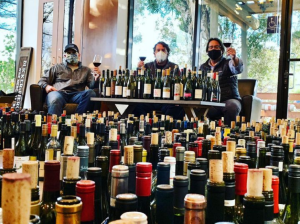
But I still don’t know that much about the people. The best I have is this photo:

What sets their sales approach apart from the others are the unusual and energized wine descriptions. Here’s a typical introduction to a featured Shiraz:

“Quick poll…who’s seen the video where the guy rescues his dog from the headlock of a big ol’ kangaroo and then squares off (you might want to Google it)!? Man, those Aussies are just the best. Speaking of BEST, how about 94 POINTS and THIRTEEN American dollars (that’s 18.60 Aussie dollars, by the by)??!! Mount Langi Ghiran SHIRAZ!!! Pure craziness.”

Or this one about a Barbaresco:

“WOOHOO!!! If you could make Burgundy with nebbiolo, this just might be it. Fine, elegant texture, no heaviness, but STACKED, simply soaring with beautifully fresh and dried roses, red cherry, orange pekoe tea, a dash of allspice and cinnamon, freshly turned earth, and shaved truffles, some toasted hazelnuts…my, oh my! SO GOOD! This will age like a champ, too – so get a few extra to save. We get all contemplative and nostalgic whenever we drink Rivetti. This is complex, thoughtful, fine, focused, and distinctly reaching for a higher level.”

These atypical wine comments keep on coming and may strike some as silly and irreverent, but their descriptions are clever, creative, and so unlike the mechanical writeups encountered elsewhere.  And the wines are top quality.

To learn more about these folks, see my article posted at http://www.winereviewonline.com

Here’s one question I asked that’s sure to tease you:

Q: You say your team tastes 40,000 wines a year, or roughly 800 a week. Really? Is that true or hype?

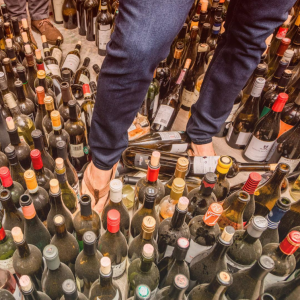
A: This is 100% true. When the tasting bar becomes too packed with bottles we set them on the floor, and have to carve little paths to get through. It can seem ridiculous, but it speaks to our commitment to assessing every wine to find the gems that make it into a daily offer. 

Here they are hard at work: the Chateau Les Feet of wine sellers:

50  Years in Pursuit of a Dream

A 50th Anniversary is a big deal not only for couples and businesses but also for California wineries. Throughout 2021, neither fires, pandemics nor earthquakes prevented two dozen wineries from celebrating their 50th harvest. While those special events were low key by necessity, celebrations can now be more festive this year and next.

As I sip its delicious 2021 Fume Blanc, Dry Creek Vineyards, a member of the Class of 1972, was the first to remind me it has good reason to recognize the accomplishments of Dave Stare and his family.

Milestones tend to be ignored or pushed into the background when the current issues are major ones like smoke taint, climate change and pandemics. Nevertheless, the class of 1972 brought us many exciting new wineries and the class of 1973 was ever bigger. Fifty years pale when compared to Old World wine history, but what happened in 1972 and ‘73  signaled the beginning of the small winery proliferation which dramatically changed California wine.

A look back at these early start-ups, to use the current term, helps us better understand California wine. And why starting a winery is so wrapped up in the California dream even today. It began in Napa and spilled over into Sonoma and Mendocino in the 70s and continued to Santa Barbara, Paso Robles, and the Sierra Foothills during the1980s and 90s. 

Yes, I’m aware there were pre-1972 small wineries like Stony Hill, Mayacamas, Hanzell, Heitz and Martin Ray, but from 72 on, the newcomers were more numerous and shared one thing in common.

Members of the class of  72 and 73 were for the most part outsiders making life-altering career choices. In one of those “road not taken moments,” they decided to take the plunge, pursue their dream, to follow their bliss as a result of a whim, an epiphany or maybe after too much fine wine the night before. 

And these newbies in the early 70s opened the door widely for others with no wine heritage. My random survey of those two years reveals many founders were doctors, lawyers, and engineers.  But the backgrounds vary widely to include bankers, teachers, wine merchants, airline pilots and artists. One was a geologist; another a private investigator. A few, like Jack and Mary Novak of Spottswoode, simply wanted to retire to a rural retreat.

The Anniversary Gang & Where They Came From

Burgess Cellars: Retired airline pilot

Chateau Montelena: Jim Barrett, lawyer  

Carneros Creek Vineyards: wine retailer

Cakebread Cellars: photographer & auto repair

Diamond Creek: pharmaceutical salesman

Franciscan: Justin Meyer, defrocked Christian Brother 

Joseph Phelps Vineyard: Building contractor/developer

Rutherford Hill : lawyers and grape growers

Silver Oak: Ray Duncan, contractor from Colorado

Stag’s Leap Wine Cellars: Political Science professor from Chicago 

Stags’ Leap Winery: Restaurant owner, property developer

Stonegate Winery: Teacher

Trefethen Vineyards: Executive from Kaiser Industries

Jordan Vineyards: Oil explorer from Colorado

Dry Creek Vineyards: MIT grad, civil engineer

Hoffman Mountain Ranch—Stanley Hoffman, medical doctor

Montevina Vineyards: Banker

Edmeades Vineyards: Cardiologist from Pasadena

Enz Vineyards: engineer

Lazy Creek Vineyards: restaurant worker

Of course, some had deep pockets, the cliched “Rich Americans.”  The old saying was that “If you want to make a million in the wine biz, you have to start with 2 million.” Sure there were people like Tom Jordan, the wealthy Colorado oil executive, who built a replica of a French chateau in 1973, but there were also many more like Hans Kobler, a San Francisco maitre d’ who bought an old barn in Anderson Valley in 1973 and commuted while developing  Lazy Creek Vineyards in Mendocino.

The who is one part of the story, but the why, the motive for changing careers, is also telling.  The two primary figures in the Judgment of Paris were both newbies. Chateau Montelena’s founder, Jim Barrett, was a Los Angeles based real estate lawyer. With an expanded business and staff, he was seeking a retreat, a getaway from LaLa land. Warren Winiarski of Stags Leap said he had an epiphany over a glass of wine.  Winiarski, the University of Chicago professor, was drawn to the rural lifestyle and in 1964 packed up his family and drove the station wagon to Napa.

Barrett got a good deal on a historic dilapidated chateau. Winiarski studied wine and once in Napa, was hired to perform basic tasks like cleaning tanks and barrels and doing lab analysis at Souverain Cellars. During an interview with Lee Stewart, Souverain’s founder, he mentioned he had hired both Warren and Mike Grich to work in his lab. And, neither when they began, he noted, knew how to titrate acidity.

But they help define the two pathways to fulfilling the dream. Those with money, build a chateau or remodel an ancient one and hire people.Those who don’t have the bucks, , start from the bottom, gain cellar experience and/or take classes.

Jack Cakebread is a favorite example of the “anyone can” own a winery. Assigned as a semi-professional photographer to illustrate Napa wineries for a book, he fell in love with the lifestyle. Meeting an owner, on a lark he said, “if you ever want to sell.”  They did, and Jack then used his $2500 photography commission as a down payment on the land for Cakebread Cellars. For the first several years, he kept his day job running the family’s auto repair shop in Oakland.

Whatever career the startups abandoned in the 70s, the common denominator was a lack of winemaking tradition. Caymus Vineyards and Raymond Vineyards were exceptions, started by people who knew how to prune a vine and drive a tractor. Clos du Val had a French winemaking connection, and two of Freemark Abby’s partners owned vineyards. 

Neither Normal nor Logical

The upside for the others is without being tradition-bound, anything goes. Lacking preconceptions they can think out of the box.  Winiarski bet the farm on a sub-region called Stags Leap. MIT grad, Dave Stare of Dry Creek Vineyards converted a prune orchard to focus on Fume Blanc.  Rich Sanford returned from a Naval stint in Viet Nam, studied Santa Barbara’s unusual geography, borrowed money to plant one acre and is now commonly referred to as the “Godfather of Central Coast Pinot Noir.”  A pharmaceutical wholesaler from Los Angeles, Al Brounstein of Diamond Creek Vineyards made not one, but 4 vineyard-specific Cabernets from his mountain vineyards. None of these focuses could be defined as normal.

This free 70s spirit of going against the grain carries over into today’s wine scene. While no denying that California wine production is dominated by the top 3 or 4 wine companies/corporations, over 80% of today’s  4,775 wineries make under 5,000 cases annually and 95% of Napa’s wineries are family owned.

And career-changers still lead the way.  Napa’s ultra high tech Palmaz Vineyard was founded in 1997 by Dr. Julio Palmaz from Argentina who among other things developed the balloon-expanding coronary stent. Yes, “the” stent.

Don’t know what it is about photographers, but Aperture Cellars in Alexander Valley, recently bursting on the scene, was founded by Andy Katz, a famous photographer. 

But not all bring such fame and fortune. Typifying the other side is Jeff Fadness of La Vie Dansante in Gilroy. He’s had several careers, speaks several languages and after leaving the corporate world to take a year off wrote: “To be clear, I never meant to own a winery, swore I wouldn’t in fact – that would be stupid.” But as it happens somehow by 2015, “Suddenly, against all odds, I own a winery.” And, he makes excellent wines, especially Rhones.

Since 2015, 100 or more new wineries have started up each year led by career changers reinventing themselves. 

Raising a Toast

So to those members of the class of 1972 who went against all odds and are organizing their 50th anniversary events, I think it’s time for the rest of us to remember what got them into the wine world, to think about their achievements, and of course to raise a glass in their honor.

 Dry Creek Vineyards and founder Dave Stare are my favorite examples of this can-do spirit. 

Why would a graduate of MIT and a devout sailor raised on the East Coast be drawn to the unknown Sonoma County region, the Dry Creek Valley and focus on Fume Blanc, still not widely known in 1972? 

He also has a degree in Business, so none of this makes sense. 

Once when visiting Chile in 1993, my wife. Ginny,  and I had ventured way south to a tiny resort town. There we bumped into a young honeymooning couple, both in a D.C.  law school. After a brief exchange and a second Pisco Sour, they said their dream was to make a lot of money as lawyers, then quit and start a winery in Napa. And it wasn’t just the Pisco talking! 

Yes, it is nuts! While most young people in France or Italy want nothing to do with the family vineyard, it was and remains a part of the California dreaming attitude. The winery dream is often a shared dream, a couple turning their backs on the material world and enjoying a Folie a Deux. 

A shared fantasy; that was one of the best names ever for a Napa Winery. And the owners of Folie A Deux,  the Dizmangs, Eva and Larry, were both shrinks who lived the dream for about 20 years, then gladly sold the winery in 1995.  But they did it! They lived the Dream.

Best Websites for Savvy Wine Shoppers in 2022

Let the Countdown Begin

Now that Spring has arrived and we can look back on all those wild sales from Thanksgiving to St. Patrick’s Day, this an ideal time to review what has happened over the last year in the fast-changing world of online wine sellers. 

It’s also Academy Awards time, with its ongoing chatter and debate about the best of this and that sets the tone for this post. I’ll be shining the spotlight on several wine webites that stood out and performed well over the last year.

As most of you know, I’m not a fan of subscription boxes since you can find better wines at better prices if you do a little research. Nakedwine, Vinesse, and Firstleaf seem to make many people content. But those are not my kind of  wine-loving people.

Much like the selections for best movies, actors, and whatever, selecting the best sites for serious wine shopping also has to be broken down into categories. 

For one stop shopping, the big retail guys like wine.com, wineExpress.com and cinderellawines.com maintained their positions over the last year as reliable and only occasionally exciting. 

Taking our cue from the Oscars, we are spotlighting the best websites in specific categories.

In the Best of “Curated Selection” category, the nomination for the best website for red wines is invino.com. Since the present partners took over in 2019, it is often my go to place for red wines. 

www.invino.com 

“Curated” is overused by so many others, but it applies perfectly to the wines offered at this site. Based in the town of Napa, it lists around 100 wines at any one time. But they reflect excellent choices that are not available elsewhere.  

If you prefer red wines, then this is the site for you. It is particularly good with Napa reds and carries such proven Cabernet wineries as Luna, Von Strasser, and Clark-Claudon. From Bordeaux, it now has very attractive red Graves for around $20 and a lovely 2018 Bordeaux for $9.95. Then there’s the rarely seen red wines from Betz Family, Ken Wright and School House Vineyard. The selections from Argentina, Spain, and Italy are also inviting and unusual.

An exciting list of red blends confirm these guys work hard to offer values, and many good deals are priced below $25 a bottle. A highly rated Dolum Estate Napa Cabernet was offered recently at 60% off and a Sonoma Coast Pinot for $23.95.  

If you buy wines based on ratings, then even here you can look over a collection of 94+ rated wines under $40. Many exciting wines and several are deeply discounted, such as a first rate 2016 Chateauneuf-du-Pape and 2016 Pomerol Château Croix-des-Rouzes. 

While a few other sites have recently offered Frisson Napa Cabernet, invino.com came up with a special deal on Frisson magnums at 50% off and free shipping on orders of 2 or more.

Pros:

Authentic wines, not custom made, private labels

Strengths are in wines from Napa, Spain, France, and Argentina with frequent surprises from other California regions..

No crazy BS write ups about the latest cult wine from icons and  rockstar winemakers

And, best of all, discounts of 50%-60%

 Shipping rates vary but always seem fair and based upon sales price.

Cons:

Not really a negative, but it is somewhat limited by appealing primarily to serious, well-informed, and somewhat adventurous wine lovers.

WALLA WALLA: Recent Notes & Updates

Walla Walla is unusual in many, many ways. First it is a rare AVA falling within two states, Washington and Oregon. About 60% is within Washington. Defined by the Blue Mountains to the southeast, the Palouse to the north, and the Columbia River to the west, Walla Walla is said to be the size of Napa but contains only 3,000 vineyard acres. 

But, for surprise #2,  there now are about 120 wineries calling Walla Walla home. Nothing much happened vineyard-wise after Repeal as the region expanded its orchards and wheat growing. Then In 1974, Gary Figgins planted a small vineyard and by 1978 his Leonetti Cellars was the first new winery. Figgins who was interested in Italian reds like Sangiovese made a 1978 Cabernet that by the early 1980s won so many awards and earned so many high ratings that it was being talked about as a cult wine. Walla Walla had awakened with a bang.

As its reputation spread, Figgins responded to his new found success and high demand by announcing release dates for subsequent vintages. The wines sold out quickly over a weekend in May.

Leonetti’s success, it is fair to say, kick-started Walla Walla as a special wine region which until then was better known for its onions, apples, and wheat. Selling wine to visitors from out of town caught the attention of Marty Clubb, who founded the nearby family winery, L’Ecole No 41 in 1984. Clubb was soon offering his attention-getting Merlot, Semillon and Cabernet on the same day Leonetti scheduled its open house. Not surprising, there were traffic jams caused by wine lovers coming from Portland and Seattle.  Adding to the evolving wine scene, Rick Small who planted a vineyard in the late 70s converted a machine shop into a winery in 1981. His Woodward Canyon Winery was yet another reason to hit the road to Walla Walla.

To be frank, Walla Walla is in the proverbial middle of nowhere. Portland is 250 miles west, Seattle around 275 miles away, and otherwise, nothing but farmlands and magnificent rock formations. The area is beautiful and the town of Walla Walla with its brick buildings is absolutely charming, home to Whitman College and more bike trails than you thought existed.

My first visit to Walla Walla was in 1996 and during that time I was welcomed by the owners of Leonetti, L’Ecole, and Woodward Canyon. Two wineries had tasting rooms downtown, Seven Hills and Canoe Ridge. My hosts were the owners of a new vineyard named Pepper Bridge who were at the time also major apple growers shipping their product worldwide. All three wineries remain family owned and Pepper Bridge, owned by Ginnie and Norm McKibben, is now both a winery and a major grower selling to dozens of  wineries.

But to return to my list of what makes Walla Walla unusual, #3 is the fact that in the little town there are presently 32 winery tasting rooms open to the public and to wine club members. That’s almost a third which is amazing. As I was packing up to leave on the most recent trip, a local stopped to ask what I thought of Walla Walla. After mentioning I first visited years ago, she noted,  “Yes, the wineries saved the town and brought it back to life.”

But what really sets Walla Walla apart from most AVA is that 95% of the grapes grown are red. Cabernet, Merlot and Syrah combine for 70% of the total. On the Oregon side, The Rocks District sub-appellation, approved in 2015 and known for its distinctive gravel, cobblestone soil,  Syrah edges out Cabernet and Merlot is a distant third.

While it is fairly clear that Syrah is the rockstar of The Rocks, Cabernet faces some stiff competition from Merlot and Bordeaux blends as the signature wine of Walla Walla Valley. And Syrah is gaining some steam with new wineries like Valdemar Estate raising the bar. 

From the revisit, I left with the belief that Walla Walla is just gaining momentum and is on track to become a leading voice for many red wines. Currently, there are excellent Cabs and Merlots but it is easy to get excited about the Bordeaux blends, especially those with a good dose of Cabernet Franc. 

5 Best Representatives: All have wine clubs

Northstar Winery “Red Blend,” Walla Walla Valley 2016 $60

Pepper Bridge Winery Merlot, Walla Walla Valley 2018 $55

Amavi Cellars Cabernet Sauvignon, Walla Walla Valley 2018 $36.00

Valdemar Estate Syrah, Walla Walla Valley  2019 $65

Saviah Cellars 2018 Cabernet Franc Walla Walla Valley, 2018 $35

Merlot

L’Ecole No 41 remains a leader with both its regular and Estate Merlot. Northstar has 14 acres planted to Merlot but uses the Columbia Valley AVA.  Northstar’s 2013 Merlot, with 23% Cabernet, is a gorgeous, concentrated berry-infused, lightly oaked version for $41. Northstar’s limited production 2017 Premier Merlot, is as big and beautiful as Merlot gets. Loaded with flavors, It only needs cellaring. The retail price is $100.

Pepper Bridge Winery Merlot, Walla Walla Valley 2018 $55

With 13% Cab Franc, this Merlot made from Seven Hills and the estate vineyard, this is a perfect example of what Walla Walla offers. It displays ripe cherry, raspberry and light herbal aromas with a touch of oak spice. On the palace it is medium-full bodied with ripe fruit, an earthy streak and good acidity to accompany the tannins. Concentrated, textured, and balanced, it begs to be cellared 3-5 years. While owning both Pepper Bridge and Seven Hills Vineyard, the winery produces only 8,000 cases a year. Dozens of wineries buy grapes from Pepper Bridge, including Leonetti which bottles a vineyard designated Cabernet. All Pepper Bridge wines were excellent. One reason why the winery is not better known is that it sells almost all direct to wine club members. But if there were one club I would join , this would be it.

Cabernet Sauvignon

A recent taste of a 2002 Leonetti Cabernet confirmed that this winery remains in the forefront with its signature balance and longevity. Woodward Canyon with its Estate Reserve Cab also remains in top form. The 2016 Northstar Walla Walla Cab ($60) offered beautiful aromas with light tannin and was presented in an attractive elegant style. Offered through its wine club,the 2016 Pepper Bridge Cabernet ($56), blended with the four other Bordeaux grapes, is a classic, ripe, structured version with bright fruit and rich tannin that will drink beautifully for many years.

Amavi Cellars Cabernet Sauvignon, Walla Walla Valley 2018 $36.00

A vintage that was warm in July and threatened by smoke, 2018 turned out to be fine thanks to the ultra-long growing season that is a hallmark of the region. The last Cab was picked in mid-October. Made from 76% Cabernet and equal portions of the usual suspects, it was aged primarily in neutral French oak. With cherry, sweet spices and black currant fruit, it is medium bodied, nicely balanced with hints of anise and dusty tannins. As an estate wine that is sustainably grown, Amavi’s Cabernet has been consistent over recent vintages and is attractively priced. A little over 5,000 cases were made in 2018.

Bordeaux Blends

Here as elsewhere, what to label traditional Bordeaux blends remains a problem. Meritage never caught on as a useful moniker. One of the early proponents of Bordeaux blends in Walla Walla, Reininger which began in 1997 finally decided by the 2017 vintage to label the wine “BDX Red Wine.” A relative newcomer to the scene, Va Piano labeled its attractive blend, “Uniti.”  “Trine” is a name newly adopted for Pepper Bridge’s Bordeaux blend.  “Night Owl” is used by Amaurice Cellars for its red blend.  Oh well, one that stood out was Northstar’s “Red Blend.”

Northstar Winery “Red Blend,” Walla Walla Valley 2016 $60

Northstar’s first vintage was in 1994 and the state-of-the-art winery was built in 2002.

In its earliest years, Northstar was guided by  California’s well-known winemaker, Jed Steele. It is part of the Ste. Michelle portfolio which was recently sold. The 2028 Red Blend is made from 51% Merlot, 47% Cabernet Sauvignon, and 2% Cabernet Franc. The barrel regime consisted of 100% French oak with 38% new barrels for 18 months. It is definitely not shy with wide open aromas of herbs and ripe dark cherries, and is rich and silky smooth on the palate. Beautifully textured, it finishes long with sweet, toasty oak notes. It does throw some sediment, so decanting is recommended.

Another standout Bordeaux blend:

Va Piano Vineyards, Walla Walla Valley “Uniti”, Estate Grown 2018 ($85): 

Born and raised in Walla Walla, winemaker/owner Justin Wylie started Va Piano in 2003.  A year in Florence encouraged the “va piano” name from an Italian proverb that means go slow and take it one step at a time.  For a wide range of red wines led by Cabernet and Syrah, he relies on grapes from his 20-acres in mid-Walla Walla and the high elevation Octave Vineyard on the Oregon side.  A top-of-the line blend, the 2018 Uniti is 30% Cabernet, 30% Cab Franc, 28% Merlot and 12% Malbec.  The winery has a tasting room in Bend.

Syrah

Although I didn’t taste many Syrah on this trip, one caught my attention: 2019 Valdemar Estates from Walla Walla. This new winery is simply amazing! Founded by the 6th generation Bujuda family who also own Bodegas Valdemar in Rioja.  It is both a restaurant, featuring tapas, and a state of the art winery. To date, the investment is said to be well over $10 million. It is run by Jesus Bujuda who attended the University of Washington and fell in love with Walla Walla on a visit. The mantra heard in the tasting room is that “we are here to help put Walla Walla on the international wine map.” An attractive lineup of Rioja wines are also offered in the tasting room and are for sale. The 2012 Conde Valdemar Reserva is delightful for $30 and there’s a selection of older library vintages going back to 1985. As good as the Grenache was, the Walla Walla Syrah was a standout.

Valdemar Estate Syrah, Walla Walla Valley  2019 $65

A little under 200 cases were made, and the fruit was sourced from Stoney Vine Vineyard located south of Walla Walla with its rocky terroir. The Syrah is the old style head-training method for vine management. Blended with 5% Grenache, the wine was aged 16 months in 25% new and 75% 2-year-old, French oak. It’s dark and vibrant, loaded with dark blackberry fruit, anise, and a slight earthy streak. The flavors are ripe and concentrated but are under control with light tannin leading to a balanced finish.

Cabernet Franc:

As another writer finding more to like these days with Cabernet Franc, I was happy to see several wineries offering a varietal version. Saviah’s is a splendid example.

Saviah Cellars, Walla Walla Valley Cabernet Franc 2016 ($35): 

Founded in 2000, Saviah Cellars offers an extremely wide range of limited production wines including the only Barbera from Walla Walla, an attractive Nebbiolo, and this extremely well-made Cabernet Franc.  It was sourced from three vineyards: Watermill Vineyard which is located in The Rocks District, Dugger Creek Vineyard and the Summit View Vineyard.  It is a textbook example of the varietal with aromas of ripe berry, spice, tobacco and anise.  Medium bodied, it has similar flavors with highlights of dried herbs and raspberry fruit.  It has a slightly fleshy palate feel and no rough edges as it finishes long and smooth.

Today’s Best Wine Deals

2 Super Deals on Classic Vineyard Designated Red Wines

1. http://www.winespies.com

2017 Steele Zinfandel Pacini Vineyards, Mendocino $17

Super old vine zin that’s a field blend with a touch of Carignane and mixed reds. Made by

Zin master, Jed Steele, before the winery was sold.

2. reversewinesnob.com 

2017 Winesmith Cellars Grenache, Bates Vineyard Santa Cruz Mountains

A 3-bottle pack for $54.99

This is a great version of Grenache which happens to be a perfect choice for

Traditional holiday meals. Only 212 cases were made.

Unbeatable Springtime Wine Deals

Direct from the winery: Navarro Vineyards

take advantage of three wines perfect for casual sipping this Spring:

2017 Chardonnay, Mendocino, $18 $216 case)

2017 Pinot Noir, Anderson Valley $18 ($216 case)

2018 Pinot Blanc, Mendocino $13.75 ($165 case)

Now the details:

Bottle Prices are for one case, 25% off regular bottle price

Shipping is one cent, yes, only one penny per case!

Why We Like This Deal:

  • Real wines from a real family winery
  • Great shipping price
  • Better than standard discounts
  • Experienced in packaging and shipping wines direct
  • Wines are not available in shops or supermarkets
  • Hard to find this quality of Pinot and Chardonnay for under $20
  • The Pinot Blanc at this price will make you forget about all watery-thin or over-priced Pinot Grigios and mass produced Chardonnays

Check these and other Spring deals at www. NavarroWine.com

Online Wine Shops: The Final Four

Final Four NCAA basketball, Spring Break, and Baseball is Back.

Add Easter weekend, Passover, and we have all kinds of reasons for special sales offers and deals.

We began the season by following 36 candidates, each claiming to have the best deals for members, exclusive offerings of super-duper values, rare wines and great vintages and, of course, the next cult wine.

But we are now down to the 4 teams that have been working the hardest to offer exceptional wines and/or exceptional deals.

www.invino.com

has played extremely well over the last two weeks.

It continues to find new ways to score, locating unusual wines such as the

Vaughn Duffy Pinot and Sauvignon Blanc.

Current exciting offers:

2013 d’Arenberg d’Arry’s Original

Grenache, Shiraz | Australia, $14.99

2017 Sancerre, Laporte, $27.00\

www.sommselect.com

Showing great depth with recent selections of a Hermitage, a Tollot-Beaut Savigny, and a Ribeiro Blanco from Galicia, a ballsy play. Also outstanding  Gigondas but the Bouzy Rouge was odd. Here are examples of an unusual find and a rare culty wine:

2017 Ribeiro Blanco, Galicia $22.00

2016 Coche-Dury’s Meursault “Les Chevalières, $75.00

www.napacabs.com

These folks have truly upped their game recently. A longshot a few months ago, this week it turned heads with several exciting wines. I liked the way it balanced big names and excellent discounts:

2015 Beaulieu Vineyard Private Reserve Cabernet, Napa Valley for $89.99 (regularly $149)

2010 La Colombina Brunello di Montalcino, $29.97

2013 Geyser Peak, Alexander Valley Reserve, $19.97 (60% off)

www.gargistewine.com

Made it into the final four for being so unpredictable but always managing to come up with a surprise play. An excellent Muscadet for under $10 or the 2016 Cos d’Estournel for under $200 may seem unlikely, but this site has them both. I am wildly impressed by the depth of the offerings from the Loire Valley.

Two versatile players:

2018 Bourgueil, Domaine Cotellergie, $16.76

2016 Scott Paul Pinot Noir, Chehelam Mts, $19.71

What about the pre-season favorites and especially www.vivino.com with its 35 millions fans?

That’s a story for another time.