Holiday Wine Sales: Budget-Friendly Tips for Shoppers

Now with the crazy days of holiday shopping hype coming at us from every direction, the major online wine retailers and wine merchants are also doing their best to get our attention. 

Although these Prime, Cyber, Black Friday and what have you holiday sales are now an annual event, lots of circumstances have changed over the last 2 years. People in general are much more focused on soaring prices of eggs and gasoline, or whatever their reference point may be. 

The phrase “sticking to a budget” is now heard in so many circles.

Because wine sales have trailed off over the last 2 years or so, these holiday sales will be closely watched. As of now, wine prices haven’t spiraled because tariffs haven’t made an impact on prices. 

The fact is that there is a glut or over-supply of wines and we have seen the number of wine producers entering the discount world increase as many once solid wineries feel the need to reduce prices to move inventory.

Wine is different from eggs and gas because it is a discretionary product, meaning not vital or necessary. Well, to all but a few of us. If there has been a lesson those in the wine biz should have learned over the last two years as wine sales dipped, it is that non-snobby wine lovers are really no different than other consumers and now realize a need to be extra careful about sticking to a  wine budget. That often means having a target maximum price or price point when buying wine. 

What’s Going on in Online Wine Sales

When previewing t several of the Black Friday deals, I can’t help but notice the many luxury or cult wines that are over $100 a bottle are now being offered at deep discounts. Online seller winespies.com offered the 2020 Caymus Special Selection at $147 ($225 regular price), vivino.com announced a culty Chardonnay for $34.99, regular price $90, while lastbottle.com featured a Pouilly-Fuise for $34, regularly $100.  Another site had the 2018 Beringer Reserve Cabernet at $87.50, roughly 50% off. Earlier this week there was a “sale” of the 2022 Joseph Phelps Insignia, which retails for $350-$400 at $195 a bottle. 

Don’t know about you, but to me even these discounted prices still are not budget-friendly. High ratings and non-stop hype are behind so many of these exorbitant prices.  Some might argue that many wines priced in the 3 digit range are on allocation or enjoy a cult following. Then one wonders why some are offered online to begin with and often at deep discounts. We’ll probably never get a consistent explanation, but that shouldn’t stop us from shopping the sales.

Insider Tips for Savvy Wine Shoppers

One great website to find truly fine and reasonably priced wines is wtso.com  What stood out to me is that its Black Friday sales on November 28-29 has an end of the year Clearance Sale. While it continues with its daily flash sale, wtso has many attractive, highly rated wines in its clearance sale. With a few bottles priced at $11.99, the list is heavy in Italian wines but also has something for every wine drinker. At $19.99 a bottle, you can buy the 2024 Calculated Risk Cabernet, the 2021 Havens Cellars Red Blend, and the 2022 Left Coast Cellars Willamette Valley Pinot Noir. An Old Vine Lodi Zinfandel topped the list of the $11.99  specials.

Wine Access is another website that has dozens of great wines for the budget minded Black Friday shopper. At wineaccess.com  the sale works by knocking an extra 20% off their already discounted prices. For example the 2022 Zinfandel from Marietta Cellars is listed for $25, but with the added discount sells for $20 a bottle.THe extra discount is applied at check out.

 Those wines that stood out to me before the discounts are the Three Wine Company Old Vine Field Blend ($28), Meeker 2022 Grenache ($22), 2023 Lang & Reed Cabernet Franc ($29), 2022 La Vigne Paso Robles Merlot ($21) and a San Luis Obispo Chardonnay from Oceano Vineyards( $18). Others are the Pinot Noir and Chardonnay from Oregon’s Solena Estate. And if you like wines from Australia, Argentina, and France, wineaccess.com has something for you at Black Friday prices.

Another site pushing its Black Friday sales also with a large inventory is wineexpress.com A few caught my attention, especially the J. Dusi Cabernet “The Don” from Paso at $22.49. J. Dusi is a favorite of mine. Also, there’s the Rutherford Ranch Chardonnay for $13.47 and a Reverdy 2021 Cotes du Rhone for $7.47. 

The California Wine Club, one of the oldest, has announced its Black Friday 50% off sale. The sale will continue through Sunday. At $12.50 the 2022 Armida Zinfandel from Dry Creek and the Eden Rift Sauvignon Blanc, also at $12.50 are excellent deals. The full list is worth checking out at cawineclub.com 

When the Dust Settles

These holiday sales will likely be extended way beyond the holidays, but they will end. Most of these are flash sales, daily deals or one-time only sales which not everyone is comfortable with because of the need to act quickly.

Budget-Friendly Paso Robles Wines Under $25

With the crazy days of holiday shopping hype coming at us from every direction, all the major online wine retailers and wine merchants are also doing their best to get our attention. If there has been a lesson learned over the last two years as wine sales dipped, it is that wine lovers are really no different than other consumers and now realize they need to be extra careful about sticking to a budget. 

 When word got out that the average price of a Napa Valley wine was $108 a bottle, normal people probably explored alternatives. If you count yourself among the budget minded, normal people then let me share my latest wine shopping discovery. Though I’ve been following it for years, Paso Robles has emerged as a leader when it comes to quality for the price.

Paso Robles remains one of the most energized and dynamic wine regions even in these difficult times. At least it is to me. Paso Robles came alive back in 1998 when the Rhone Rangers began holding their annual event there which was followed up in 2010 by the annual Garigists wine festival. Though once just a lonely way station midway between San Francisco and LA, Paso has also come on strong as a tourist destination. And here in 2025 there’s lots of excitement in the hotel and culinary scenes.

 With so many possible story angles staring at me, one that caught my eye during a recent trip to the SoCal Coast was the way so many Paso Robles wines are beginning to dominate wine lists and special deals in wine shops. We’re talking high end restaurants, sommelier-managed wine lists.

Que Pasa Paso?

Why? Beyond quality and availability, the one pattern that emerged is that the trend setting wineries in Paso know how to hit today’s magic price point. When looking back over my recent tasting notes, it was amazing to see so many of my Paso favorites selling for around $25 a bottle or less. My gut feeling is that today’s savvy wine shoppers see $25 as the top price that fits their budget. Maybe $29.99 if a wine strikes them as exceptional. 

The Paso Players

The Paso wineries I see as major players in this trend are a mix of well-established names like Ancient Peaks and J. Lohr and newcomers. A few others belong to major marketing companies, and many are your Mom & Pop family folks. Most of the wines are red which is no big surprise. Overall, when you visit the Tin City wineries or many others, the energy level and enthusiasm is reminiscent of Napa before 2000. Paso has become a magnet for creative maverick winemakers and outliers. Just recently Napa’s Tank Garage Winery joined the Paso scene. Check it out and you’ll get my point.

As for wines, Paso was noted early on for Petite Sirah, Zinfandel and the Rhones, and these are all included in the price point $25 club. But Cabernets, Bordeaux blends and other creative blends are well-represented and seem to be replacing Napa wines on many wine lists and also in the minds of many wine lovers.

So now that we’ve plugged in the destination on our map, “let’s go” to the top Paso wines hovering around the  $25 price point. 

First Stop: Petite Sirah and Zinfandel

Peachy Canyon Paso Robles (California) Petite Sirah 2021 $20

Best known for its bold Zinfandels, Peachy Canyon also has a good track record for Petites in a rich but supple style. Deep dark in color, this 2021 offers an aroma of sweet black fruit and fig along with some dried herbs. It turns plush and smooth on the palate driven by a solid core of blackberry flavors and light oak. It finishes long and seamless. With its lovely silky texture and subtle oak notes, it is well-knit and ready to drink now.  90

Brady Vineyards Paso Robles Petite Sirah 2021  $20

 After honing his winemaking skills in Texas, Don Brady went West to work for Robert Hall in Paso Robles. In 2006 he acquired a 24 acre vineyard and began focusing on Paso red wines.

If you like Paso Petite, Brady checks all of the boxes. His 2021 was aged in French oak for 18 months. Dark in color, it has that  intense, ripe blackberry aroma with some black pepper that sets the varietal apart. Full-bodied with concentrated flavors of blackberries, boysenberries and some vanilla bean, it is tight and concentrated on the palate with light tannin and oak.  More powerful than nuanced, but fairly well-mannered, it could benefit from a little cellaring to soften. But with decanting, it would serve you well as a complement to most smoked meats and, to me, especially with osso buco. Also, a good value. 90

The Big, Red Monster Lot #2 Paso Robles, Zinfandel $20

Yes, here’s a Paso red wine that boasts about being big. Now owned by War Room Cellars based in San Luis Obispo, this brand began in 2005 as a partnership between winemakers Bob Pepi (formerly of Robert Pepi winery) and Jeff Booth (formerly of Conn Creek). The brand was relaunched in 2019 and aimed at a market that loves big and powerful wines. Promoted as a “savage beast,” this Lot #2 is Zinfandel blended with Petite Sirah and Tannat. After an extended maceration “for bigger extraction,” it was aged in French and American oak, 20% new. While definitely big, ripe and juicy, it offers an attractive aroma of blackberry and pepper with some spiciness. On the palate it is round but ultra soft and has enough fruitiness to keep the tannin and alcohol at bay. 91

Next, let’s move on to Syrah

McPrice Myers Central Coast (California) Right Hand Man Syrah 2023 $ 20

Headquartered in Paso Robles, this winery enjoyed a cult-like following for its red wines. They usually are given unusual names like “High on the Hog” and “Right Hand Man.”  Blending Central Coast fruit, winemaker Mac Myers crafts this well-rendered Syrah that offers depth and approachability at a very attractive price.  Aged 10 months in neutral oak, it has a lovely aroma of ripe plum with secondary fragrances of pepper, spice and leather. Nothing overdone or funky here, this Syrah is rich and smooth on the palate delivering savory flavors of fresh berries, plums and spice. The tannins are soft and add roundness to the texture. Syrah lovers should keep a bottle of this “Right Hand Man” close at hand. Wine lovers should check out this winery. 92

Ancient Peaks Winery Paso Robles, Santa Margarita Ranch Renegade 2020 $26

With its “Renegade” blend, Ancient Peaks has been successful in working with Paso Syrah to come up with an attractive drink now red.  I like the way it tones down the gamey, meaty side of Syrah but still emphasizes its fruit. In 2020 the final blend was 67% Syrah, 27% Petit Verdot and 5% Malbec.  The individual components are cold soaked and after fermentation they are aged for 20 months in French and American oak, 20% new.  Dark in color, the wine shows a pleasing mix of Syrah’s dark fruit along with subtle fresh berries. It continues with this combination and adds some coffee and oak toast and spice in the flavors. Nicely structured with modest tannins, it finishes with simple fruit and good length. Excellent all-purpose red. 90

Turning to The Main Event: Cabernets

 Daou Vineyards Cabernet Sauvignon Paso Robles 2021 $25

This dark, ripe and juicy Cabernet is made for those who like it plump and chunky. The aroma of dark, ripe fruit with hints of anise and dried herbs sets you up for a big, rich mouthfilling wine with light toasty oak and tannins providing structure. With some airing the flavors open to reveal nuances of black tea and berry fruit before the youthful tannins are picked up to carry this to its rugged, sturdy finish.This full-bodied Cab is a blend of 83% Cabernet with 9% Petite Verdot and a splash of Merlot and it was aged for 10 months in 50% new French oak. It is a lot of wine for the money. 91

Groundwork Wine Co. Paso Robles (California) Cabernet Sauvignon, 2023 $23

Groundwork Wine is a new line of wines from Curt Schalchin of Sans Liege which is noted for its high-end Rhone blends. With Groundwork, he focuses on good value varietal wines from Paso Robles and this 2023 Cabernet confirms that Paso Robles is the real deal for great value Cabs. This 2023 is made from three vineyards within Paso, and the wine, blended with 12% Petit Verdot, was aged in neutral oak for 18 months. Bottled unfined and unfiltered, it delivers plenty of ripe black fruit with hints of black pepper and bay leaf. With light tannin, it is firmly structured and has an aftertaste of black cherry and spice. Enjoy now through 2028.  92

The Fableist Wine Co. Paso Robles (Central Coast) “373” Cabernet Sauvignon 2022 $25

Andrew Jones, winemaker for Field Recordings and Curt Schalchlin, owner of Sans Liege combine their talents for the Fableist collection of wines. The names are based on Aesop’s Fables, and apparently, judging from the label, fable #373 is about ants and bugs. Or whatever! Moving on to the wine, in the 2022 vintage the fruit was picked earlier than usual due to the heat wave. Fermented in tanks and aged in American oak barrels, 10% new, the final blend was 85% Cabernet filled out by Merlot, Malbec, Petit Verdot and Petite Sirah. Once poured, this wine shows fresh blackberry and currant aromas and flavors with youthful tannin poking through. With aeration, it slowly opens and adds a little spice and cedar to accompany the  juicy dark fruits. Needs time to settle down and should be decanted.  A good value for a Paso Cab. 90

Maddalena Paso Robles Estate Reserve Cabernet Sauvignon  2021 $24.

Part of the Riboli family’s expanding portfolio, Maddalena offers white wines from Monterey and reds from the estate vineyards in Paso Robles. Blended with 5% Petit Verdot and 5% Cabernet Franc, this Cabernet was partially aged (45%) in small oak. It is all about ultra ripe black fruit such as black cherry and plum in aroma and flavor. Medium full bodied, it comes across as plush on the palate with plenty of tannin and oak spice. It finishes on a slight tannic note.

Overall this is an attractive fruit-forward Cabernet for current drinking.  89

Paso D’Oro Wines Paso Robles Cabernet Sauvignon 2023 $23

Paso D’Oro is a relatively new brand created by the Terlato family which owns prime properties like Chimney Rock, Rutherford Hill, Sanford among others. This 2023 was sourced from 4 AVAs within Paso, and the wine was aged in neutral oak and blended with 24% Petite Sirah. Deep and dark in the glass,  it opens quickly with attractive black fruit with accents of clove and spice. Quite full bodied with rich flavors supported by velvety tannins. Smooth finish. With loads of terrific ripe fruit, pleasing texture, and some complexity, this is a great choice for current enjoyment.  91

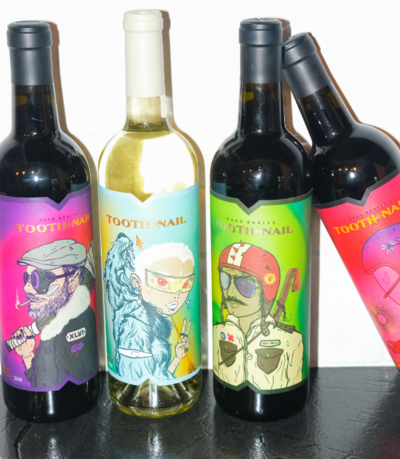
Tooth & Nail Wine Co. Paso Robles, Cabernet Sauvignon 2020 $26

This is an old review, but it is from the winery that ignited my interest in Paso Cabernets.This vintage was presented in a unique bottle that requires a detailed background explanation and an APP to download.  But the wine inside is first-rate and a wonderful example of Paso Cabernet. Saying it “reinvented the wine label,” the winery created an augmented reality label that with the app will sing to you. Literally sing, honest. From its deep purple color to its rich, ripe aromatics, this wine sings on its own. Initial aromas of chocolate and spice give way to ripe blackberry and oak spice. It is big-bodied with a smooth unctuous texture. The flavors remain focused on ripe black fruit with dusty oak tannin in the background. The finish is long with good acidity keeping it balanced throughout. The current vintage is 2022 and sells for $28. 

Quest Austin Hope Winemaker, Paso Robles Cabernet Franc 2023 $23

The “Quest”  label is the Hope family’s long-term  commitment to Paso Cabernet Franc, and prior vintages contained some % of Cab Sauvignon. This is the first vintage made entirely from Cab Franc. The majority of the fruit sourced for the 2023 Quest Cabernet Franc was from the Creston District, Future vintages will also incorporate fruit from the Highlands District and Adelaida District.  You don’t need a SOMM course to recognize this is Cab Franc. The aroma is a textbook combination of plums, dried herbs and tobacco leaf. Medium bodied and solid, it is lively with plum and licorice flavors. Some briary tannins give a little push to the finish. Sort of like a footballer’s “tush push.”  A red to enjoy with grilled meats and rich pastas. 90

J Lohr Wines Paso Robles Los Osos Merlot 2022  $15

This Merlot is hard to beat at this price. J.Lohr’s Merlot is planted in the relatively cool El Pomar District. Blended with a big splash of Malbec (10%) and a dash of Cabernet Franc (5%), this 2022 was aged for 12 months in American oak. In an approachable and lively style, it opens with an aroma of fresh plums and light spice. Medium bodied and balanced, it offers plum and cherry flavors in a smooth package. Not flashy, just easy to enjoy.

WHITES

Sans Liege Wines Central Coast Cotes du Coast 2023 $20

Based in Paso Robles, winemaker Curt Schalchlin is a noted Rhone wine specialist. But as evidenced by his artsy labels and unconventional wine descriptions, he does things differently. Sourcing from some of the best known vineyards in Santa Barbara and elsewhere, he assembled this blend of 36% Viognier, 32% Marsanne, 17% Clairette, 11% Roussanne, and 4% Grenache Blanc. All but the Grenache are barrel fermented by native yeasts and lees aged in French oak. But the wine is, surprisingly given its composition, a smooth, subtle and lively ready to drink white. It immediately gets your attention with fresh peach, lemon and honeysuckle aromas. Medium bodied, nicely textured and vibrant, it offers stone fruit flavors and has a long finish that is neither bitter nor acidic. Charming and fun to drink and nicely priced to boot.

92

Ancient Peaks Winery Paso Robles Santa Margarita Ranch Sauvignon Blanc 2023 $18 

Made from the coolest blocks within the family’s estate vineyard, this 2023 also benefited from the relatively cool growing season. It is pale straw in color and shows plenty of vibrant fruit such as melon and pear along with light ginger and flintiness. Medium bodied, it continues with flavors of melon and lemongrass. In the crisp but lengthy finish, I pick up subtle hints of ginger and  apple. Aged for 6 months in stainless, it makes a good case for unoaked Sauvignon Blanc and pairs well with a wide range of entrees. 91

One Stone Cellars Central Coast Rose of Pinot Noir 2024 $18

One Stone is a brand created by Ancient Peaks Winery in Paso to support mentoring programs for women venturing into the wine business. The label’s image projects moving mountains one stone at a time. From the estate vineyard in Paso and others in the Central Coast, this Rose is made 100% from Pinot Noir that was grown and harvested solely for Rose production. Aged 4 months in stainless steel, it is a big friendly wine that is all about fresh strawberry and juicy watermelon aromas and flavors. Smooth and round on the palate, it finishes with a touch of acidity to sustain its lively personality. 90

Wait, There’s More

The wines mentioned so far are good examples of the great deals from Paso Robles, but they are just a solid beginning. 

The Harvey & Harriet label, associated with Booker Vineyards, offers an attractive Red Blend from Paso and a White Blend from San Luis Obispo. Both are priced below $25.

Another wine to check out is named Big, Bold Red. It is a blend of 50% Merlot, 30% Cabernet Sauvignon, 20% Syrah. 

Highlands 41 is a new brand from the Riboli Family. Among the first to hit the market is its 2017 “Darkness,” Estate Reserve selling for $15.00  

So, that’s for now. Many of the reviews you see here are available at www.winereviewonline.com 

Go to the sight, and specify Paso Robles to see a lot more reviews of good value wines.

Marietta Cellars: Wines for Sharing

If you are shopping for excellent wines at reasonable prices, then forget about those made by celebrities, cult wines, and wines made by 100 point rockstar winemakers. Let them all be legends in their own minds, and seek out wines made by real people.

I recently rediscovered one of my favorite examples of a family owned winery making excellent, affordable wines. Here’s how the winemaker summarizes things:

“It feels right to make the best wine possible and to sell it at a fair price. Our instincts tell us that being honest, being consistent, working hard, and thinking outside the box is more important than anything else in business.” 

The California winery is Marietta Cellars, founded in 1978 by Chris Bilbro and now in the hands of Scot, his winemaker son. While the original winery in Sonoma County was a rented cow barn, they now own 300 acres in Mendocino and Sonoma. And  if you like old vine wines from Syrah and Grenache, well the Bilbros are your kind of people. They have some of the best vineyards farmed organically.

Since Day #1, Marietta Cellars produced affordable wines, starting with blended red wines based on Zinfandel. Their benchmark Old Vine Red was first made in 1982. “Affordable” and “blended” are not exactly popular search tags in today’s wine world. Then add that the production is not tiny and the wines are not allocated to a select few, and voila?  Marietta wines are available direct from the winery, online, and yes, even in wine shops.

Go to www. mariettacellars.com  You can also find 8 Marietta Cellars’ wines today at www.wine.com 

Here are my recent reviews on two of those wines:

Marietta Cellars California OVR Old Vine Rose 2023 $19

Here’s an absolutely lovely Rose to enjoy year round. The Bilbro family has long specialized in old vine wine, and Scot Bilbro has been the winemaker since 2012. Chris Bilbro, his dad, founded Marietta back in 1978. This 2023 Rose is made from 50% Syrah, 25% Grenache, and 25% Grenache Gris, with all of the fruit from the estate’s organically grown McDowell Valley vineyards established well over 100 years ago.  With its inviting coral-pink color and its lively peach and melon aroma, the wine charms you and seals the deal with its juicy peach and pomegranate flavors which come with  a hint of spice. Nicely textured, it remains lively on the palate and finishes on a crisp note. 93 points 

2021 Marietta Cellars “Christo,”  Estate Grown, North Coast  $20.00

“Christo” refers to the family nickname for Chris Bilbro, veteran Sonoma winemaker. A Rhone blend (68% Syrah, 20% Grenache, 18% Petite Sirah, & 4% Viognier), this is a powerful, full bodied red. Aged for 18 months in neutral oak, this blend offers a solid core of ripe fruit and is built on a solid foundation. The aroma is fantastic. It opens to reveal background notes of spice, ripe plums and earthy, forest floor. Some subtle floral hints of violets and lavender emerge with aeration. On the palate, black pepper pokes through in the intense, rich berry flavors. The lengthy finish has a pleasant touch of juicy blackberry fruit and light tannin.  Taken altogether, this wine has it all. It is a whole lot of wine for the money and should age well. 94 points

So why isn’t Marietta Cellars better known?

Well, I’ll let the Bilbros offer a reason: “We are hands-on and busy year-round.”

Savvy Wine Shoppers: Start Your Engines

Exciting online wine deals and steals are really happening.  They are not the typical, over-hyped discounted wines that have been offered over the last year or two.  It strikes me as a new beginning, a fresh start to Spring. 

The real deal door began to swing open around April 1st and by the day of the eclipse, it was no illusion, no April Fool’s prank.

 And the wines that signaled this change  were excellent, time-proven Cabernets, Pinot Noirs,  Chardonnays, a few imports and, well, many others. What was different was the appearance of so many authentic wines from real producers instead of made up private labels and brands. And often, new vintages, newly released wines, not leftovers.

Before getting to the reasons behind this development, let me lists those deals offered online  that caught my attention:

2021 Peju Cabernet Sauvignon, Napa Valley, regularly $70, offered at $26 

2021 Daou Reserve Cabernet Sauvignon, Paso Robles $65 to $39.99

2018 Whitehall Lane Estate Cabernet, Napa Valley $90 to $59

2020 Beringer Vineyards Knights Valley Reserve Cabernet Sauvignon $32 to $23.99

2019 Handley Cellars Anderson Valley Pinot Noir, $37 to $19.

2018 Ketcham Estate Pinot Noir, Russian River Valley $45 to $19.95

2022 Long Meadow Ranch Rose of Pinot Noir, Anderson Valley $32 to $12

2022 Caymus Vineyards, California Cabernet Sauvignon, $75 to $49

These are top names and the reason the last two are cited is to reinforce the fact that new vintages, not old stuff getting dusty in warehouses, are showing up as real deals! That’s a spanking brand new release from Caymus and I’ve not seen any Peju wine so deeply discounted until now. Clos du Val just released its new Cabernet Sauvignon vintage to an online retailer at 20%, not enough to make my list but good support for the trend.

Just now winespies.com announced a 30% off deal on an absolutely great California Chardonnay, one of the top 3-4 made and never ever discounted, until now. It is the 2021 Wayfarer ‘The Estate’ Fort Ross-Seaview Chardonnay 30% off. 

Then I’m seeing a few unknowns and  newbies to the Napa Cabernet scene resorting to the online discounters to help their launch. The garigiste.com site announced the sale of  Rockmere Estate Cabernet Sauvignon Napa Valley from 2018 for $59.71 a bottle, with the winery price being $95.

So why now, you ask? Well, it has to do with supply and demand. Over the last several months, business stories have focused on the global surplus of wine, and here at home, both Napa and Washington State wine folks are trying to deal with the present surplus of wine and the need to start removing vineyards in big numbers for future stability. Talk about pulling up vines let’s you know this is not a blip.

Meanwhile, retailers are staring at big inventories in their stores and warehouses. I’ve noticed much more exciting offerings from vivino.com so far in 2024. This online site works directly with retailer partners across the country. Sales are slow in brick & mortar places across the country.

Who’s to blame? Well, the easy way out is to point fingers (the middle one?) at the Gen Zers.

Apparently, recent surveys indicate a lack of interest in wine. That’s a demographic representing 18% of the population and it is more interested in energy boosting drinks. Is “Liquid Death” an energy drink? Just asking. 

The brains behind Drizly analyzed the alcohol beverage market and came up with this conclusion: “When it comes to trying new bev alc brands, Drizly’s 2023 Consumer Trend Report found that pricing was the top factor that influences Gen Z “

The  high price of wine is a big deal these days. Recent surveys show that the average bottle price of a Napa Valley Cabernet is $108. An article in The Wall Street Journal  surveyed restaurants and came up with the belief that $25 is the new restaurant normal for a glass of wine. And, yes, the prices for many consumer items are now high. But wine is non-essential, a choice, not on the same level of importance as eggs and fuel. 

Driving the prices of wine up and Gen Zers away is that wine is perceived as a luxury enjoyed by those who equate price with quality. Snobs! Yes, those who buy what others can’t afford and those who associate inexpensive wine as “cheap stuff.” And the big corporations have not helped by their push to create so-called “luxury brands.” 

But right now it is the online wine retailers, the flash sale types, that are driving the discount wine deals.  A report from the Silicon Valley Bank made this observation:

“Wholesalers are full up, as far as they can go,”  which is making them “more picky” in what they buy from wine producers. Wholesalers “are more afraid of being stuck with inventory that they may have to discount.” 

It concluded with a prediction that “flash sales and increased discounts” are likely in the offing in the near future.”

5 Real Deal Dealers

That future is now. Flash sales, meaning limited time offerings are leading the way. For those  interested in checking out the best wine deals offered online, here are my top 5 best sites for non-snobbery, savvy shopping wine drinkers:

www.reversewinesnob.com  This site was finding super wines at great prices before the glut, and so far in 2024 has earned my top spot for its selection of wines from California and the Northwest. It works directly with small, family owned wineries. Begin here.

www.winespies.com  Off to a great month of April with exceptional finds such as the 2020 Caymus California Cabernet and the Wayfarer Chardonnay. Also, super price for a Flying Goat Pinot Noir. Special deals on Lake County Cabernets are frequent.

www.lastbottleswines.com

 Still the best flash sale site, and is keeping up by finding wines never offered before the glut. A great offer for Handley Cellars 2019 Pinot Noir at $19. It also has marathon wine sales, and recently offered dozens of wines as “under $26 deals and steals.”    

www.vivino.com 

These are the people who have a huge database and encourage subscribers to offer reviews, But its main strength is its partnerships with retailers around the country. Here I found the 2020 Beringer Knights Valley Cabernet at 30% off. The new 2022 Caymus “California” Cabernet was first offered by vivino.

http://www.wtso.com

WTSO was one of the first, if not the first site for flash sales. It offers many wines, but I found it is a great resource for imports, especially Spanish and Italian wines. Here are three examples of excellent deals:

2021 Resalte Ribera del Duero Vendimia Seleccionada for $19.99 (50%)

2018 Famiglia Castellani Chianti Classico Riserva  DOCG $14.99

2019 Luca Bosio Barolo  $24.99

Going Rogue, Part 2: The People Behind the Label

Why would any normal person start a winery these days? Well, let’s go rogue and find out.

Oregon just nudged ahead of Washington State and is now home to over 1,000 wineries, second only to California. The last I heard California  had over 4000 wineries. New wineries are opening up each week and the Rogue Valley is attracting more than its fair share of newbies.

But why now?

The oft quoted reason is “the pursuit of a dream and the lifestyle.”  That was voiced during the boom decades of the 70s and 80s in California and still reverberates in this decade along the entire West Coast.  

Who are these wine dreamers? In the US, unlike in traditional wine countries, most winery start-up founders are career changers (doctors, lawyers, high-tech) but a few are from a farming background and a few are out and out science nerds. Yes, there are wineries started by celebrities of some kind with too much money and too big of an ego. And then there’s the epiphany story. 

When you peek behind the label to see who the owners are among the rising stars, you once again encounter the Rogue Valley’s diversity. 

Goldback Wines: Watch out for Lightning

Speaking of an epiphany, Goldback is a good place to start our second tour of the Rogue Valley. Named after a fern indigenous to Southern Oregon, this authentic, small lot artisan winery was launched in 2016 by winemaker/owner Andy Meyer. He caught the wine bug as a college student looking for a summer job.  “I answered a craigslist ad for a tasting room job for the summer, which just happened to be for Cristom Vineyards.  Within 15 minutes of driving up the driveway for the interview, a lightning bolt struck. I knew that working in wine was what I wanted to do for the rest of my life.”

 After the lightning strike his resume expanded to include working harvests at William Selyem and Hirsch Vineyards in Sonoma, Felton Road in New Zealand, Mark Ryan in Washington, and Cape Mentelle in South Africa. From these experiences as well as his time as a restaurant wine director, he favors a minimalist approach to winemaking and aims to preserve natural acidity in whites and tannin integration in his reds. 

As for his own wines, the red Cuvee is the winery’s version of a Cotes du Rhone, drink now red. A blend of  58% Syrah and 42% Grenache, it offers plenty of bright raspberry fruit in its aroma and has a pleasing soft entry to deliver berry and cherry flavors.

Goldback’s Syrah is a blockbuster that showcases Syrah’s full throttle concentration and purity and is all about the grape and the site.  In recent vintages, Meyer sought out the nearby Meadowlark Vineyard with its granite soils and sustainable farming. But the site is also very windy which forces the vines to shut down frequently and contribute to a long growing season. Similar, says Meyer, to the effect of the Mistral in the Rhone. The resulting wine is dark purple and loaded with ripe plum and a floral, wild thyme character. Medium full, it is concentrated with dense, ripe black fruit flavors and some black pepper. Plush and seamless, it will benefit from a couple of years of bottle aging. But could age for a decade or more. 

From the oldest block of Grenache from the neighboring Jaxon Vineyard,Goldback’s  Grenache is a selection of the winemaker’s favorites. Those selected stood out for being “Pinot Noir-ish”and the wine is indeed not your typical Grenache. A long cold soak and a 22 day fermentation with some whole clusters, the wine was aged 18 months in neutral French oak. The nose offers up loads of vibrant, cherry, strawberry fruit that carry over into the smooth flavors. There’s a touch of earthiness in the nicely textured finish. In 2020, Goldback continued experimenting and bottled one barrel of Grenache that was 100% whole cluster, carbonic maceration.

Did I mention the remarkable Chenin Blanc? 

www.goldbackwines.com

Is There a Doctor in the Winery?

A beautiful hillside vineyard overlooking the Rogue Valley in Southern Oregon was planted by Dr. Peter William Adesman. Along with being a full-time practicing physician, he has been an avid wine collector and educator since the 1970s, and long dreamed of producing his own wines. He notes: ”In 2007, my wife, Dr. Robin Miller, and I moved to a property in the Rogue Valley where we could plant a 10-acre vineyard. That is how Peter William Vineyard was born. Our first commercial vintage was 2016.”

Peter, only call him “Doctor” if you are his patient, is dynamic, enthusiastic and has an encyclopedic wine knowledge based on tasting and traveling. For his winery,  Syrah is offered in several styles. Of the 4 Syrahs made by this winery in 2018, one labeled Candives is 100% Syrah made from the estate vineyard and aged entirely in French oak, 50% new. To distinguish it from the others, the winery went with the “Candives” name, said to be an alternate name for Syrah used in the tiny village of Chavanay in the Northern Rhone Valley. As fine as the other 2018s are, this is so dark, dense, and dramatic that the special name is certainly merited. Ultra smooth and seamless, it is beautiful now but will also bring rewards with cellaring. 94 points.

Another small batch Peter William Syrah is made from estate grown grapes which are vinified by winemaker Eric Weisinger who is the “W” referenced on the label. The end result is a compact, powerful expression of Syrah that may be one of the best values around these days. It is pure ripe Syrah beginning with its dark color and earthy, leathery, black pepper aromatics. 

Then there’s an exciting blend  from Peter William aptly named “Extravagance.” It may be going on elsewhere, but Southern Oregon sure seems to be a hotbed of creative winemaking energy leading to fascinating blends and unusual wines.  A 50-50 blend of Tempranillo and Syrah, Extravagance is aged for 21 months in French oak and bottled unfined and unfiltered. This intriguing blend turns out to be delicious red wine with both depth and charm. It comes across as ripe, plush Syrah built on a Tempranillo framework.

Check out the club possibilities at

www.peterwilliamvineyard.com

Padigan

3rd Generation Grower/Farmer

In 2023, the 2-Hawk Winery was rebranded Padigan, the name taken from a soil type. This 24 acre vineyard is owned by Ross Allen, a third generation farmer from the San Joaquin Valley. 

Both before and after the name change, Malbec was a major success along with the winery’s Syrah and Viognier. With the release of its 2019 wines, the winery began hitting full stride. 2019 was an exceptionally long, coolish growing season, and  the winery’s estate grown Malbec was not harvested until mid to late October.  The juice was wild yeast fermented, blended with 10% Cabernet Sauvignon and aged for 28 months in oak. 21% new, 61% neutral. Intensely dark, this Malbec is concentrated and needs some aeration to strut its stuff  Overall, an exciting, multi-layered Malbec.

Then there’s Padigan’s Viognier. It takes a grower who knows every vine on the estate to know the best time to harvest Viognier. Ross works closely with winemaker Kiley Evans who explains:

“The trick with Viognier is getting it ripe beyond the bitter almond finish that can be a nuisance in the wine, but not so ripe that it is overly alcoholic/hot and I’ve seen that progression happen in as little as 2-3 days.”

Padigan’s 2021 is a lovely expression of Viognier. Big and round on the palate, it remains lively with good citrus fruit along with crunchy melon flavors. The texture is heavenly and the wine brings it home with a long lasting finish with a subtle zing to it. This could serve as a benchmark Viognier that’s neither over the top in ripeness and alcohol nor one that relies on oak. Native yeast fermented, It was aged sur lies for 11 months in 35% new French oak and later rested on  the lees in stainless for 6 months. It seems likely to become even more complex with aging for 3 to 5 years

http://www.padigan.com 

Dancin Vineyards: Viticulture Students

DAN and CINdy Marka met while studying viticulture at UC Davis. To them, wine is all about sites, clones, soils and aspect. Both must have been super students because their vineyard is beautiful and impeccably maintained. 

Dancin is also one of a handful of Rogue Valley wineries making a Pinot Noir, but Dan Marka explains,

“ Our site was created for Pinot Noir and Chardonnay with its north, northeast facing aspect, 1800 foot average elevation and shade occurring beginning at 5:45pm (depending on the Block) throughout the growing season. We are finding that we can produce delicious Pinot Noir with great flavors and balance at alcohol levels in the mid to upper 12’s to the very low 13’s. Our wide diurnal swings allow for flavors and ripeness to occur during the day with acids retained during the overnight hours. We can see daytime highs to overnight lows vary by 40 degrees!” 

And he adds that the same Pinot Noir clones ripen later at his site than they do in McMinnville or Dundee.

As a specialist, Dancin is an exception where it is more common to grow a dozen or more varieties within an estate. But, digging a little deeper, you discover the winery’s roster offers lots of exciting choices.  Dancin makes 4 distinct Chardonnays, 4 Pinots from different blocks or different clones. It also makes Syrah, Sangiovese and Barbera. If you enjoy Barbera, Dancin’s won’t disappoint.

www.dancin.com

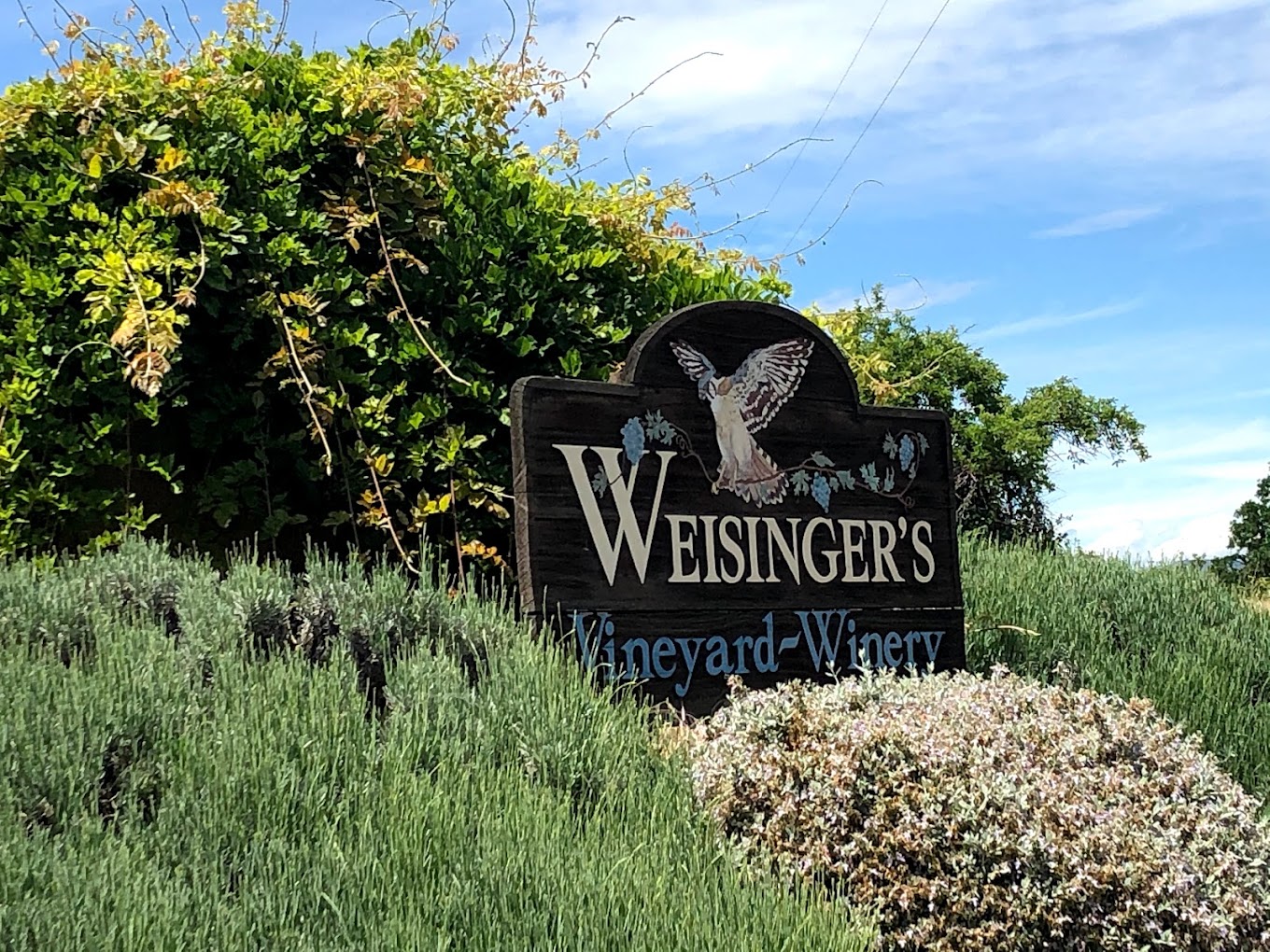
Weisinger Family Winery: 2nd generation wine grower

Tempranillo Estate, Rogue Valley

The Weisinger Family, on the eastern edge in Ashland is said to specialize in Tempranillo along with, Rhone and Bordeaux varietals.. Quite diverse for a 3,000 case annual output.

Acreage planted to Tempranillo has steadily increased in Southern Oregon over the last decade. Located just outside of Ashland, Weisinger was founded in 1988, making it one of the oldest in Southern Oregon. After assuming the winemaker’s role, Eric Weisinger began grafting over the original Gewurztraminer vines to Tempranillo. Adjacent to the winery, the Tempranillo occupies a steep, high elevation (2235 feet) northeast facing site. The Weisinger Family, on the eastern edge in Ashland is said to specialize in Tempranillo, Pinot Noir, Rhone and Bordeaux varietals, as well as proprietary blends. Quite diverse for a 3,000 case annual output.

My first experience with Weisinger was with the wines from 2018. 2018 was an ideal long, slow growing season with the Tempranillo picked in the first week of October. After being cold soaked and fermented for 20 days by native yeasts, the wine was barrel aged for 17 months in 30% new American oak. It offers lovely bright cherry fruit with hints of black tea and spice in a solid, medium weight package. The black cherry and spice theme continues in the deep flavors with subtle oak toast and firm, integrated tannins coming into play.  Beautifully structured and focused throughout, it should drink well over the next 5-7  years. Not surprisingly,  Weisinger’s Tempranillos have won many awards. I’ve scored them 93 and 94 in two recent vintages.

Weisinger Family Winery Roussanne, Fortmiller Vineyard, Rogue Valley, Oregon, 2019 

Normally part of a Rhone blend, Roussanne as a stand alone varietal is one that seems to challenge winemakers. After experimenting earlier with Roussanne, in 2018 Weisinger resumed its efforts after discovering the north-facing Fortmiller Vineyard in 2018. In 2019, Weisinger harvested the Roussanne at a low 22.4 Brix to preserve acidity and after whole cluster pressing the winery barrel fermented the wine using native and commercial yeasts. The lees were stirred throughout the long fermentation. The result is a wine that showcases floral and lemony aromas, and the flavors are bright with citrus and honeysuckle notes. The leesy texture adds complexity and length to this delicate, lively and pretty wine.

http://www.weisingers.com

Belle Fiore Winery: Scientists

Belle Fiore is the closest thing to a Napa-ish winery with its rather elaborate tasting room and chateau-like facility. It has a busy restaurant and is even a mini art gallery. But it is also serious about its wines made from its 31 acre estate vineyard surrounding the winery. The roster consists of the usual varieties  such as Merlot and Syrah but then you get to the “others,” especially the Italians. Here you’ll find a Montepulciano (my fav), a Barbera, Teroldego, Fiano,  and a rare Caprettone grape.  These are all possible because the owners have identified what they call “16 micro-blocks” based upon soil types and elevation.  Owner Edward Kerwin is a clinical research scientist and his wife Karen has an M.A in genetic counseling. Together they launched Belle Fiore in 2007. 

Long Walk Vineyard: A Dream Retreat from Silicon Valley

Located in the hills above Ashland, Long Walk is a newly developed vineyard and historic 35 acre orchard owned by Kathy and Tom O’Leary, Silicon Valley techies. After a prolonged search, they settled on this cool, south facing site to pursue their dream to make Rhone inspired wines. The 11-acre vineyard is planted primarily to Rhone varieties.  But they also like Zinfandel so there’s a smattering of Zin. “Field Notes” is  their version of a GSM Rhone blend. Made from 40% Grenache, 30% Mourvedre, 10% Syrah and a splash of Carignane, it is medium dark in color and unfolds quickly in the glass. The nose starts out with pretty plum fruit along with a hint of leather and game but the bright black fruit character prevails. The flavors add some herbs and cherry and are presented in a round body with gentle, dusty tannins poking through. Pleasantly subtle and charming overall, it is one to enjoy over the next several years. Kudos for the light touch. 

With Rose wines being so trendy and Roses now being made from just about every red grape available,  it was an eye opener to encounter Long Walk’s rose from a red grape that’s ideal for a Rose: Cinsault. Popular in Southern France, Cinsault is light in color and low in tannin and  remains the backbone for many Provence Roses. From vines planted in 2002, this winery’s Rose is an attractive pink-copper color and offers an aromatic mix of  just picked strawberries, rose petals and summer flowers.  Medium bodied and vibrant, it is balanced and has just enough acidity to bring it to a delicate finish. 

As for the Long Walk Zinfandel, it too is impressive. 

www.longwalkvineyard.com

Talent Cellars “Nuf Said Red” 

This new family run winery is based in the small town of Talent, near Medford. The label is a replica used by the family when the land was a pear orchard. Winemaker Matt Newbry and his wife Janéa, attribute the Inspiration Behind Talent Cellars to the very soil their family has been farming In Talent, Oregon since the 1920’s.

Sourced from two nearby vineyards, the 2017 Nuf Said is a blend of 75% Cabernet Sauvignon with 13% Petit Verdot and 12% Grenache. It was aged 22 months in French and American oak (50% new). It is medium bodied and vibrant with bright berry fruit and graphite and cedar in the aroma, yet it sweeps across the palate with juicy, ripe fruit and a hint of vanilla from the oak.  Beautifully balanced, it finishes with light, ultra smooth tannins. Production was 250 cases.

And with that, I too say “nuf said.”

Exploring Guadalupe ValleyWines

5 Takeaways from Guadalupe Valley 

Throughout 2023, numerous stories appeared in national media outlets announcing Mexico’s Guadalupe Valley as “the next Napa Valley.” Or Guadalupe as “Mexico’s Napa Valley.”

In one of those annual reader survey pieces, it finished a close second to Walla Walla. 

Travel articles with a romantic getaway theme or wine country destination focus were common.  A google search for Guadalupe Valley wines will show dozens of travel suggestions, tours tips, tour packages, tour guides and itineraries featuring wineries and culinary recommendations. 

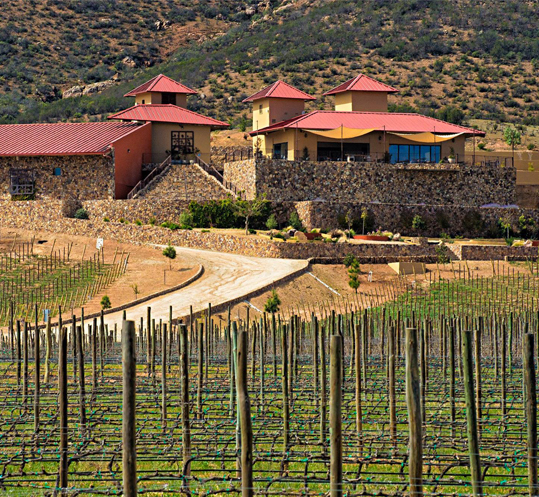
 Located about 60 miles south of the US border, or just over an hour’s drive from San Diego, Guadalupe’s wine route has come alive with new wineries, new resorts, boutique hotels, and trendy restaurants. Wine-related income in Guadalupe Valley hovers around $200 million a year.

No longer flying under the radar, Guadalupe Valley secured international recognition in late 2022 by hosting the 43rd annual World congress of vines. Many of its wines win awards and medals in various annual wine competitions. With only 25 wineries existing before 2005, Guadalupe is now home to 150+ wineries, 100 restaurants, 92 hotels and boutiques, and 12 taco stands. A few sources now say there are over 180 wineries. 

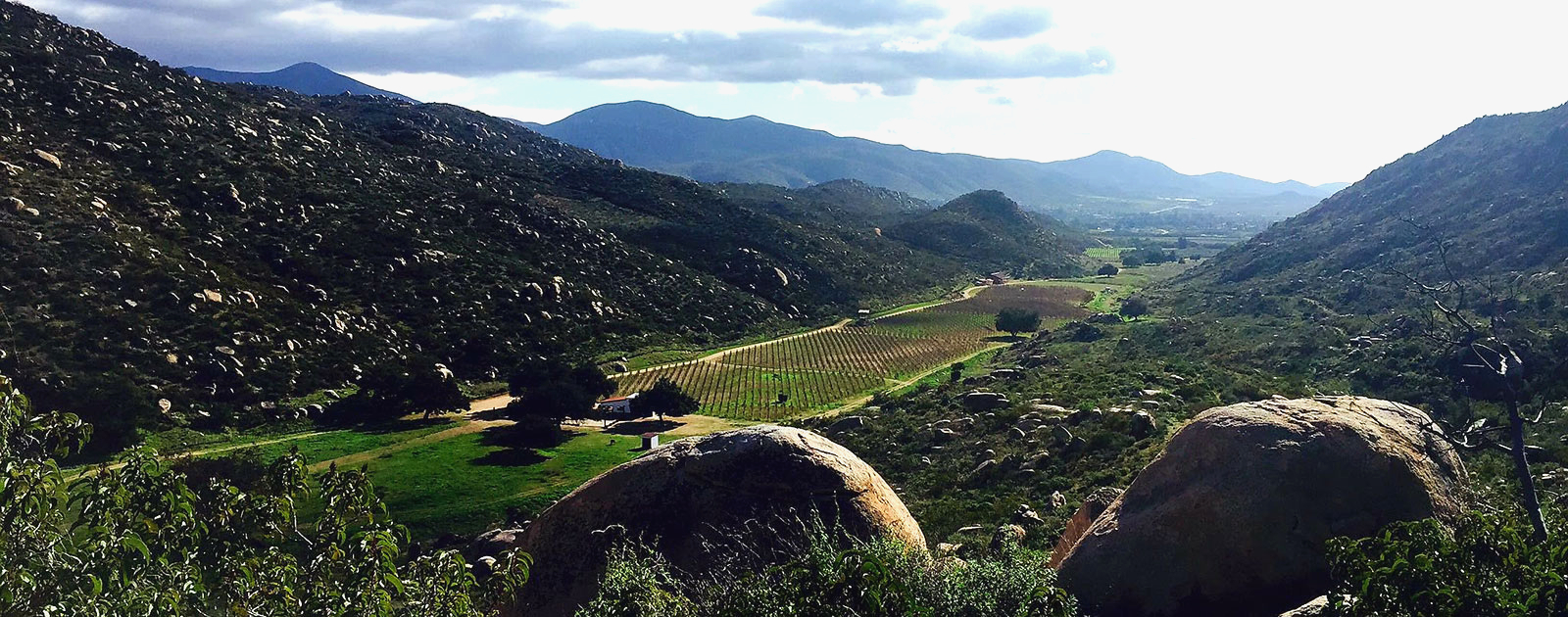
Regarding viticulture, Guadalupe Valley is a real anomaly. Standard logic in all textbooks maintains that wine grapes should only be grown within the 30 to 50 latitude. Guadalupe is located at the 21-22 degree latitude and there are over 10,000 acres planted to a wide range of vinifera varieties. 

Defying logic, the mantra in Guadalupe is that it is all about altitude, not latitude. Located at elevations from 500 to 2000 feet above sea level, most vineyards benefit from cooling breezes from the Pacific on one side and the Sea of Cortez on the other. With wide diurnal swings during the summertime, the climate is basically Mediterranean. Or “best described as Mediterranean” as one winemaker explained because being dry and desert-like, it doesn’t fit into any neat category. 

So after postponing a planned visit due to covid, I finally visited this much talked about wine valley in Northern Baja. Research before the visit entailed reading many of the feature stories and, of course, tasting as many Guadalupe wines that were available during my stay in Cabo San Lucas.

My vinous version of the Baja 1000 began by departing the totally screwed up city of Tijuana in a crappy rental car that barely made it out of town. Later in the day we were welcomed to Guadalupe by rain that challenged the car’s wipers. That’s right, rain in Guadalupe Valley is about as common as rain in the Sahara.

That rain was a great omen or set up for a series of unexpected experiences that followed when visiting wineries, tasting wines, and getting a feel for this most unusual wine region. The rain made the sandy roads to the wineries even more challenging to navigate with deep potholes filled with water along with rocks and a few chickens. But holding on tight to the wheel we visited the region. What follows are takeaways from five wineries that capture the uniqueness of Guadalupe as not only an emerging wine destination but also an exciting wine producing region.  

“This can’t be Nebbiolo,” I tactfully mentioned to the Vinedos Malagon hostess. It was deep garnet, concentrated, with ripe flavors and some tannin. She brought over the bottle and yes it was Nebbiolo. I shouldn’t have been so surprised since the previous wine was Malagon’s Grenache, also unusually rich. She explains that the winery has access to Grenache planted by Russian immigrants in the 1940s. That’s right, the vines are at least 70 years old. And as for Nebbiolo, it was said to be brought into Guadalupe long ago but identity tags were never found to verify its DNA. Well, that was my first visit.

#1 Takeaway: Prepare for Guadalupe wines that aren’t typical and for wines made from odd, old varieties, old vines.

Malagon was founded in 1997 when only a dozen wineries were operating in Guadalupe and very few wine varieties besides Grenache and Nebbiolo were planted. Pedro Domecq opened a winery in 1972 but like many of the distillers who arrived earlier, it favored Palomino and Colombard in the early years. Also in the 1970s Jim Concannon and others from California visited and introduced then popular varieties such as Chenin Blanc, Petite Sirah, Zinfandel, Barbera, Cabernet, Carignane, and the once popular Ruby Cabernet. The latter variety is a key component in Domecq’s XA red and Petite Sirah is one of Cetto’s most popular and attractive wines. 

Today the Valley’s wineries reflect a balance of an international cast of characters and local families. Those established varieties attracted foreign investors such as the Henri Lurton Medoc family. It seems telling that Bodegas Henri Lurton’s flagship wines from Guadalupe are Nebbiolo and Chenin Blanc. 

Next stop was Casa Magoni whose wines I had enjoyed prior to the visit. In the new tasting room, white wines were first offered and they were not the typical blends. Magoni poured a Chardonnay and Fiano blend named “Manaz.” Also, another white brings together Chardonnay and Vermentino which is just as impressive. Among the reds, the Sangiovese-Cabernet is excellent, but the most unusual tasted was labeled Origen 43 which combines Montepulciano, Aglianico, Canaiolo, Sangiovese and Cabernet Sauvignon. All those varieties were established 16 years ago. But, of course, Magoni makes a Nebbiolo which is excellent.

Turns out that Camillo Magoni, who studied Enology and Viticulture degree from the Enologica a Di Alba in Piedmont, Italy was invited by the Cetto winery to work in the cellars. After 40 years he left to establish Casa Magoni where he introduced many Italian varieties as well as others from France. Today with more than 100 different grape varieties on 278 hectares, this is the largest experimental vineyard in Guadalupe and all of Mexico. 

#2 Takeaway

Today with over 100 wine varieties being grown, some of Guadalupe’s finest wines are rare combinations and unique blends. There’s the Red from SantoTomas that is made from 34% Mission, 33% Tempranillo, and 33% Carignan. I love Emerve’s “Isabella” which brings together Chardonnay, Sauvignon Blanc and Viognier in a bright, full bodied style. El Cielo’s 2020 Blanc de Blancs consists of Sauvignon Blanc and Chenin Blanc with a good dose of Palomino and Chardonnay. 

So be prepared to encounter wines with fanciful proprietary names derived from the planets, the stars, children, family pets, nicknames, whatever. 

Moving on, I finally visited a new winery unknown to me but one I drove by several times: Emerve.

Many of the new wineries are locally owned and started by home winemakers or by cellar workers moving on after apprenticing at one of the big wineries. That door opened In 2004-2005 when Hugo D’Acosta who studied at Montpellier, France, and the Agrarian University of Turin, Italy, organized La Escuelita, a school teaching local farmers and families the fundamentals of winemaking and cellar procedures. The school also functions today as a cooperative, providing the necessary equipment to growers and future winemakers to make wine. 

Today, Emerve, which was one of those wineries,  draws from 18 ha and produces around 5,000 cases a year. In addition to a lovely Rose of Cabernet, Emerve is best known for its proprietary blends. “Isabella” brings together Chardonnay, Sauvignon Blanc and Viognier mentioned earlier. There’s a red Bordeaux named “Los Nietos” and another red blend, “Armonia de Tintos,” a blend of Merlot, Cabernet, Syrah and Cabernet Franc. That cuvee was aged for 8 months in a combination of French and Hungarian oak.  It is much more than a simple red. And just for a little variation there’s a 100% Shiraz that’s bottle aged for 5 years before its release.

#3 Takeaway

While the top 3 wineries of Cetto, Santo Thomas, and Bodegas Pedro Domecq produce 80% of wines from Guadalupe Valley, there are 100 or more small family owned businesses offering a wide variety of high quality wines. And the wines are often unique.

Next up in my learning journey, Casta de Vinos

Whether it was sheer luck or fate, my visit to Casta was truly eye opening. Opened in 2010, Casta is an authentic mom & Pop family winery with Sergio Castañeda as owner/winemaker and Claudia, his wife, as director. With an annual output of 4,500 cases, Casta makes 12 wines, 10 red. The 2018 “Domina,” a 100% Merlot exudes charm in an elegant style, and the 2019 “Cirio,” a Cabernet Sauvignon and Mourvedre blend is big with multi- layered flavors. “Casta Tinta, “ a Bordeaux blend, could easily be mistaken for a young Medoc. Another amazing accomplishment, the 2020 Syrah is heavenly and stylishly refined for a young Syrah. I also liked the Petit Verdot. Clearly, the winemaking is top notch and shows a subtle use of small oak and tannin management that makes this one a genuine superstar.

#4 Takeaway

Not only are there many new wineries, Guadalupe is a paradise for anyone who loves to explore and discover previously unknown wineries. Or one that opened the week earlier.

Tuscany also has a strong foothold here thanks to the Paoloni family.  Born in Tuscany, Paolo Paoloni left his post as an Enologist at the Perugia University to manage the Valle Redondo wine company in Aguascalientes, Mexico. After several years with Valle Redondo, Paoloni purchased 38 hectares in the Toros Pintos section of the Valle de Guadalupe. 

If anyone doubts the uniqueness of Guadalupe, well the wines that were presented at the Paoloni/Villa Montefiori winery will erase all doubts.  First came the dramatic 2020 “Ross del Valle” made from 100% Montepulciano with amazing concentration. It is the first mono-Montepulciano from Mexico. Even more exciting was the 2019 Nebbiolo, a dark colored, deeply flavored version, aged for 15 months in French oak. Then the house speciality is Nero d’Avola, and the 2018 aged 12 months in oak is stunning for its depth and layers of flavors.

#5 Takeaway

Located on a steep hillside, Paoloni’s vineyards look beautifully maintained, indicating that grape growing here is as good as anywhere. Overall, the yields work out to be slim by Napa’s standards, estimated as between 1.2 to 2 tons per acre. With little water available, irrigation is not excessive with many vines being dry farmed.

 I heard during my visit  and have also read that farming practices are moving toward sustainability and organic methods.  Carrodilla is said to be the first certified organic and biodynamic vineyard in Mexico. More recently, Santos Brujos which makes a lovely Tempranillo has earned its stars as a certified biodynamic vineyard. 

So, I’ll stop here after noting that despite what you may be thinking, Guadalupe Valley wines are showing up in more and more US markets. That was reinforced a few weeks ago when looking over the shelves of Desert Wine, a small retailer in Palm Desert, there were several Paoloni wines and a few others.  

Thankfully, in 2024 you might not have to travel along those bad dirt roads to explore Guadalupe Valley wines. Check out  the list of wineries available and which states they are sold in at La Competencia Imports in Napa, Same goes for Tozi Imports on the East Coast, Nossa Imports in Arizona and Beso imports in Washington. LMA imports in San Diego specializes in wholesale to restaurants. 

And one more thing about those rough, unpaved roads: don’t expect any improvements soon. Arguing that bad roads attract good tourists and good roads will appeal to the loud, rude, sloppy wine drinkers who will ruin the character of the Valley, a powerful resistance group has been organized to control growth.

In other words, they don’t want Guadalupe to become the “next Napa Valley,”

Exploring the Rhones Less Traveled

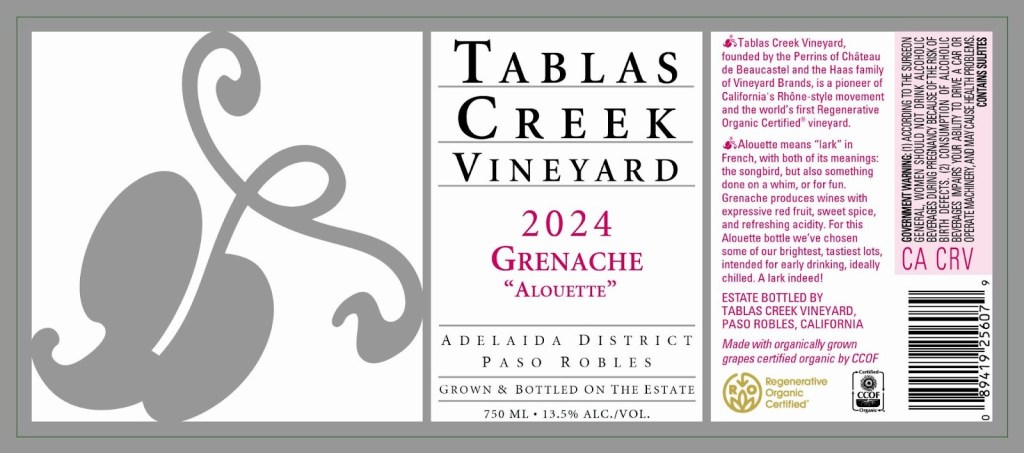
Having long been intrigued by Rhone wines, I regularly check out theTablas Creek Vineyards blog. A recent post mentioning the availability of Terret Noir and Bourboulenc stopped me in my tracks. Of all the varieties permitted to grow in Chateauneuf-du-Pape these two were total mysteries to me.

Never one to pass up an opportunity to try a new wine and maybe learn something along the way, I reached out to Jason Hass.  As always, he was helpful and informative and kindly made it possible for me to taste these two new Tablas Creek wines. 

 In wildly different ways, both the Bourboulenc and the Terret Noir were exciting new experiences. That set me off on a mission to explore other lesser known Rhone varieties, those usually dismissed or ignored as blenders, to see what they might offer as varietal wines.

But first, here are my notes on those two amazing wines that had me saddling up for this journey:

Tablas Creek Vineyard Adelaida Hills District Paso Robles Bourboulenc 2022 $40

From 2/3rd of an acre, this is the winery’s 4th Bourboulenc and it is wonderfully unusual. Medium straw in color, it offers an intriguing aromatic mix of orange rind, apricot and lychee nut. Surprisingly rich and round on the palate, it combines orange and citrus flavors with a hint of stone fruit. The texture is rich, and then it finishes with a rush of lemony flavors and bright acidity. All of this is to be enjoyed in a refreshing wine with only 12% alcohol. To summarize: lovely aromas, terrific texture, mouthwatering flavors and youthful acidity holding it together. A great food wine. What’s not to like?  94

Tablas Creek Vineyard Adelaida Hills District Paso Robles Terret Noir 2021 $40

Originally from the Languedoc, Terret Noir has seldom been made on its own, most often blended with Grenache or its fellow family members,Terret Gris and Terret Blanche. Tablas Creek bottled 70 cases in 2021 and offers it at the winery.  Once poured, it has an unusual light red color that sets it apart from most red wines. The aroma is also strikingly unusual, neither berry-ish nor overtly fruity, it offers a pretty floral nose of roses and orange blossom. While light medium bodied at best, it delivers refreshing flavors reminiscent of red currants that are sustained and persistent. Gentle, fresh and lively in the finish, it is all together pleasant and refreshing. It is a fun party or aperitif style red. Fun is good, right? 92

My takeaway after trying these two unusual wines was a suspicion that there probably are other lesser-known Rhone blending varieties that might be worthwhile looking into. And sure enough, by continuing along the Rhone road less traveled, I encountered four other Rhone varieties that also have much to offer as stand alone wines and, best of all, these four are being made by several key California winemakers, a few original Rhone Rangers and some new, younger folks dedicated to Rhone wines.

The four wines are two whites, Marsanne and Roussanne and two reds, Cinsaut and Counoise. Grenache Gris was on my list, but not many are available. Picpoul wines are enjoying a well-deserved surge, but are not as unusual as are Roussanne and Marsanne.

 Marsanne is hardly a newcomer since Bob Lindquist who founded Qupe, made California’s first back in 1987. But it is still usually downplayed as part of a blend with Viognier or Roussanne. And while there are many attractive blends now coming from Australia and Santa Barbera, on its own, Marsanne is still not that common. 

And from what I’ve experienced at this early stage, I can only wonder why. Marsanne is, afterall, the white grape of Hermitage fame. The 2022 Marsanne from Starfield Vineyards in El Dorado is a fantastic, complex and stunning version and it was a great wine to begin the journey. 

Starfield Vineyards El Dorado Marsanne 2022 $34

Aged for 6 months in neutral French oak, this Marsanne is attractive now but has all it needs to age long and well. On the nose it comes across with ripe peach and nectarine fruitiness with citrus as well. Then on the palate which is plush and round, it has vibrant flavors of orange rind

and cloves with minerality as well. Solid and well-integrated, it continues the ripe peach, apricot theme in its lengthy finish. Overall, it is concentrated but so lively it invites a second glass. 165 cases made. 94

After that re-introduction to Marsanne, I reached out to Bob Lindquist who sold Qupe in 2018 but has never stopped making Marsanne. As he explains,”Marsanne and Roussanne are near and dear to me, and I continue to make both of them under my Lindquist Family label.”  He adds, “In 1986 I got Marsanne budwood from Randall Grahm and grafted over some own-rooted Cabernet vines at a small vineyard just outside of Los Olivos called the Ibarra-Young Vineyard.”

Marsanne ages well, Lindquist noted, and his vintages from the early 90s are still showing well he added. As for style, he explains:” I make Marsanne in a lighter, fresher style, all in neutral barrels and bottled after about 8-9 months.”

“Lighter” it may be, but his current release is most attractive:

Lindquist Family Vineyard Edna Valley, Sawyer Lindquist Vineyard Marsanne 2020 $38

All of the fruit is grown in this the Demeter certified biodynamic vineyard.  Yellow with green tint, this wine is medium bodied with lots of youthful character. Aromatically, it combines nectarine and white peach fruit along with some almond and lemony accents. Smooth and refreshing on the palate, it has good acidity for a balanced impression and concludes with lively fruit and a crisp finish. 92

At the end of our conversation, Lindquist added this zinger:”I think Roussanne makes the more important and complex wine…I make mine very much in the same style as Chardonnay.”  

 It turns out Roussanne is a favorite of many other winemakers. Bill Easton of Terre Rouge who makes exquisite Syrah and Viognier chimes in with this: “Roussanne is the most serious white Rhône grape. It reaches its apex with age – slow oxidation.. But it is not easy to grow.” The team at Truchard in Napa simply say “it is a challenge.” And then John Alban the unchallenged champion of Viognier adds this: “There are legions of whites that one can make for all kinds of commercial reasons, even if the resulting wines are less than compelling, but Roussanne is for people you love.”

After tasting the latest from Terre Rouge and Lindquist, I can understand the appeal. Easton offers a perfect summary of what a newcomer will encounter:  “American palates are not accustomed to classic Roussanne characteristics: Straw golden color; with exquisite quince, honey-nut, and beeswax aromas.”  To that I’d add exotic pineapple fragrances, rich viscosity, and depth unique among white wines. It is definitely a white on steroids. The Terre Rouge Roussanne is given several extra years of bottle aging before being released to the market.

The name “Roussanne” relates to the French word for russet which explains the wine’s dark color. In the early phase of the Rhone Ranger period, what was thought to be Roussanne turned out to be Viognier. The true Roussanne was eventually introduced by Tablas Creek, so most of the current plantings began in the late 1990s. 

There’s one major exception: Terre Rouge. Its Roussanne clone is unique, originating from a Chave family parcel on the hill at Hermitage. It is the real deal and you can get a good feel for what Roussanne is capable of if you are fortunate, as I was, to taste the 2011 Terre Rouge and the 2021 Lindquist Family. See the tasting notes at the end. 

Cinsaut is another Rhone that was misidentified and that’s one likely reason why it was long overlooked. It turns out that in Lodi the Bechthold Vineyard which was planted in 1886 is actually the oldest Cinsaut vineyard in the world. Until 2003 when UC Davis proved by DNA testing that it was Cinsaut, the grape was believed to be Black Malvoisie. And it was sold to home winemakers.

Often spelled Cinsault, the grape is used these days to produce Roses or in blends. It is well-represented in South Africa likely due to its parenting role in Pinotage. It was not planted at Tablas Creek until  2017, and for now the winery suggests “it will be a useful blending partner to higher-alcohol, more tannic red grapes, and it makes for delicious lighter reds on its own.”  

Thanks to Holly’s Hill Vineyard in El Dorado, my most recent encounter with a varietal Cinsaut is highly memorable and is a delicious red. Here is my note:

Holly’s Hill Vineyard El Dorado Cinsaut 2020

Based on its color and the initial sniff, my instinct says this could be a Cotes du Rhone Villages. A real good one. But then after the initial taste, it comes across with subtle, but charming flavors that don’t match anything in my experience. Though Cinsaut is classified as a lightweight, this is no such thing. Its bright, fresh cranberry aroma mingles with spices and black tea, and the flavors are full of fresh picked dark cherries and an earthy, leathery back note.  Balanced, with light tannin it finishes on a slightly tart note along with lingering berries. Lovely! 93

Starfield Vineyards, also based in the Sierra Foothills, impressed me earlier with its 2019 Cinsaut. It turns out one of Randall Grahm’s most recent obsessions is with Cinsaut, so he had lots to say when approached.

“But let me tell you why I’m so enamored of Cinsault…. By restricting yields aggressively – via water restriction, bunch and cluster thinning – one can actually produce a very elegant wine of heady fragrance and beautiful color.  For me, this is the classical  (you will forgive the expression) conundrum of how to produce an elegant, complex, let’s call it “continental” wine in a warm and dry Mediterranean climate.”

While Cinsaut seems to be gaining in traction as a Rose and as a red wine in South Africa, that leaves Counoise as the ultimate, unwanted red grape on the Chateauneuf-du-Pape team. It ripens late in the season which makes it unappealing in Southern France. Only 60 acres are planted in California today. 

 But like the last player drafted in pro football, it too could become the next star. Tablas Creek has 6 acres and bottles it as a single varietal from time to time.  Fess Parker offers an excellent Counoise under its Epiphany label which impressed me a few years back. Others now on my radar are the new Counoise from Frick in Dry Creek Valley, Adelaida from Paso Robles and the 2019 Prie Cellars in Lodi. 

 However, in my most recent experience,  Counoise was well-represented by Holly’s Hill and that winery seems ready for stardom based on its 2020. As winemakers Carrie and Josh Bendick explain, when their various new wines were tasted every January, the Counoise lot always stood out. Eventually, the winery converted some Syrah to Counoise. It is difficult to grow, though, they add, because it ripens unevenly and you always have to focus on its color. 

Holly’s Hill Vineyard El Dorado Counoise 2020

Excellent, deep color with an aroma of raspberries, lovely baking spices and floral notes. On the palate it offers vibrant flavors of spices and berries. The subtle floral component adds intrigue and there’s plenty of crisp acidity keeping it nicely woven together. Tannins are light and smooth. And the finish is fresh and long with spices such as cinnamon and clove. 

It is reminiscent of a Moulin-A-Vent in weight and direct appeal but it offers more layers as a result of the floral note and baking spices. 94

As I begin wrapping this journey up, it hits me that this Counoise like the other three wines is a food-friendly wine. Both the new and older Roussanne reviewed here were definitely serious food wines.

Lindquist Family Vineyards Santa Maria Valley Bien Nacido Hillside Roussanne 2021 

From 5 acres on a west facing hillside,planted to the Tablas Creek clone between 1997-2000, Lindquist has made Roussanne from this block since 2000. It is aged on the lees in one year-old barrels for a year and then in neutral oak for 6 months. Bottled unfined and unfiltered, it is light yellow and with aeration, opens up to show pineapple, beeswax, and honey aromas with some oak. Big, generous palate, silky texture with deep flavors of ripe apples, hazelnuts and honey.

A little leesy, creamy texture and a long aftertaste of lemon curd and oak toast. 94

Domaine de la Terre Rouge Sierra Foothills  Monarch Mine Vineyard Roussanne 2011

In 2011, the crop ran into mildew problems and the yield was down by 80%. Following whole cluster pressing, the juice was barrel fermented and the wine aged on the lees. Beginning with its deep golden color, this wine was a unique experience. Rich and deeply concentrated with great viscosity, it delivers ripe pear flavors with some floral notes. Maturing nicely, but still has plenty of life ahead of it. As for a rating, how about rare and wonderful.

All of the wineries singled out here sell their wines direct, so for those wanting to jump aboard and continue the journey into the unknown Rhones, here are the contacts:

www.starfieldvineyards.com

www.hollyshill.com

www.lindquistfamilywines.com

www.terrerougewines.com

So that’s it. Oh, hold on, just got a late breaking news alert from Tablas Creek about another variety:

“Vaccarèse. There are just over 10 acres planted in Chateauneuf, just a little more than that elsewhere in France, and none, until we brought in ours, elsewhere in the world. But we believe it shows great potential, with lovely dark color and floral and herbal aromatics. It’s been so good that it’s already playing a significant role in the Esprit de Tablas.”

Well, now that sounds worth exploring on another trip!
Special Spring Sales Alert

A truly exciting winery is having a sale now until this Sunday.

You can buy wines at prices that are normally “members only” so you can first select some exciting wines to sample. And then also through these wines, consider joining the club.

And THE winery is: Tooth & Nail Winery

www.toothandnailwine.com

Based in Paso Robles, this oddly named winery offers several types of wines under 4 different brand names:

Tooth & Nail: Creative, unconventional wines with unusual names and stunning labels. For example, “The Fragrant Snare” brings together Chardonnay, Albarino, and Viognier.

Amor Fati: Syrah, Grenache, Pinot Noir and Chardonnay, all from cool climates.

For me, these 4 were love at first taste. All scored 92 points or higher. See reviews at 

http://www.winereviewonline.com

 Stasis: Pinot Noir from Santa Maria and a Viognier. Both excellent.

Destinata: Drink now, no fanfare Chenin Blanc, Riesling, and Syrah. All good. All fun. Especially the drink-now style Syrah. The dry Riesling and Chenin will surprise you.

Bundles: special packages at 20% off prices. 

There’s a Pure Bliss” bundle and a” Once in A Lifetime” bundle you should check out.

BTW: the labels are so artsy, so creative, and so collectible!

You can see my wine reviews at winereviewonline.com and better understand my enthusiasm.

Who’s Behind these Wines?

Rob Murray is the owner. After making Rabble Wine a raving success, he sold it to start Tooth & Nail. With Rabble, he was the first to use augmented reality technology in wine labeling, thereby injecting a sense of movement and play onto a bottle of wine. When it comes to label artwork and design, he is far ahead of everyone.

Winemaker Jeremy Leffert’s motto is: “Pour now. Live for today.” He has a degree in Environmental Science and later studied at Cal Poly. At Tooth & Nail, Jeremy leans toward the philosophical and is ever alert to avoid “the dominance of the winemaker’s hand.” With that in mind, he views himself as a shepherd as much as a maker.

Wait! A winemaker without a BIG ego? Not puffed up about high scores, not an icon or living legend? Just a highly skilled professional.

As a wine club, Tooth & Nail not only meets but nails it by exceeding my 4 very demanding standards:

1.High quality wines

2. Wide variety of wines, unusual wines, and wines at all price points

3. Membership has real value, VIP, being part of cutting edge thinking, something trending

4. Fun

Well, the “fun” requirement eliminates about 90% of all winery wine clubs, the snobby places with way over the top prices.

Also those wineries where members feel pressure to buy or else get dropped. And those with the weekend traffic and the crowds? 

So  hello Paso Robles, the home to high quality wineries owned by crazy, gifted, fun loving, creative, enthusiastic and, well, nice people.

And one more major thing, this winery is within reach of TinCity, home to dozens of other wineries, a few artisan breweries, and a food vendor or two. Yes, part of a wine destination!!

El Dorado Wines: Checking All the Terroir Boxes

El Dorado wines: A Case Study in Terroir

In 1988, Steve Edmunds, one of the original Rhone Rangers, was looking for new sources of Mourvedre and Syrah for his Edmunds St. John winery. He was referred to Richard Bush, owner of El Dorado County’s pioneering Madrona Vineyards, who introduced him to a nearby grower. And soon Edmunds St. John was making an El Dorado Syrah. It was and remains one of the finest. More recently, his Edmunds St. John Gamay from El Dorado is a beauty.

Steve, who was responsible for the clever Rhone Ranger designation, summarized his experiences: “ Over the years the Barsotti Vineyard in El Dorado planted, at my request, or urging/suggestion: Syrah, Grenache, Gamay, Mourvedre, Vermentino, Grenache Blanc, Pinot Gris, Cabernet Franc. Each has performed admirably, and in some cases, spectacularly.”

That’s certainly high praise and in fact from my recent experience, a great case can be made that El Dorado, still a well kept secret, may be the mother lode of terroir driven wines. Well, at least it checks most of the boxes. 

Unusual location? Check. It is one of the few U.S. appellations defined entirely by elevation, which ranges from 1,200ft-3,500ft. The region’s elevation and proximity to the alpine terrain of the Sierra Nevada Mountain strongly influences the grapes and wine.  

Special soils? Check. The majority of the vineyards in El Dorado are planted in young volcanic, granitic, and slate soils. The soils are thin and lack a permanent water table allowing growers to control the availability of water during the growing season. Vine roots extend deep below the surface which many experts feel is a key to terroir. 

Different growing conditions? Check. Budbreak is 2-4 weeks later than Coastal regions. Heat spikes are rare. Vines enjoy longer daylight hours. Harvest is under cool conditions in late September into October.

High quality wines? Check. But El Dorado remains under the radar for now. But not for long.

Now with over 80 varieties being cultivated, there’s much more than Zinfandel in these ther hills. In recent years, winemakers looking for special wine have discovered El Dorado. A few like Marco Capelli, long time Swanson winemaker, and Joe Norman from Heitz Cellars have settled in. Recently, more and more  outsiders like Helen Keplinger, Donkey & Goat, Jolie-Laide, Belong Wine, Tank Garage Winery, Rombauer for Zinfandel and Edmunds St. John, to name only a few, regularly source El Dorado varieties that offer something not found in their home area. 

A Little Background

Gold was discovered in 1848 and those old mining towns later remained alive as vineyards caught on and grew to over 2,000 acres. Then Prohibition came along. Vineyards were abandoned and its wine history buried. 

El Dorado, 40 miles or so east of Sacramento and within driving range of Lake Tahoe and Reno, remained flatlined during the 1960s when California wine was re-born.  It started its comeback In 1972 when Boeger Winery became the first modern-day winery in the El Dorado AVA. Greg Boeger became a pioneer by experimenting with lesser known varieties such as Barbera, Carignane, Refosco, Charbono, and Aglianico, just to name a few of the over thirty varietals that the winery grows today.

 In 1980 Madrona Vineyards settled in to offer several El Dorado grown wines, including remarkable vintages of Riesling and Gewurztraminer. Today Maggie and Paul Bush, the second generation, continue with their winery’s outstanding Rieslings, but now cultivate 25 varieties at their 3,000 foot elevation vineyards.

Setting the Gold Standard Today for Terroir Wines

As the region slowly came back to life, these pioneers set the tone for taking the less traveled road. Both remain family owned, and today Barbera is Boeger’s flagship wine and it sets the bar high for first rate Barbera. Meanwhile, Madrona offers a Grenache and Syrah that are at the top of their class. With their help, the El Dorado A.V.A. was established in 1983 and has since grown to encompass over 2,000 acres of grapes and is now home to over 70 wineries.

Attracting mavericks making wines from unsung or obscure varieties at high elevation sites in a remote corner of California is only a part of the El Dorado story. But If you seek out wineries that are specialists and happen to love Rhone wines, then a newcomer, Holly Hill’s Vineyard, merits your full attention. Within its full range of Rhones, this winery is going all out to explore Mourvedre. Right now, Holly Hill’s offers six wines made entirely or in part from Mourvedre, including a Vin Doux dessert wine. The real attention getter is its 2020 “Patriarche,” a GSM blend that is 41% Mourvedre.

However, in my review of El Dorado, the most important box checked is high quality, distinct wines. When tasting through a selection of El Dorado wines, I kept noting the balance, solid structure, and concentration. The varietal wines came across as ideal benchmark wines. Boeger’s Barbera, Miaflores Malbec, Lava Cap’s Cabernet Sauvignon, Madrona’s Grenache,  Element 79’s Syrah, and Cedarville’s Viognier…all true to type, unmanipulated wines loaded with old fashion varietal character.

With El Dorado, I rediscovered wines that, well, taste like wine. Powerful, but well-mannered. Wines that are not trophy culty wines but rather beg to be enjoyed with food. 

Regarding the uniqueness of El Dorado wines, several winemakers suggest that the mountain elevations result in Increased exposure to UV radiation which leads to lower berry size, and a higher ratio of skin to juice in red wine. “This combination of hours and intensity of sunshine leads to ripening conditions unique to El Dorado, and are critical in shaping the character of the wine.”

Paul Bush of Madrona draws from his family’s 40 years of experience and sees the soils as another key. He explains,  “The Aiken Clay soil  is a volcanic decomposition soil that is relatively fertile and drains beautifully. This soil series for us has a pH level of between 5.7 to 6.2. My understanding is that high pH soils give more mouthfeel. Low pH soils give more elegance and varietal focus. And since we have the sun, we generally already have the tool for working with mouthfeel. I’ll take elegance and varietal focus.”

And he continues: “But once we get into fall, the days shorten, our temperatures are often cooler than other regions during the day, but our nights aren’t so cool that the vines shut down. All in all, it’s perfect (in my humble opinion).”

Whatever the underlying factors may be, El Dorado wines have, in my not so humble opinion, their own distinct and engaging personality.  

Current Wines: All Terroir Driven

2020 Holly’s Hill Vineyards El Dorado “Patriarche” $38

 For its GSM Châteauneuf-du-Pape rendition, the winery makes Mourvedre the lead with 41% followed by Syrah at 38%, with 11% Grenache and 10% Cournoise. And the winemaker is said to get first dibs on each to assemble this blend. The wine is aged for 10 months in neutral French oak. Well, this wine is enormously appealing with lots of spice, cranberry, black pepper and savory flavors. Medium full bodied, it has a solid core of ripe fruit that is vibrant and persistent. It unfolds with each sip, showing a slight earthiness and smooth tannin. It is

much more complex and refined than most GSM wines. 95 points

2020 Cedarville Vineyards El Dorado Estate Bottled Viognier  $25

Offering a mix of wines, Cedarville organically farms 15 acres and was the first to plant Viognier in the area. With twenty vintages now under its belt and working with Viognier on the coldest, north facing site,  it has learned to harvest on the earlier side of ripeness. And the end result is a distinct, and full bodied style. The primary fermentation is finished in barrels and with lees stirring, the wine is bottled unfiltered.  In the glass it shows a bright, light yellow color and its aroma displays meyer lemon, lemon zest and lychee nut along with a floral note. But on the palate, this is full throttle with round, mouth filling pear & citrus flavors that are lively yet viscous. And it surprises with its lovely rich texture and  a slight fresh lime and acid tingle in the finish. 92 points

2019 Boeger Winery El Dorado Estate Barbera 2019 $30

From the pioneering winery, Barbera is made in several versions with the Estate being the standard bearer.

From 3 high elevation sites, the Barbera is harvested as late as mid-October, and is blended with 9% Cabernet. Aged for 14 months in neutral French and American oak, it is a big mouthful of a wine that has an amazing structure and somehow remains vibrant and refreshing.  With a little airing, it displays the lovely blackcurrant, dark berry and spice side of Barbera with nicely layered flavors that are surrounded by fine grained tannins.  It can be aged for many years, but I found it appealing now with its solid core of fruit and rich texture. 94 points

2020 Edio Vineyards at Delfino Farms Estate “Robyn’s Blend,” El Dorado  $32

Highly regarded for their apple orchards and bakery, the Delfino family have been farming in El Dorado for 60 years. After studying at Cal Poly and gaining wine experience in San Luis Obispo, the third Delfino generation (2 brothers and a sister) planted vines in 2007 and named the winery after their grandfather, Edio. In 2017 they ventured into winemaking, and based upon this wine, they are super talented and Edio could well be a rising star. Robyn’s blend is 75% Viognier and 25% Roussanne, co-fermented in barrels and aged in French oak (10% new) for 5 months. It has a lovely aroma of fresh sliced pear and honeysuckle, and its flavors pick up a touch of peach, citrus and oak spice. Smooth and viscous, it has a good touch of acidity to keep it lively right through the aftertaste. Holds up well to chilling 93 points

2017 Element 79 Vineyards Fair Play, El Dorado County Syrah $40

As some of you may recall from your high school chem class (and to save others from embarrassment) element 79 is gold. In 2016 Les and Sharon Heinsen purchased property and an established 32 acre vineyard in El Dorado County. The 2017 vintage was a few weeks early with the Syrah picked on October 5th. Consulting winemaker Scott Johnson harvested some Viognier on the same day and the field blend was fermented in open top tanks. With 2% Viognier, the wine was aged for 20 months in French oak, 44% new. Dark in color with beautiful upfront black fruit aromas of blueberry and plum and, with some airing, a hint of lavender pokes through. It is silky smooth in texture and the flavors expand to showcase berry, dried herbs and spice with refined tannins in the finish. Despite the declared alcohol of 14.5%  it comes across as youthful, vibrant and charming. It should develop even more complexity with short-term cellaring. 94 points

2019 Starfield Vineyards El Dorado, Cinsaut  $32

Seldom bottled as a varietal, Cinsaut, also spelled Cinsault, is more often found in a Rose. It is used as a blender for red wines in the Rhone and elsewhere. But Starfield and several neighbors in El Dorado are giving it a fresh look on its own. From its 31 acre vineyard, Starfield produces several Rhone wines as well as others in its “Mountain Mediterraneans” program.  Fresh picked strawberry and cranberry juice dominate the expansive aroma in this medium light-bodied red. Without any noticeable tannin, iit really turns on the charm as its lively flavors expand across the midpalate with fresh berry and spice and red fruit that all persist well into the aftertaste. More than a summer sipper, this is a versatile food companion. And delicious. 91 points

2019 Holly’s Hill Vineyards El Dorado Fenaughty Old Vines Syrah  $27

This new Rhone-centric winery is on a hot streak, especially with Mourvedre and Syrah. This old vine Syrah is concentrated and focused. Dark garnet, almost black in color, it displays spicy, earthy, some leathery aromatics along with black olive. On the palate it is dense, with savory ripe black fruits and dried herbs with a hint of pepper, all with light tannin as a backdrop. But everything is under control and the wine opens up beautifully over time. Give it at least a year or two, and you’ll be thrilled. 93 points

For more specific wines, see all the El Dorado reviews at winereviewonline.com 


A Heads Up: Major Wine Sale Starts Tuesday

Vintage Wine Estates is running a serious sale with heavy (50-70%) discounts. 

While its portfolio of wineries runs the gamut, there are a few wineries you

might check out. You might pass on the Cherry Pie and Layer Cake, 

but there are some real fine brands represented.

Here are two examples of real deals:

Kunde Family Estate: the 2018 Zinfandel is on sale for $12.10 a bottle

Swanson Vineyards 2019 Pinot Grigio, San Benito $13.80 a bottle

Also, on Tuesday when the sales begins, see what is offered from these established wineries: 

Qupe, one of the most reliable Rhone wine producers 

Laetitia  is good for its cool climate Chardonnay and Pinot Noir

 Clos Pegase is one of Napa’s big names. Look for its Chardonnay

B.R. Cohn has a great Zinfandel from Moon Mountain and several Cabernets

Here’s where to begin:

www.vwecellarevent.com

Shipping is 1 cent for a case

You can thank me later