“The Ambassador of terroir” is how Kermit Lynch introduced a selection of Grenache-based French wines. Kermit Lynch, one of the most respected wine importing companies, then added: “Grenache yields an astounding range of experiences, from dense and soulful to bright and ethereal.” Leave it to Kermit and his crew to come up with such a brilliant description.
“Grenache is the new Pinot Noir” was the best I could come up with a few months back. As someone who came to wine during the sticky sweet Grenache Rose heyday, my admiration for Grenache had to overcome a few bad experiences. But now I’m a big fan.
A new Grenache just recently encountered offered yet another reason to appreciate Grenache: it is a red wine that can be chilled and enjoyed without compromises:.
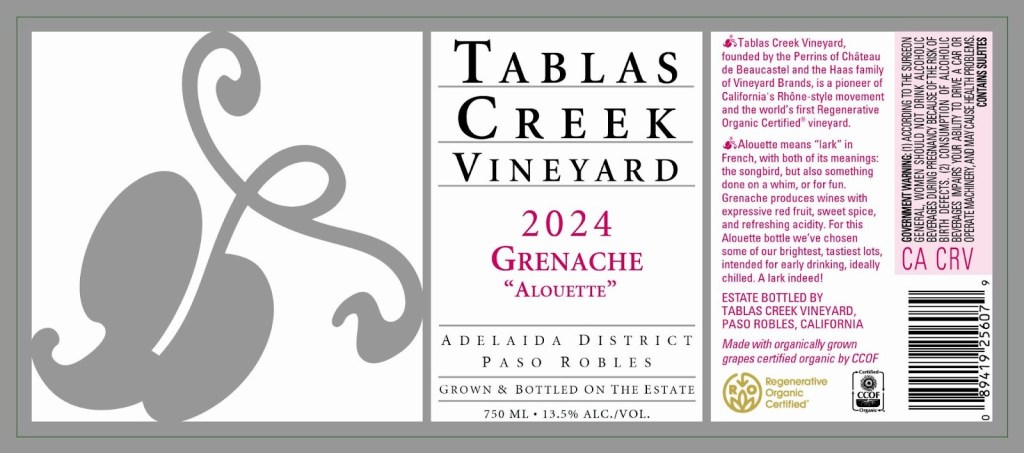
“Alouette” is the name of this Grenache made by Tablas Creek Vineyards. The back label says it is “intended for early drinking, ideally served chilled.” The name “Alouette” was chosen for this wine because it conveys a sense of fun.
Suggesting chilling a red wine is not totally unprecedented, but the wine usually mentioned is a Beaujolais, especially Beaujolais Nouveau. And today, there are low alcohol, pet nat or other light wines like the latest “Blouge”arriving on the scene trying to capture a new wine market. But the difference is that Alouette is a solid wine with normal alcohol (over 13%), has authentic Grenache character and has an affinity for food.
So listen up you wine snobs with your vintage charts who talk down to anyone putting an ice cube in a glass of red or keeping the bottle in the fridge. You may have something to do with the lack of interest the young generation has for wine.Too many rules and rituals when what is needed is for many to chill out so to speak.
Tablas Creek Vineyards has scored so many “firsts” since it arrived in Paso Robles that it wasn’t a total surprise to see it break the ice (sorry about that pun) on chilling red wines. Afterall, under the direction of Jason Hass, Tablas Creek has made a single varietal wine from each of the permitted varieties allowed in Chateauneuf-du-Pape. I’ve been lucky to have tasted many of them and am now a fan of Bourboulenc, Clairette Blanche, Terret Noir…and, sorry, I wandered off course.
Back to Alouette the wine. Being quite vigorous, Grenache yields a big crop in some years. 2024 was one of those vintages and as Jason explains: “We decided to make two wines: our traditional varietal bottling of Grenache, from the more classic, structured, deeper lots, and a new wine from the highest-toned, palest, and juiciest lots that we’re calling Alouette.”
The year before the winery offered the wine in boxes and kegs. But as Jason explained, the feedback they got was that the wine needed to be in bottles. And so the 2024 Alouette is presented in a clear bottle which leaves no doubt it is a red wine. Jason concludes,”This year we’re expanding it to national scale and reducing the price to $30 SRP so it can be a viable wine by the glass candidate for restaurants (at $35 it was just a little too expensive).”
My note for the 2024 Alouette is that it is a medium red in color, and the aroma is very assertive with cranberry and strawberry to it along with a hint of licorice. Feels smooth on the palate with balancing acidity and flavors that fan out featuring cranberry. Pleasing bright fruit in the finish with no hint of tannin, oak, or alcohol coming through when served chilled.
Overall, it is different yet attractive and seems like a perfect wine by the glass candidate.
Perhaps Kermit Lynch’s “bright and ethereal” is a little too poetic, but “Alouette” by Tablas Creek is a refreshing new take on Grenache. And a tasty, chillable red!
Gerard Bertrand, the ex rugby star who led the revival of Rose wines currently offers a wide array of wines from the South of France. From sparkling to orange wines, you name it and there’s probably one under his label. No, this is not another article about Bertrand who has apparently charmed the media. But one wine under his Heritage Group, the 2022 Cotes du Roussillon-Villages, Tautavel “An 560,”caught my eye and got me thinking.
When writing for Decanter Magazine a couple of decades ago, I visited Tautavel and other villages within Roussillon. After tasting wines at a dozen or so wineries that week, I found the wines to be truly unusual and exciting. The article that resulted was absolutely brilliant, of course, and dripping with enthusiasm.
Many of the owner-winemakers visited were young and enthusiastic, and were committed to sustainable farming. Here are those that whose wines were the most memorable: Domaine Gauby, Força Réal, Domaine Mas Cremat, Domaine Fontanel, Domaine Gardies, Domaine Piquemal, Domaine Joliette, Domaine des Schistes and Domaine Mounie. But what really unified these young winemakers is summarized by Gerard Gauby:
‘From selected sites within Roussillon, we can offer wines that are modern but authentic. If you are passionate about wine, you want authenticity. Without it, or when you try to make wines in the international style, you lose your identity as a region and as a winemaker.”
“Authentic” wines, as opposed to those made in the international style, too often fly under the radar these days. My visit took place when Robert Parker was extremely influential. And for any region or single winemaker to opt for a pass and not court him was unusual.
Places & Rules
In 1997, when the appellations, Cotes du Roussillon and Cotes du Roussillon-Villages were officially defined and all the guidelines worked out, the emphasis fell on maintaining traditional approaches. Basically, single variety wines were ruled out. For red wines, five varieties were permitted – Grenache, Carignan, Syrah, Mourvèdre and the rare Lladoner. To qualify for either AOC, winemakers were required to use a minimum of three varieties, with the two most significant used not to exceed 90%. Whenever Carignan was included, the law stipulated that at least 50% be made by carbonic maceration. Whites were similarly regulated and had to be blends.
Also In 1997 after a lengthy wait, AC status was given to four stand-alone communes: Tautavel, Lesquerde, Caramany and Latour de France. But today, only Tautavel merits special status.
In 2023, the AOC regulations were modified and the Carignan requirement was modified. But still the rules work to preserve the historic identity of the appellations. Both reds and whites must be made from at least two varieties. For reds, no one variety can exceed 80%, and for whites, Grenache Blanc and two other varieties must make up 50% of the blend.
Of the two appellations, Côtes du Roussillon extends over more territory and includes more low-lying vineyards. The area covers 6,300ha in and around 118 towns. As a rule of thumb, red wines from this appellation are still likely to contain more Carignan and are less likely to have been oak aged.
Confined to the northern sector, Côtes du Roussillon-Villages covers 2,500ha and is for red wine only. It includes some of the oldest and steepest vineyards – many of these must be terraced. Here are some old vine Grenache and Carignan, but also the push to plant Syrah was obviously felt here. Starting in the 1990s, many of the cuvees began including some Syrah.
If winemakers want to stray from the strict rules, say, by making a single varietal or using varieties like Cabernet Sauvignon or Chardonnay, the wine can then be labeled “GP Côtes Catalanes.”
Back to the Present
Recently my enthusiasm for traditional Roussillon wines was revived after tasting an unusual white wine.That wine, a 2021 from the Domaine de Clos des Fee is a Côtes du Roussillon blend under the Les Sorcières” moniker. The winemaker is Herve Bizeul who back in 1995 acquired 8 hectares, including a large parcel of old vine Grenache Blanc. Herve at the time was a bit of a celebrity in France having been named Sommelier of the Year.
Though he had no intention to quit his day job, his first wine named “La Petite Sibérie” was an instant hit so he turned to winemaking full time. Over the next few years his vineyards were expanded parcel by parcel and now consist of 30 hectares. He offers a red and white under “Les Sorcieres,” both intended as entry level wines, not collectibles.
This 2021 Les Sorcieres is 40% Grenache Blanc, 10% Macabeo, 30% Vermentino, and 20% Roussanne, the last two planted on limestone soils in 2011. The Grenache Blanc vines date back to 1945.
The wine is a bright light yellow in color and offers a fresh pear and chalky aroma with light citrus accents. On the palate it is a big, round mouthfilling wine with lively white fruit flavors that won’t quit. Finishes with good length and ends on a palate cleansing, long lasting note. The main takeaway is that the wine is unusual in an extremely pleasing way. Probably the best descriptor is “authentic.”
Back In the Day
In my Decanter Magazine article, I singled out his 2001 Les Sorcières red, with just a hint of oak, and the 2000 Vieilles Vignes with more oak which was intense, complex and a long ager. Even more impressive was Bizeul’s high-end cuvée Le Clos des Fées, from equal parts Syrah, Grenache, Carignan and Mourvèdre. My review ended with “Aged in oak for 18 months, this incredible wine is hard to top.”
Domaine Gauby, founded in 1985, may have inspired Bizeul to settle into Roussillon. In early 1985 Gerard Gauby convinced his family to leave the Coop and make wines from their vineyards. Arguably among the first to abandon chemicals and move toward biodynamic farming, Gerard Gauby won over the British trade with his early vintages and was heralded as an authentic garageist by the 2000 vintage. High praise was heaped upon his Syrah-driven cuvée, La Muntada, that in both 2000 and 2001 went way off the charts.
Working with partners from the UK, Gauby added wines under the Domaine Soula name. A blend of Marsanne, Grenache Blanc, Sauvignon Blanc and Chenin Blanc from late-maturing hillside sites, Soula’s 2001 Blanc struck me as an amazing, vibrant wine. The Soula 2000 Rouge, predominantly old-vine Grenache aged in new oak, was concentrated and garrigue scented. Though Gauby is no longer involved, Soula maintains the same goal of regional authenticity.
While the Brits strongly suggested a visit to Gauby would be crucial to my article, my favorite wine merchant in St. Foy La Grande, pointed me toward another voice, Domaine Gardies and its young winemaker, Jean-François Carrel. His was the third garigiste type winery to be established in the mid 1990s.
“Since putting his signature style on the 1996 vintage, he has become one of the top winemakers here. His wines are also having a profound impact on the future direction of Roussillon: intricate, structured and harmonious, they show the kind of restraint often tagged feminine with regard to ripeness, oak level and flavour complexity.”
With the 2000 vintage, Domaine Gardies hit full stride. With half of the cuvée aged in oak, the 2000 Gardies, Les Millères (50% Syrah and equal parts Mourvèdre and Grenache) is finely balanced. With fine tannins and perfect balance, Domaine Gardies 2000 La Torre, (Mourvèdre, old-vine Grenache and old-vine Carignan) is an outstanding example of the heights that can be reached with a traditional cuvée.”
Acknowledging the difficulties winemakers face in this warm climate, he feels that knowing when to harvest is the key to success. “Picking a day late or a day early can spell the difference between a balanced wine and overripe jam.”
Back to the Future
Along with the three early pioneers mentioned here, Roussillon has attracted several bigtime players. Michel Chapoutier offers both red and white Cotes du Roussillon under the Bila Haut brand. Domaine Lafarge includes wines from this region in its ever-expanding portfolio.
Current vintages from these two share a style that is at once rich, lively and unctuous:
Bila-Haut Michel Chapoutier Côtes du Roussillon (Languedoc, France) 2022 $15
Grenache Blanc and Grenache Gris with a dollop of Macabeo, this is full-flavored and lively. Yellow with a hint of green, it offers lots of spice, fennel and mineral notes. Smooth, round and gentle on the palate, it has some bright citrus taking it to a pleasing finish.
From vines a century old, this white brings together Grenache Blanc and Grenache Gris and adds younger Roussanne in a full bodied package. Peach and citrus along with light floral notes on the nose. Rich, unctuous palate with broad flavors of stone fruit and some chalky back favors.
Let’s not forget Gerard Bertrand. He ended his 10-year rugby career in 1987, following the death of his father, a well-known winemaker in Languedoc. He inherited Domaine de Villemajou, which is based in Corbieres. That’s where the Rose Clos du Temple is made today.
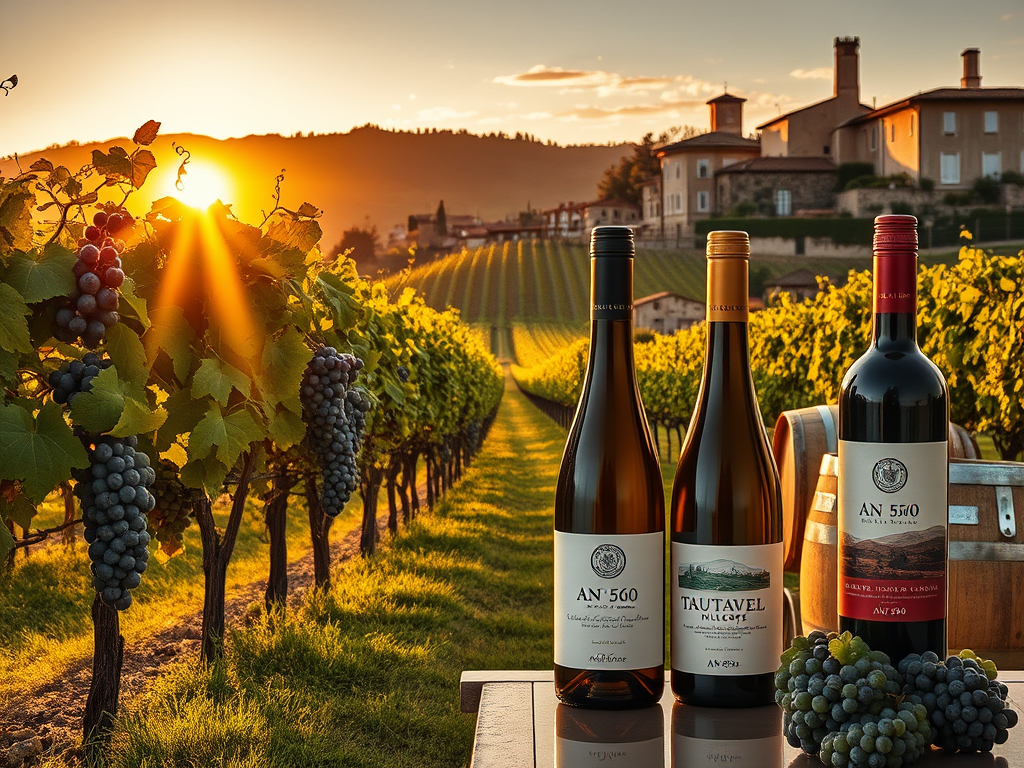
And now Gerard Betrand is a major player in Roussillon. He focuses on Cotes du Roussillon-Villages from Tautavel. His wine named “Heritage An-560” brings together Grenache, Carignan and Syrah, with a portion blended in oak for 9 months. Another Tautavel is the 2021 Gerard Bertrand Tautavel “Grand Terroir.”
And what does that “An-560” mean in the name? Well, like so many who were born and raised in the area, Bertrand is ever mindful of the region’s place in history. It was once the home to the Cathars, a fascinating religious group living in several villages. But they annoyed certain people and the Cathars were wiped out during the Crusades.
But Roussillon’s historical impact goes way, way back. In 1971 around the village of Tautavel, some of the oldest indicators of human life were uncovered. Known as “Tautavel Man,” these remains date back to 450,000-560,000 years ago, so that’s the “560” reference. Basically, the Roussillon area is thought to be one of the cradles of civilization.
We can suspect that Tautavel Man who was found in a limestone cave probably engaged in a little winemaking. What do you think? Did he make a blend of Grenache and Carignan? Mostly new vines probably.
 Norm Roby's Unfiltered Guide to Savvy Wine Shopping