Power to the (Wine) People!


Or, what Happens when 26 Million People Vote for Best Wines

Vivino just published its 2018 Wine Style Awards which it describes as  “the only awards within the industry wholly decided by the public.”

Here is how it works: “Over 26 million wine lovers from around the world have chosen the 1,490 winning wines, that span 149 wine style categories, by rating them on Vivino over the past 12 months.”

The full winners can be viewed at  www.vivino.com/awards.

Vivino founder and CEO, Heini Zachariassen, commented:

“The Vivino Wine Style Awards showcase the democratization of the wine world, by putting the power into the people’s hands.”

“Through our 26-million strong community, we’re not only able to deduce which are the best wines in the world, but also a host of other interesting wine trends…”

If you don’t know  much about vivino, see my review at www.bestonlinewineshopping.com   which is generally favorable.

Vivino is certainly one of the most dynamic online wine sites. 

A few business articles have suggested it is trying to become the Amazon of the wine world. No harm in trying.

But let’s try to figure out what this list is and whether it has any real value to consumers or the wine trade. Is this a list of “the best wines in the world” or simply the “most popular” to vivino’s subscribers? Or are they one and the same?

Having read through all 1,490 wines listed, I came away thinking it is primarily a re-listing of the most famous, most expensive wines in the world.

With few exceptions. This is especially true of all French and most Italian and Spanish categories. But also of California. And Argentina led by high-end wineries such as Via Cobos and Catena.

I was hoping for some exciting trends to emerge, breakaway producers, dozens of new wineries pushing the old guard aside. But this was not the case. Instead you get all the oldies from Antinori to Petrus to Chateau d’ YQuem with only minor shuffling within categories.

I’m not opposed to ratings from the wine community, consisting of people with widely different levels of expertise. I’m supportive of anything that might be more useful than the 100 point system.

Posting notes and comments empowers some people and makes wine tasting fun. It also forces them to focus on the wine and to develop a vocabulary to support their opinions.

Best of all, it frees wine lovers from relying on ratings from any and all professional critics.

So why didn’t this concept of “putting the power into the people’s hands” yield some amazing newsworthy or at least some totally new stuff?

Too many categories? Too many reviewers? Something clearly did not click when the top White Rioja is one from 1986 priced at $899.99 and when the best Amarone will cost you $546 a pop.  

And for one more example: the best northern Italian white is the 2011 Gaja Chardonnay at $241 a bottle!

Maybe the answer lies buried in the French Burgundy categories. One has to wonder did 194 Vivino members taste and review the 2006 DRC “La Tache?

And did 127 taste the 2012 La Romanee which retails for $14,962?
So how does any of this high priced stuff, to quote from the press release “help producers better understand consumer behavior and demand”? 

The news release mentions the inclusion of Tannat from Uruguay and the growing interest in Cremant as a sparkling choice. Both wines consumers should know better.

The ten best New Zealand Pinot Noir list is excellent with several newcomers to join oldtimerFelton Road. Also found some excitement in the Chilean Malbec list and in the Spanish Syrah list.

In the various California categories, it was newsworthy to see such solid names as Frank Family, Rombauer, and Cakebread continue to be recognized.

And, yes there were a few new names such as Garguilo for its Cabernets, Robert Lloyd for Chardonnay and Arkenstone for Sauvignon Blanc. They google very well.

So what is the takeaway after studying this list of “The Year’s Best wines chosen by 26 million people?

One idea that keeps coming back is that since one assumes these amateurs actually bought the wines with their own money, 

It is normal to want to love the most expensive wine. Especially if you bought it.

Who wants to  shell to out $795 for the Harlan Estate or $1,4962 for the DRC only to admit to friends and family that the wine really wasn’t that great?  And then rate them both 3 out of 5.

Not gonna happen!

Nor am I going to slip in a comment about the occasional failure of the democratic process to come up with the best.

It is an imperfect system.
Finding the Right Wine Club

If Quality, Variety and A Proven Track Record are Your Thing…

Navarro Vineyard’s “Pre Release Tasting Program” is highly recommended.

Overall Rating 4.75 stars.

Rated 5 out of 5 in 4 of 5 main categories

Background

Navarro could well be the granddaddy of all wine clubs. Still family owned and operated by Deborah Cahn and Ted Bennett, Navarro has been selling direct through its mailing list since 1974.

Over such a long run, the winery fine tuned the wine club program and in many ways wrote the book on how to make it work.

And, most important, these guys how to keep members’ loyalty over the years.

Almost all wines are sold direct from the winery, and with rare exception, they are not sold in wine stores. So the exclusive angle is strong.

Quick View:

First, the staff, many of whom have been there for many years, is extremely knowledgeable and attentive. They have first hand information about the winemaking and get involved in the evaluation and marketing of all wines.

Members are offered all wines before non members can buy them. This is a big plus.

Normally wines are pre-released in the Spring and in the Fall. Members are notified about new wines by mail or email, and either way, the information is cleverly presented in a personal, no baloney prose style.

Memberships remain active by purchasing a case a year. The choice is yours, but the winery also offers special case samplers around a theme like “Springtime Whites” or “Hearty Reds.” Typically, six different case samplers are offered.

The Wines

Without question, the wines are of high quality as evidenced by the inordinate numbers of medals won each year. I’ve judged their wines on several occasions and they almost always steal the show.

The flagship wine is the high end Pinot Noir, “Methode a l’Ancienne.” closely followed by the Barrel Fermented Chardonnay.

But if you have never liked a Gewurztraminer or a dry Riesling, you owe it to yourself to try Navarro’s, each  the best of the breed. My favorite is the Sauvignon Blanc.

But there are wide choices for members as the winery normally bottles 20 or so wines per year. There are 3 different Chardonnays and 3 Pinot Noirs as a rule.

And there is always something new going on…a new varietal to the roster, a new vineyard source, or a new technique.

Some wines are offered in half bottles and a few magnums are available.

Prices: range from $16 to $50 a bottle. There normally are 3 or 4 wines priced below $20 a bottle.

Discounts range from 20% to 25% for members

Twice a year timed with the Pre-Release events, the winery offers 1 cent shipping on each full case.

Special Events and Member Perks

Located in the remote town of Philo, the winery makes its facility open to members. Two Pre-Release events are held each year.

The picnic area is tranquil and lovely.  Non alcoholic grape juice is available for kids to sample.

The family also owns the successful Pennyroyal cheese company, so often a selection of cheeses is available.

Insider Tips

Best deal:

Pinot Blanc, new to the roster and far better than any Chardonnay below $20. A super everyday white!

The Anderson Valley Pinot Noir at $22 a bottle is a fantastic red wine deal.

When to buy. Wait for the window of one cent shipping and stock up.

When not to visit. Late afternoon on any Friday when tourists heading to the Mendocino Coast clog the tasting room and slam down the samples.

The Basics:

The Happy Family Ted Bennett and Deborah Cahn

Aaron and Sarah Cahn Bennett

Address: 5601 CA-128, Philo, CA 95466, USA

Hours: · 8AM–6PM

www.NavarroWine.com

Phone: +1 800-537-9463


Garagiste Wines in California

Searching for Garagist Winemakers in Lodi and Paso Robles

“Garagiste” was a popular term not long ago to describe a crazy, passionate winemaker making small amounts of hand-made wines working within her or his garage-sized location.

Several appeared in and around St. Emilion in the 1990s to challenge the old guard, to oppose uniformity of style, and to add a highly personal signature to their wine.

My first encounter with such a wine was labeled “Le Dome” and only 200 cases were made a year. It was atypical and spectacular.

Winemaking for a St. Emilion garagiste was literally hands on and was minimalist because the winemaker had minimal equipment available.

With about 90% of California wine controlled by a dozen or so wine companies, and much of the wine on the market tasting the same, we need a few garagistes to shake things up.

But since they don’t have big bucks to build showcase wineries, they aren’t likely to be discovered by the big reviewers.

The regions where some garagistes may be working are in places like the Sierra Foothills, Lodi, and Paso Robles.

In fact, you could experience the 7th Annual Paso Robles Garagiste Festival from Nov 10-12 and meet 20 or so self-proclaimed garagistes.

But, by luck I recently found one that fits the description perfectly. Found him in a hole in the wall tasting room in Clarksburg. Open from Noon to 4:00 3 days a week, the tasting room is back in a far corner of the Old Sugar Mill facility.

Matt Powell is his name, and he makes wines from Lodi fruit under his

Draconis label. As he explained, he works out of rented space in another winery, and his goal is to make wines with subtlety and finesse from Lodi grown Zinfandel, Petite Sirah and Syrah.

Only 100-150 cases of each wine is made annually which qualifies him as a garagiste. By studying winemaking in France’s Burgundy and applying that knowledge to Lodi grapes makes him a crazy, passionate, singular winemaker.

As for the wines, to someone who is not a big fan of Zinfandel, finding most to be one-dimensional and heavy-handed, Powell’s two versions are out of the ordinary.

His 2014 “French Style” Zinfandel, so named for being aged in French oak, was rich, unctuous, with subtle layers of oak spice and lively fruit. Harmonious!

The companion, named “Dark Style” Zinfandel, was rich and full flavored, but also a complete wine from beginning to end.

And to this big fan of Petite Sirah, Powell’s 2014  Draconis hits the bullseye. It is dark, mouth filling, round, with a long finish. Not a streak of hotness, not a rough edge anyway.

We also tasted a Draconis Viognier from Lodi that was close to stunning. Powell said it was about 16% alcohol, but somehow did not come across as that powerful. It was fragrant and full bodied.

The Zin and Petite sell for about $50 a bottle, not cheap by any means. You can purchase them at The Old Sugar Mill, 35265 Willow Avenue, Clarksburg, CA 95612.

You can buy them on the website which is, not surprisingly, poorly done and barely functional. Wines are available is 3,6 or 12 bottle allotments.

Discounts? Dont even ask.


The Best of the Best Of

The Top Wines of 2016 Lists

As The Wine Spectator was unveiling the top 100 Best Wines in its drawn-out dramatic countdown, others were coming out with their versions. Just because the Spectator has been compiling a top 100 list for 30 years did not prevent others for having a say.

A few days  before Randy Lewis of Lewis Cellars was revving his engine for a victory lap celebrating his 2013 Cabernet as the Spectator’s #1 wine, two competing internet sites got into the Best Of 2016 competition.

First, wine.com announced its list of top-selling 100 wines of 2016 and soon thereafter vivino.com came out with its list of” best wines on the planet.”   For detailed and brilliant reviews of both sites, visit www.bestonlinewineshopping.com

This was the 10th year in which wine.com listed top wines of the year. It compiled a top 100 list based entirely on the top wines sold nationally on Wine.com during the first 11 months of 2016.

In a not too subtle way, it added: “While many publications rank wines based on the opinions of wine critics, we wanted our customers to be the judge, voting with their wallets to determine the Wine.com 100.”

Yes, critics offer opinions, pure and simple. Well, not always pure. But price, availability, and production are not considered when critics pass judgment.

However, quite a few online wine sellers rely on the Top 100 lists from The Wine Spectator, Wine Enthusiast or James Suckling. As an aside, it seems the influence of Robert Parker is definitely fading and the Vinous/Galloni duo has yet to rise to the occasion.

But vivino also does not rely too heavily on critics. With its wine Apps and crowd-sourcing approach, it bases its top wines of 2016 list on its community of 21 million users and the millions of wine ratings they’ve submitted over the past year.

In other words, reviews and scores from your average Joe and Jo, Betsy and Bob, Shawn and John. Some seem to have lots of time and many opinions; one guy named Jack has submitted close to 2,000 reviews.

For each wine style category, the folks at vivino explain, we  “studied the reviews and selected the top ten best-rated wines with at least 50 ratings from the past year. Check out your favorite wine styles, and explore those you are curious about.”

As noted in my review, vivino loves to create categories of wines and wine styles and then compile lists.

For the 2016 results, the site came up with 147 separate categories. For red Bordeaux, there are 11 separate categories which seems excessive.

In the Best Rated category, the 2000 Chateau Margaux is #1 followed by the 1982 Latour. No surprises here! And the Best Wines to Buy Now is another very odd list of fabled names, including most of the Classified Growths including y’Quem.

Furthermore, vivino does not sell wines directly, so there’s no correlation between these community ratings and actual purchases which wine.com uses.

Apples and oranges you might  say.  Regardless, I tried to compare them.

First, the indisputable winner is Chilean Sauvignon Blanc. Brancott’s 2015 was wine.com’s #1 and the 2015 Casa del Bosque headed vivino’s list of Top Values.

Almost as fascinating, Rombauer Winery makes wine.com’s top 10 with its 2014 Chardonnay, and the Rombauer Zinfandel is high on vivino’s Best Value list.

When it comes to Cabernet Sauvignon, the 2013 Clos du Val and 2014 Caymus were among the best sellers on wine.com.

And the Hundred Acres Napa Valley Cabernet was #1 overall on vivino.com and rated high in its other categories.

Malbec fans might be excited to see that the 2012 Vina Cobos was tops with vivino and wine.com’s top ranked malbec was the Trivento 2015 reserve.

And this Champagne fan was intrigued to see Clicquot Brut as top rated at wine.com. Vivino’s high ranked non-vintage Champagne was the Jacques Selosse. Some 168 people reviewed it.Most people will never even see a bottle anywhere.

But to return to The Wine Spectator’s top 100 which had a few surprises. Great to see an Oregon Pinot Noir ranked #2 and the biggest surprise was the #3 wine, an Oregon Chardonnay. That was a gutsy call.

However,The Wine Spectator will invariably include a mandatory wine from Antinori in its top 100, as well as some wine from Jackson Family, and whenever remotely possible, a wine from itsother major supporters and advertisers.

Of the three top wines of 2016 lists, the one that stands out as speaking to me and the typical wine buyer is…wine.com.

And you?

A Real Happening App

How is it that two guys from Denmark created the world’s most popular wine App, Vivino, now headquarted in San Francisco?


Vivino.com,  now the most popular wine App, began simply as a resource tool and has evolved quickly into an all-purpose site.  

It caught my attention about 3 years ago as a clever, useful App that allows you to take a photo of a wine label and get instant feedback and reviews of that wine.

The App is free to download on the apple store, google play, and windows phone. Other sites now have a similar app but these guys started it.

Headed by a couple of techies from Denmark, Vivino is the brainchild of Heini Zachariassen who was joined by co-founder Theis Søndergaard in 2010. The Founding Fathers, as they call themselves, simply saw a need for making information readily available to wine consumers.

Et Voila Vivino! Or whatever they say in Copenhagen.

Vivino now employ 80 people and even have an office in San Francisco to help it deal with its over 18 million subscribers. Yes, 18 million!

As it fine-tunes its own direct wine sales department, Vivino offers wines no other site has. Many are from California, and it is now featuring the 2013 T-Vine Grenache, 2012 Elizabeth Spencer “GPS,” 2012 Seltzer Stags Leap Cabernet,  2012 Lateral Napa Red, and Marietta Cellars Arme.

Vivino is also the only website offering wines from the cult-like Alpha Omega and other hard-to-find wines such as Sbragia  Home Ranch Chardonnay.

Imports, when offered, are equally fascinating, such as a Pomerol, the 2010 Gombaude-Guillot, and the 2013 Ornellaia Serre Nuove.

You also know how many bottles remain for each wine offered and how much time is left before the deal is removed.

New wines are added daily.

As A Search Engine

In the early days,  it occasionally failed to deliver reviews of older vintages or under the radar wines.  But recently, it had reviews of every Cabernet, Pinot or French wine I could think of because it now elicits reviews from its members as well as published reviews from experts.

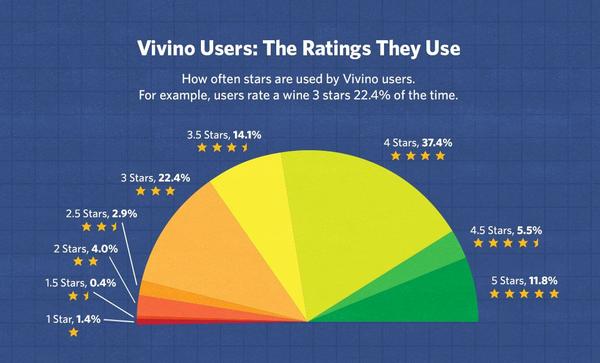
These reviews from members follow the Tripadvisor 5-star format, and some reviewers are then followed by other reviewers on Facebook.  Several subscribers, mainly sommeliers, have reviewed over 1,000 wines.

According to the Founders, its “users contribute ratings for millions of wines from around the globe, and collectively, this database makes up the largest wine library in the world.”

To make your decision-making easier in this social media world, Vivino now lists the top wines rated by subscribers in specific states. So you can see the top 25 wines from $20 to $40  from Texas or Mass. Washington State, or whatever state you live in.

But the list of lists continues with 11 Malbecs, 10 New Zealand Sauvignon Blancs or 2 California Syrahs. Or maybe that was two turtle doves.

Well, the point is these people like compiling lists.

Admittedly, I was intrigued by the top ten wines sold at Safeway and Whole Foods. Seriously, do people buy Opus One and Dom at a Safeway?  There’s also a top 100 wines list.

As an Online Merchant

Recently, Vivino ratcheted up its own list of wines for sale using a third party retailer for fulfillment.  This exciting development is spearheaded by Peter Ekman who judging from the selections, knows where to find excellent wines at good discounts. Shipping is normally free for 4 or 6 bottles and the discounts range from 25% to 60%.

These wines are offered through a local retailer, Vintage Berkeley which ships out of San Leandro.

A Crash Course in Flash Sales

Hold onto your hat or whatever may blow in the wind, because on Tuesday, July 19th, WTSO (Wines ‘til Sold Out) is conducting its day-long marathon for wines priced at $19.99.

The kick-off is 8:00 am, East Coast time. A new wine will be for sale every 15 minutes or sooner. 


To sweeten the deal, they are offering free shipping with no minimum purchases and they will store your purchases for free, should there be concerns about high temperatures.

You can follow the sales online at www.wtso.com, download the app, or use your twitter account for notifications.

So, are you ready for some Flash sales?

If you are a newbie at this, it can be a bit unnerving with the time pressure. But if curious, this could be like a crash course in flash sales. You can be a spectator or a player.

I’ve followed WTSO for about 4 years and reviewed its 1,359 offers over the last 10 months to get a feel for what might be up for sale. At $19.99, there were a few exceptional deals, most were decent enough, and there were some wines I wouldn’t want if they were given to me.

Overall, the best deals were wines from the Rhone Valley, off-brand Champagne, Tuscany, and Australia, along with Pinot Noir and Zins from California.

If you are game and ready to tune into to this upcoming marathon, we are happy to offer a little pre-game advice and pep talk along with a game plan. Go to

www.bestonlinewineshopping.com


Two Great Wine Deals

Two Awesome Wine Deals for This Weekend

  1. Winelibrary.com just announced  that it will offer 150 wines from various regions as part of its July weekend sales.

Most of the wines will sell for 50% below suggested retail with free shipping for a case. Just remember that you need to use the code JULY2016 to get free shipping.

As an added incentive, you can mix and match wines to qualify for the free case shipping. That’s an attractive  alternative.

When thinking about case purchases, I looked for wines under $20 a bottle and came up with these five beauties.

2014 Lafage Cuvee Centenaire Blanc, $11.98, lovely, full-flavored white from southern France.

2014 Gabriel Meffre Cotes Du Rhone Saint Vincent, $12.01, from a reliable producer, and a real deal for a Rhone red.

2010 Olarra Laztana Rioja Reserva $12.44, This is a ready to enjoy classy Rioja from the fine 2010 vintage.

2012 Casey Flat Ranch Estate Red $19.99, An excellent combination of Cabernet, Cabernet Franc, Syrah and a dash of Viognier.

2013 Willowbrook Cellars Kastania Pinot Noir $19.99, This delivers pure Pinot flavors and soft,silky texture. Hard to find a better Pinot at this price.

2. As a big fan of Navarro Vineyards, I was thrilled to see this special July 4th offer in my mailbox. For some reason, wineries aren’t allowed to ship totally free, but every now and then a winery will go with the 1 cent per case shipping fee. That saves about $40.

Since the owners, Ted and Deborah, are better writers than I am, I’ll quote their offer below.

The Sauvignon Blanc is one of my all-time favorites and this  vintage is the finest to date.

I’d also go with the 2014 Pinot Noir at the enticing price of $16.50 a bottle. But the Pinot Grigio is a perfect summer sipper as is the Rose of Pinot Noir. Tough to decide, but what great choices!

Here’s the offer:

“The Fourth of July is just around the corner and Navarro has six Gold Medal winning new releases that will make your barbeque taste better than ever, especially since the One-Cent Ground Freight offer is still in effect. Here, in order of popularity, are our bestselling new releases:

2014 Pinot Noir, Anderson ValleyBottle price by the full case: $16.50

2015 Rosé of Pinot Noir, Anderson ValleyBottle price by the case: $17.55

2014 Chardonnay, MendocinoBottle price by the full case: $16.50

2015 Sauvignon Blanc, Cuvée 128Bottle price by the case: $17.10

2014 Chardonnay, Première ReserveBottle price by the case: $24.30

2015 Pinot Grigio, Anderson ValleyBottle price by the full case: $12.42

2015 Edelzwicker, Anderson ValleyBottle price by the full case: $12.42

2012 Cabernet Sauvignon, MendocinoBottle price by the case: $28.80

2014 Riesling, Deep End BlendBottle price by the case: $26.10
Can’t decide which wines to purchase; check out Navarro’s Summer Samplers with savings up to 25%! You can assort twelve bottles of these new releases or any other wines or juices, and qualify for Navarro’s One-Cent Ground Freight and discounted Air Freight. You can place your order online at www.NavarroWine.com


Amazon’s Wine Dept

Chances are good if you own a smartphone, have a credit card, and are over the age of thirteen, you are familiar with Amazon. And if you are among those who once enjoyed hanging out at bookstores, you may still be a bit resentful, but for most people, Amazon is the Mother of all online sellers.

So you will not be shocked to hear that Amazon has a large wine department. Not the biggest, but close enough as the most recent listing of available wines exceeds 9,000.  Amazon is a little different from other online wine sellers and Amazon loves to assemble wine packs of 2, 4, or 6 bottles. And toss in a few 12 bottle packs as well. So that 9,000 wine items listed includes these packs.

To digress, it is fascinating to hear Amazon label this category “wine packs” whereas the other sites prefer to label a selection of two or more wines as something curated. And the curation, if that’s a word, is almost always performed by experts curators.  

But Amazon is not without shame as many wine packs are grouped by producer, by region or by theme, as in wines to give to pacify the “Mad Housewife” or some other equally silly theme. Then there are wines sporting  the “Fifty Shades of Grey” theme. That’s pushing it.

That said, now let’s get back to the details. About two-thirds of the wines on Amazon are US in origin, mostly California, but Washington State (1,500) is well-represented as in New York (550). These last two states have earned the recognition, so bravo Amazon.  French wines offered hover around 1,000, and Italy shows up with 485 offerings.

Maybe my expectations were too high, but after the first few hours of checking it out, I felt like I was browsing the wine section at Rite­Aid with so many Barefoot wines and others found in most supermarkets and drugstores with a wine dept.

Amazon invites advertising, and it would appear that many of those wine packs feature wines from their advertisers. No problem with that; it is good business to punch up its featured brands and partners.

When you begin hunting for deals and discounts, Amazon surprisingly is not exactly a savvy wine shopper’s paradise.  In fact, as is often pointed out in their customer’s reviews, quite a few of the wines can be bought at better prices at grocery stores like Safeway and at Costco and similar stores. Cupcake, Layer Cake, Pacific Rim, Smoking Loon, Pepperwood Grove and Barefoot….and many other brands owned by Gallo may be cheaper at Rite-Aid, Safeway and CVS. (Note to Amazon brass: you often get as many negative reviews from your wine customers as 4 stars.)

When it comes to basic discounts, again Amazon pushes its mixed packs, offering 20% off on most of them. All told, there are about 165 “Deals,” many of them packed. But I could not find much to get excited about under that category. Not totally discouraged, I then clicked on  the category of “1 cent shipping,” Eureka! The mother lode. The Mother’s mother lode. If you have some leisure time, you can browse through about a 161 pages with about 4,000 listings.

Better yet, save yourself the time: there’s not much there of interest save for a few French wines.

Best Tip: go to the 20% off list and look for those items that are also part of the 1 cent shipping for the best deals on Amazon.

For more of our review of Amazon, go to: http://www.bestonlinewineshopping.com/amazon