A banner announcing “All wines, 20% off, semi-annual Wine Sale” caught my eye as I drove quickly past the shopping mall. The next day, slowing down, I noticed the store was one of those discount food places.
Probably nothing but wines in dented cans, right? So I kept driving. A few days later, no longer able to curb my curiosity, I stopped. And shopped. Like really shopped.
The sale was at a Grocery Outlet Bargain Market. The one I visited in Bermuda Dunes was a maze of wine with well over 100, maybe close to 200 wines on display. All in bottles ( no cans) and representing every wine country and many, many regions. Not surprisingly for a discount wine program, Argentina and Chile were well-represented, but Spain and Italy were not far behind. There were several Bordeaux along with the rest of France. California and Washington State had their own sections. One wall was lined with Chardonnay!
My first impression was “What the?” Prices started at $3.99 a bottle, with $6.99 looking like the average. Many of the labels were familiar brands such as Ravenswood, Pedroncelli, St. Clement, Canoe Ridge, McBride Sisters, and Mercer Estates, to cite a few examples. A Rose from one of the most reliable French producers, Chapoutier, was priced at $3.99. There also was a $5.99 white from Quinta de Crasto, a high-end winery well-known to me which is in Portugal’s Douro Valley.
Then I hit the motherlode with Pinot Noir from one of my long-time favorites, Sarah’s Vineyard in Santa Clara County. Normally selling for $35, there they were at $6.99. That first visit saw me walk out with several bottles in addition to the Pinots, and I’ve visited other Grocery Outlets since then.
I always try unfamiliar wines and while a few purchased were dogs woofing at me, the price range makes these explorations relatively painless.
But why are some wines so heavily discounted? My best guess is poor marketing on the part of the producer, the sales team, the importer and/or wholesaler. A small winery may need the cellar space for the newest vintage, or it just may need cash flow by selling in quantity. Bigger producers may be discontinuing the product or the label. Whatever, the appeal of the Grocery Outlet is that it doesn’t advertise the way the typical Safeway/Abertson chains do. For a producer, importer, and wholesaler, selling quickly and quietly has its appeal.
Since most normal people have not been writing about wines and probably haven’t spent time in every major wine country and tasted literally thousands, for what it may be worth to you, I’m going to share my thoughts and shopping tips here. After that, if you are still with me, the conversation will shift to some background about Grocery Outlet which has almost as many stores as Trader Joe’s but it is less well known.
Shopping Tips from a Wine Professional
1. Read the back label. The boring flipside with the mandatory details, not the artsy, colorful one with the brand. For each wine that interests you, if you don’t recognize the brand, look at the back label for the name of the producer. Or the company that bottled it. Both are in the fine print. Begin by learning the producer’s name is step #1.
2. The back label will also tell you the involvement of the producer/bottling company. For instance,”Produced & Bottled By” is a good sign indicating that the winery made most of the wine in the bottle, rather than buying it from another company. “Cellared By” is less reliable and
“Vinted & Bottled by” is pretty bogus. “Vinted” to me says the wine was bought ready-made and simply bottled.
3. Now to the wine’s origin. Check the place name, the appellation (where the grapes were grown) on the front label, such as Napa Valley or Columbia Valley with the home of the producer/bottler on the back. If you are looking at a Cabernet from Columbia Valley but see on the back that it was bottled in Napa, Lodi, or Acampo, it is a brand owned by a major company and the wine was trucked to a common bottling facility. The grapes may be grown in Napa or Sonoma, but If it says “Bottled in Modesto, CA,” the wine is, like Barefoot, one of dozens of brands owned by Gallo.
Yes, wines are transported in tanker trucks and in boats on their way to be bottled. You may be shocked to know that many Sauvignon Blancs made in New Zealand are shipped literally to a bottling plant in California. Check that back label if in disbelief.
4. How old is too old? Making sense out of the vintage date and vintage information. The year, say, 2020, simply tells you when the grapes were harvested, not when the wine was bottled. Most wines are at their best when young, especially whites and Roses. But a 3 or 4 year old white is not necessarily over the hill. A Rose, despite its fragile drink soon image can often be enjoyable 2 or 3 years after the vintage.
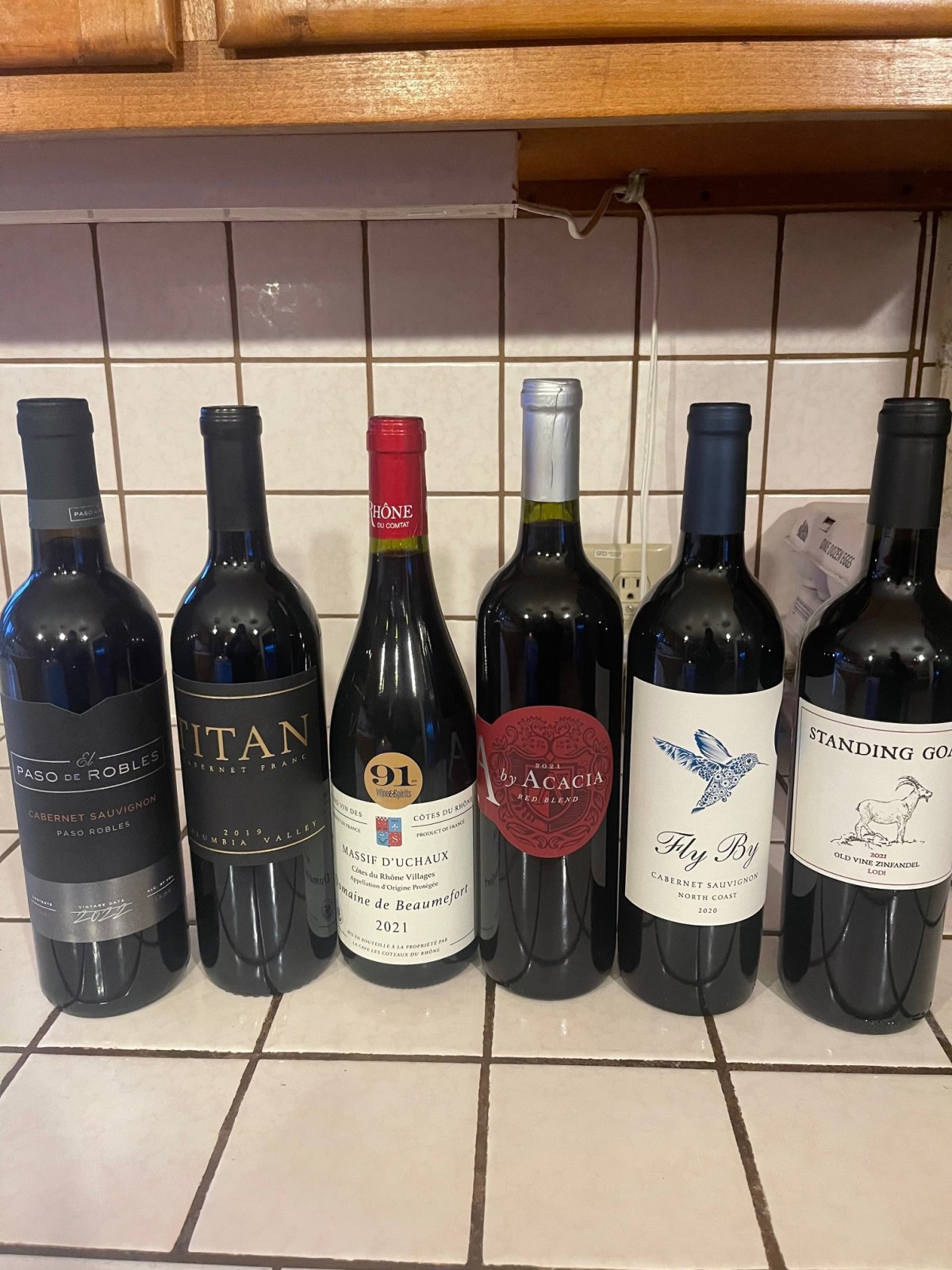
Red wines are more complicated and most are fairly safe up to 5 years after the vintage. My recent experiences involved two reds from 2013. The first, a Paso Robles, was clearly in decline, dull, lost its fruitiness and a little fizzy. The other, a Syrah from the Sierra Nevada Foothills, was at its peak. It was also an excellent Syrah. And both, to keep us on topic, were priced at $6.99.
But my shopping guideline is to avoid whites and roses that are 5 years or older and stay away from most reds more than 10 years old. Whether offered online or in a wine store, any wine around 10 years of age makes me question where it has been during those years. Was it properly stored? Moved around? Somebody’s reject? Yes, best to avoid older wines.
5. Corks and screw caps become an issue when shopping for discounted wines.. Let’s face it, most wines are displayed standing up and a few end up in the sunniest part of the store. Corks may be traditional but they tend to dry out over time and don’t protect the wine. So you’re better off passing over old wines with corks.
6. If you use the vivino site and take photos of bottles, it is better to use google to learn more about the wine. Vivino doesn’t sell most of these wines so will offer minimal info. Go to google to see if the brand exists, and then look for it at wine.com or cellartracker for its history. If it has one which is a good thing.
7.If you taste new wines with others, don’t give the price paid ahead of time. Both newcomers and longtime wine drinkers have been brainwashed to think price equates to quality. The same people who go to Amazon for the cheapest available product, will be predisposed to not like a cheap bargain wine.
 Norm Roby's Unfiltered Guide to Savvy Wine Shopping