A tale About Hubris & the Exclusive 100 Point Wine Club


Part 1

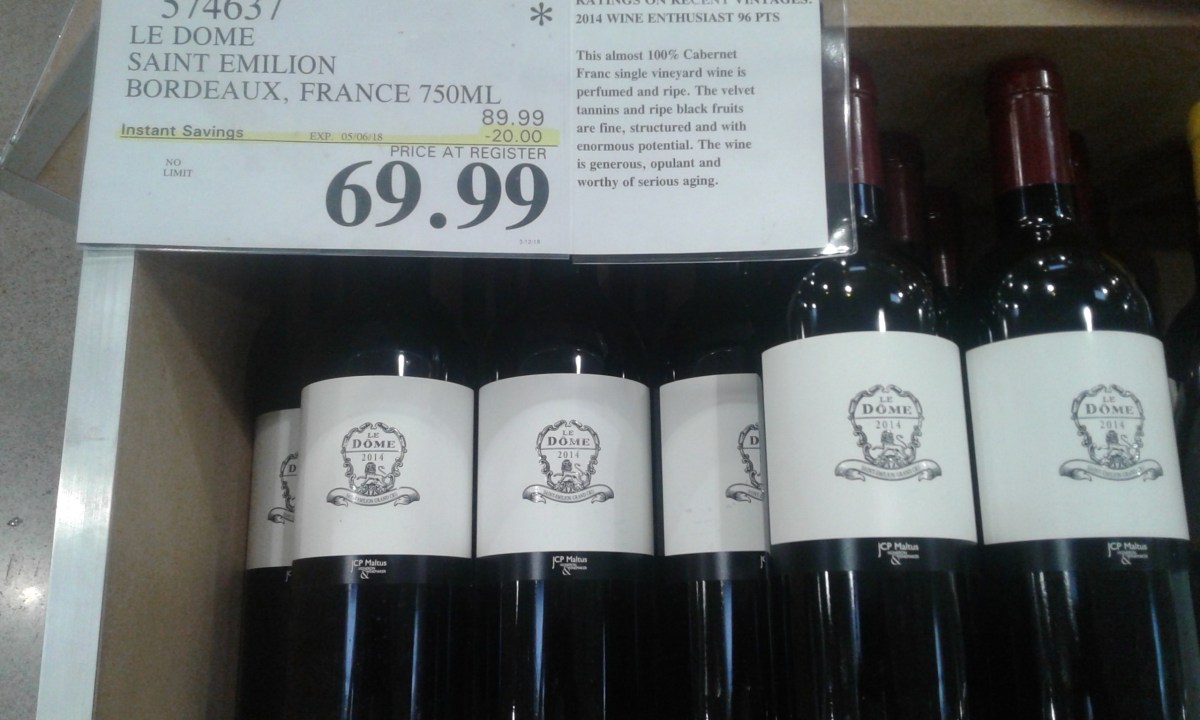
Last Wednesday, during my habitual walk through Costco’s wine department in Santa Rosa, I was blown away to see at the end of an aisle bottles of 2014 Le Dome offered at a discounted price of $69.99.

Surprised, stunned and maybe a little sad, I didn’t buy the wine. But did return to make sure I read the label correctly.

Ten years ago, one of the most famous, most sought-after wines in the world was this very same “Le Dome” from St. Emilion. The 2005 was a great wine and its reputation soared even higher when the 2009 was rated 99 points by Robert Parker.

Then, it went off the charts when Parker rated the 2010 a perfect 100 points. With that, Le Dome joined an exclusive club.

A website, Cult Wines for investors, provides ratings and prices from 1996 onward, if you are interested in all vintages.

Mere mortals could not buy a bottle of Le Dome even if they were willing to pay the $300 asking price.

Almost every bottle of “Le Dome” went to the UK market where it was as much of a national treasure as Judi Dench.  The British wine press could not hold back its praise for “Le Dome.”

Jonathan Maltus, the man behind Le Dome is British, and he was frequently introduced in wine circles as” the first English winemaker to make a 100 point wine.”

When living in the Bordeaux region, I was served Le Dome on several occasions, always by proud British friends. All vintages were extra-ordinary, unusually opulent. Jonathan was at 3 of the dinners and he was quite pleasant, quiet & easy-going. I later visited and tasted many more of his wines at Chateau Teyssier, his primary Chateau on the outskirts of St. Emilion.

Le Dome, made from a small 4-acre parcel, near Chateau Angelus in St. Emilion, was a strong player in the Garagiste movement that shocked the old guard in St. Emilion and rattled the Bordeaux wine trade. Many trace the small production, hands on garagiste movement to Château Le Pin. Others who joined it and Le Dome were Chateau Valandraux, Rol Valentin, and La Mondotte.

Le Dome is made from Cabernet Franc with a small percentage of Merlot, similar to the well-established Cheval Blanc.

Decanter Magazine and other British publications still closely follow Le Dome and gave high scores to the 3 most recent vintages, 2014, 2015, and 2016.

Several of the online  wine retailers I follow have recently listed vintages of the previously impossible to find Le Dome. And http://www.wine.com lists the 2014 for $125 a bottle. Other sites have offered the 2012 at discounted prices.

About a month ago, when reviewing www.nakedwines.com, I noticed 2 St. Emilion wines made by Malthus for less than $30 a bottle. Neither was Le Dome, but there clearly is something going on.

Is the garagiste movement over in Bordeaux?

Or is Le Dome the only star that has crashed down to earth?

Around 2005, I heard from other wine writers that Malthus was launching a similar wine in Australia, and had shipped over those special sorting machines used for Le Dome. Located in the Barossa Valley, that project is known as The Colonial Estate.

Later, around 2008, Malthus launched another project, this time in Napa Valley. The brand is World’s End and the wine, a blend of Cabernet Franc and Syrah, is called “Wavelength.”

Invino, an excellent web retailer that secures great deals, recently offered the 2009 Wavelength for $59.99 and mentioned it had also picked up the 2010 from a broker handling the brand.

Wavelength wines were made from the Stagecoach Vineyard in Napa. A few months ago, Gallo purchased the entire vineyard. So, that’s probably the end of that project as we know it.

But going back to the excitement over joining Bordeaux’s exclusive 100-point club, one line from an article in the British press about Maltus struck me: “I remember seeing [Mr. Parker] after he gave the 100 point score,” recalls Mr. Maltus. “He just smiled and said: ‘Don’t worry, it’s all downhill from now.’ ”

Wow!  I bet Parker would like to take that comment back

That remark now seems somewhat prophetic, but the truth more likely is that the road has had a few major bumps in it.

I hope Jonathan bounces back.

It does seem as if he got caught up in his own hubris and way over-extended himself.

Any return to earth might be easier if he threw away all of the old press clippings about superstar status along with membership in the exclusive 100 point club.

The Greatest Pinot Noir Deal Ever?


Leave it to Jon Rimmerman, the unpredictable guy behind www.garagistewine.com to issue this challenge.

His pick: the 2015 Trinity Hill Pinot Noir, White label, Hawkes Bay for $9.98.

That’s right…under $10.

The average price is $15.00.

You can order up to 20 cases, so he has a sh…or make that boatload on hand.

And yes, this is delicious Pinot from one of New Zealand’s best producers.

It sure beats Cupcake’s Pinot Noir. Or Smoking Loon.

Is there a better deal now?

Ever?


A Wine Club: Intimate & Educational

Can a wine club be exclusive, limited to a few hundred members, hosts private special events, make great wines and be non-snobby?  

I added that last point because the ATTITUDE you encounter in some wineries is a real turn-off, at least to me. (Are you listening, Napa Valley?)

Some people may think being made to feel uncomfortable and being talked down to by some twit on a script is part of the wine club deal. And attending over-subscribed winery events with boring speeches is the trade-off for buying expensive wines.

A good club, we can all agree, offers something more than high-priced, hard to find wines. The personal service should be attentive and the events should be more than tasting wines and listening to a sales pitch.

But membership should also be a positive experience, as in fun and a rewarding experience, as in learning.

The educational element is all too often non-existent in wine clubs today.

Drinking wine is easy; thinking about it as in expanding your knowledge, well, that’s a different thing.

So, if you share my interest in a wine club that has it all, except the attitude, look no further.

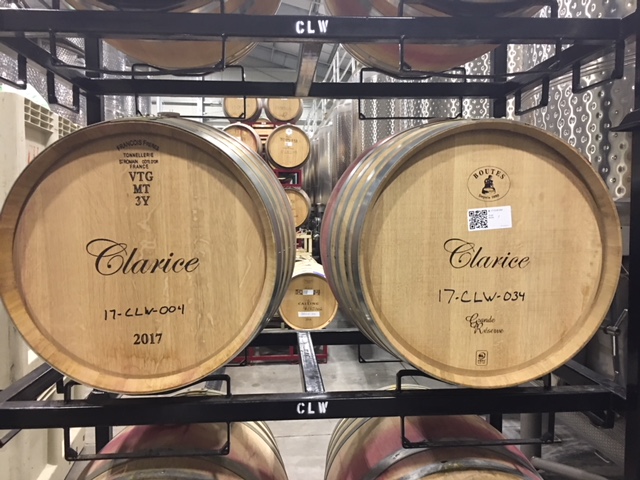
The answer is a new winery named Clarice, located in Sonoma County.

http://www.claricewinecompany.com

This is the new venture of a seasoned pro, Adam Lee, who founded Siduri Wines in the early 1990s and came to know every unusual Pinot Noir vineyard from Oregon to Santa Lucia Highlands in Monterey. And Santa Barbara. And San Luis Obispo. Well, you get the idea.

I was among his many fans who enjoyed Siduri Pinot Noirs because each was a lesson in its place of origin. Yes, they were great studies in “terroir.” Still are.

I also liked the Syrahs made under the Novy label. Make that: loved them.

Having sold Siduri in 2015 to Jackson Family, Adam has been working on a new brand and a unique wine club concept.

The concept has 3 key elements: fine wines for members only, educational discussions, and community.

It is limited to 625 members, and the wines are offered only to members.

Here’s the deal:

“As part of the Clarice Wine Community, members will enjoy two exclusive parties a year, one focusing on the Clarice Pinot Noirs and the other spotlighting a fellow winemaker and their wines, during which members will learn about their viticulture and winemaking, taste their wines, and receive special discounts. Finally, members will receive a case of Clarice Pinot Noir as part of their membership.”

Membership fee is $964.00 a year. But is it payable in six monthly installments.

The case will be available each October. The first vintage was 2017.

Granted, plunking down $160 a month is a big commitment, and once you begin, well, you are in.

The add-on to me is the personal touch in the educational programs. Members will learn about many facets of winemaking such as oak barrels, how they are made and what they add to wine.

Better to let Adam explain the educational aspect:

“From vineyard management and barrel making, to winery accounting and wine distribution — and so much more — you’ll learn from and interact with the true leaders of wine. In addition, you’ll gain access to a growing library of wine-related articles, written by a who’s who of industry experts.”

So, you will earn what the “MT” designation on an oak barel means.

Also, Clarice will offer private social media forums to handle members’ questions or concerns about wine and restaurants, or in Adam’s words:

“Wondering which restaurants have the best wine lists? Need help deciding what to add to your cellar? Join our private social media groups to share knowledge and recommendations.”

To me, that says they are willing to put a ton of effort into making members happy and a part of the family or community. The number of members is limited by the amount of wine produced each year.

The Price of Top Bordeaux

2015 Chateau Margaux 750ml (Bordeaux) – $1,268.70

Rated 100 points: (WA98-100)  (JS100)

(JD100)

Offered by     wwwgaragistewine.com

“STRICT LIMIT 1/person until we run out (in the spirit of the community and to allow as many of you as possible to acquire it at this $, please do not be upset with the one bottle limit.

(to be clear, this is $1268+ per bottle)

$1268+ is a Top Deal?”

Could well be. Time will tell.


February is Best Buy Bordeaux Month

merlotgrapes
Merlot in St. Emilion, 2015

The floodgates are beginning to open for terrific deals, even genuine bargains for 2015 red Bordeaux and a few remaining 2014s.

And we at www.bestonlinewineshopping.com will be alerting you to those unbeatable deals throughout the month. And providing insider buying tips.

So you can be amused by those stories about $500-$1,000 bottles of Bordeaux. And you can pass on the chance to buy “Futures” of 2015 and take delivery (if you are lucky) several months from now.

Time for a reality check and be prepared to ignore online retailers hyping offers of big named châteaux. Unless you want to pay $500 or more for a bottle of Cheval Blanc, or Margaux, or Lafite.

If you are not truly a compulsive collector which we respect or a totally insecure name-dropper, there is no reason to shell out big bucks for 2015 Bordeaux.

To us, “Bargain” does not mean cheap or lower quality. Or lowering your standards. It means high quality wines at honest, down to earth prices.

Though it is just beginning, we have already seen excellent deals of quality Bordeaux under $25 a bottle. And super, age-worthy wines below $50.

Not just attractively priced ordinary stuff, but 2015s that are authentic and capture that special quality that defines Bordeaux.

The following websites are the early pace-setters:

www.cinderellawine.com

www.wineaccess.com

www.garigistewine.com

www.invino.com

www.wtso.com

www.wineexpress.com

www.wine.com

www.vivino.com

Garagiste Wines in California

Searching for Garagist Winemakers in Lodi and Paso Robles

“Garagiste” was a popular term not long ago to describe a crazy, passionate winemaker making small amounts of hand-made wines working within her or his garage-sized location.

Several appeared in and around St. Emilion in the 1990s to challenge the old guard, to oppose uniformity of style, and to add a highly personal signature to their wine.

My first encounter with such a wine was labeled “Le Dome” and only 200 cases were made a year. It was atypical and spectacular.

Winemaking for a St. Emilion garagiste was literally hands on and was minimalist because the winemaker had minimal equipment available.

With about 90% of California wine controlled by a dozen or so wine companies, and much of the wine on the market tasting the same, we need a few garagistes to shake things up.

But since they don’t have big bucks to build showcase wineries, they aren’t likely to be discovered by the big reviewers.

The regions where some garagistes may be working are in places like the Sierra Foothills, Lodi, and Paso Robles.

In fact, you could experience the 7th Annual Paso Robles Garagiste Festival from Nov 10-12 and meet 20 or so self-proclaimed garagistes.

But, by luck I recently found one that fits the description perfectly. Found him in a hole in the wall tasting room in Clarksburg. Open from Noon to 4:00 3 days a week, the tasting room is back in a far corner of the Old Sugar Mill facility.

Matt Powell is his name, and he makes wines from Lodi fruit under his

Draconis label. As he explained, he works out of rented space in another winery, and his goal is to make wines with subtlety and finesse from Lodi grown Zinfandel, Petite Sirah and Syrah.

Only 100-150 cases of each wine is made annually which qualifies him as a garagiste. By studying winemaking in France’s Burgundy and applying that knowledge to Lodi grapes makes him a crazy, passionate, singular winemaker.

As for the wines, to someone who is not a big fan of Zinfandel, finding most to be one-dimensional and heavy-handed, Powell’s two versions are out of the ordinary.

His 2014 “French Style” Zinfandel, so named for being aged in French oak, was rich, unctuous, with subtle layers of oak spice and lively fruit. Harmonious!

The companion, named “Dark Style” Zinfandel, was rich and full flavored, but also a complete wine from beginning to end.

And to this big fan of Petite Sirah, Powell’s 2014  Draconis hits the bullseye. It is dark, mouth filling, round, with a long finish. Not a streak of hotness, not a rough edge anyway.

We also tasted a Draconis Viognier from Lodi that was close to stunning. Powell said it was about 16% alcohol, but somehow did not come across as that powerful. It was fragrant and full bodied.

The Zin and Petite sell for about $50 a bottle, not cheap by any means. You can purchase them at The Old Sugar Mill, 35265 Willow Avenue, Clarksburg, CA 95612.

You can buy them on the website which is, not surprisingly, poorly done and barely functional. Wines are available is 3,6 or 12 bottle allotments.

Discounts? Dont even ask.