My 3 Exhibits: Attention Class
2018 None Such Mourvedre, Enz Vineyard, San Benito County, $38.00 at http://www.nonesuchwines.com
2018 Bedrock Wine Company California Old Vine Zinfandel $27.99 at www. wine.com
2018 Ridge Petite Sirah Lytton Estate, $38 at http://www.invino.com
Are Old Vine wines better than other wines? This question likely ranks as one of the most common raised in wine classes. It is often raised when the subject turns to Zinfandel and indeed, there are arguably more Old Vine Zinfandels now on the market than any other wine type.
Yet, before getting to possible answers, let’s be clear: old vines exist in many other wine regions, especially in Spain, Portugal, Argentina and Chile.
First, “old” is not very well defined in the wine world. So because the average lifespan of a productive vine is 45-50 years, I’m using old for a vine that’s at least 50 years old. That’s
Pre-1970 in California, but there are vineyards that were planted in the 1880s, 90s.
When a vine ages beyond 50 years, it becomes less and less productive, meaning fewer clusters per vine and often smaller berries. So one attribute of old vines is a concentration brought naturally about by low yields and small berries. Without getting geeky scientific, the ratio of juice to grape skins is different. And the skins yield less tannic wines.
Another thing often pointed out is that old vines have deep roots which makes sense. Deep roots have the vine drawing different nutrients from the soil than young vines. Many winemakers believe that leads to a balanced vine, one that matures the grapes evenly and the maturation process is smooth and normal.
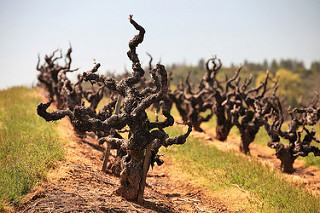
Now one more point to bring up before answering the question and that is old vines are usually tended differently. For starters, most are dry farmed, meaning never irrigated. Then many are own rooted, meaning direct bearers, not grafted onto highly productive, disease re rootstock.
That they are farmed differently was hammered home when I walked through old Mourvedre vines in Roussillon and through old steep vineyards in Oporto. In both, the vines were not planted in rows, they zigzagged their way along a slope or around a rock because everything was handled by people, not machines. The old vineyards in Oporto and many places are mixed, meaning field blends of several varieties intended to be harvested at the same time and fermented together. Many Old Vine Zinfandels are most likely field blends.
But are Old Vines better?
- Balance
For starters, they are better balanced because the vine was in balance and therefore the wine didn’t need to be adjusted, manipulated, or rocket aged by some nerdy winemaker. The reason why so many pre-1970 California wines were field blends was to prevent a new winemaker from changing the tried and true winemaking regime. I may have heard that from Robin Lail whose family ran Inglenook during its prime years.
2.Texture
In addition to aromas and flavors, wine has a range of textural possibilities. This is also known as the “mouthfeel,” as in soft, silky, astringent, puckery, harsh and whatever. Helen Turley, aka the “wine goddess” crowned by Robert Parker was not nerdy at all. Once when tasting wines with her, she started talking about “old vine velvet” and to this day, this attribute stands out to me. Old vines at their best are more concentrated but the tannins are less harsh so the wine might have high alcohol but still come across as velvety smooth.
3. History
There’s something authentic about an Old Vine wine because it captures and showcases a sense of place, not a wine made in the cellars, not a wine that’s a winemaker’s signature. In this era of over blown cult wines and cult winemakers, that’s rare and refreshing. The enjoyment of wine is more about places and peoples, not points.
Your Cheat Sheet
Wine #1
Sommelier Ian Cauble puts it better when talking about the 2018 None Such Winery Mourvedre
Made from Enz Vineyard:
It is, he explains, made from vines that are “own-rooted, head-trained, dry-farmed, and hidden deep in San Benito County, where it has flourished since the 1800s. The wines which hail from this special place are truly remarkable. To drink Enz is to understand the very fabric of California winemaking, and to be lucky enough to make a wine from Enz is to partake in history.” The winemaker and owner of None Such is Caitlin Quinn. You might want to remember that name.
Wine #2
The 2018 Ridge Lytton Estate Petite Sirah is an old field blend with Zinfandel. The vineyard was established in 1901. Ridge and winemaker Paul Draper need no explanation.
Wine #3
Bedrock’s 2018 Old Vine Zin is a blend of 85% Zinfandel filled out with Mataro, Grenache, Alicante Bouschet, Carignan, Petite Sirah and scant amounts of the many other varieties that can be found in California’s older, multifarious vineyards. And BTW, just about every Bedrock wine demonstrates the unique appeal of Old Vine and Heritage Vineyard wines. The winery is part of the Joel Peterson clan, the pioneers of old vine wines.
And yes, I reversed #2 and #3 here just to see if you were paying attention.

 Norm Roby's Unfiltered Guide to Savvy Wine Shopping