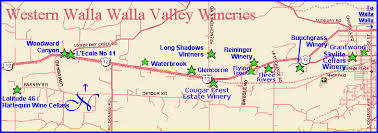
Walla Walla is unusual in many, many ways. First it is a rare AVA falling within two states, Washington and Oregon. About 60% is within Washington. Defined by the Blue Mountains to the southeast, the Palouse to the north, and the Columbia River to the west, Walla Walla is said to be the size of Napa but contains only 3,000 vineyard acres.
But, for surprise #2, there now are about 120 wineries calling Walla Walla home. Nothing much happened vineyard-wise after Repeal as the region expanded its orchards and wheat growing. Then In 1974, Gary Figgins planted a small vineyard and by 1978 his Leonetti Cellars was the first new winery. Figgins who was interested in Italian reds like Sangiovese made a 1978 Cabernet that by the early 1980s won so many awards and earned so many high ratings that it was being talked about as a cult wine. Walla Walla had awakened with a bang.
As its reputation spread, Figgins responded to his new found success and high demand by announcing release dates for subsequent vintages. The wines sold out quickly over a weekend in May.
Leonetti’s success, it is fair to say, kick-started Walla Walla as a special wine region which until then was better known for its onions, apples, and wheat. Selling wine to visitors from out of town caught the attention of Marty Clubb, who founded the nearby family winery, L’Ecole No 41 in 1984. Clubb was soon offering his attention-getting Merlot, Semillon and Cabernet on the same day Leonetti scheduled its open house. Not surprising, there were traffic jams caused by wine lovers coming from Portland and Seattle. Adding to the evolving wine scene, Rick Small who planted a vineyard in the late 70s converted a machine shop into a winery in 1981. His Woodward Canyon Winery was yet another reason to hit the road to Walla Walla.
To be frank, Walla Walla is in the proverbial middle of nowhere. Portland is 250 miles west, Seattle around 275 miles away, and otherwise, nothing but farmlands and magnificent rock formations. The area is beautiful and the town of Walla Walla with its brick buildings is absolutely charming, home to Whitman College and more bike trails than you thought existed.
My first visit to Walla Walla was in 1996 and during that time I was welcomed by the owners of Leonetti, L’Ecole, and Woodward Canyon. Two wineries had tasting rooms downtown, Seven Hills and Canoe Ridge. My hosts were the owners of a new vineyard named Pepper Bridge who were at the time also major apple growers shipping their product worldwide. All three wineries remain family owned and Pepper Bridge, owned by Ginnie and Norm McKibben, is now both a winery and a major grower selling to dozens of wineries.
But to return to my list of what makes Walla Walla unusual, #3 is the fact that in the little town there are presently 32 winery tasting rooms open to the public and to wine club members. That’s almost a third which is amazing. As I was packing up to leave on the most recent trip, a local stopped to ask what I thought of Walla Walla. After mentioning I first visited years ago, she noted, “Yes, the wineries saved the town and brought it back to life.”
But what really sets Walla Walla apart from most AVA is that 95% of the grapes grown are red. Cabernet, Merlot and Syrah combine for 70% of the total. On the Oregon side, The Rocks District sub-appellation, approved in 2015 and known for its distinctive gravel, cobblestone soil, Syrah edges out Cabernet and Merlot is a distant third.
While it is fairly clear that Syrah is the rockstar of The Rocks, Cabernet faces some stiff competition from Merlot and Bordeaux blends as the signature wine of Walla Walla Valley. And Syrah is gaining some steam with new wineries like Valdemar Estate raising the bar.
From the revisit, I left with the belief that Walla Walla is just gaining momentum and is on track to become a leading voice for many red wines. Currently, there are excellent Cabs and Merlots but it is easy to get excited about the Bordeaux blends, especially those with a good dose of Cabernet Franc.
5 Best Representatives: All have wine clubs
Northstar Winery “Red Blend,” Walla Walla Valley 2016 $60
Pepper Bridge Winery Merlot, Walla Walla Valley 2018 $55
Amavi Cellars Cabernet Sauvignon, Walla Walla Valley 2018 $36.00
Valdemar Estate Syrah, Walla Walla Valley 2019 $65
Saviah Cellars 2018 Cabernet Franc Walla Walla Valley, 2018 $35
Merlot
L’Ecole No 41 remains a leader with both its regular and Estate Merlot. Northstar has 14 acres planted to Merlot but uses the Columbia Valley AVA. Northstar’s 2013 Merlot, with 23% Cabernet, is a gorgeous, concentrated berry-infused, lightly oaked version for $41. Northstar’s limited production 2017 Premier Merlot, is as big and beautiful as Merlot gets. Loaded with flavors, It only needs cellaring. The retail price is $100.
Pepper Bridge Winery Merlot, Walla Walla Valley 2018 $55
With 13% Cab Franc, this Merlot made from Seven Hills and the estate vineyard, this is a perfect example of what Walla Walla offers. It displays ripe cherry, raspberry and light herbal aromas with a touch of oak spice. On the palace it is medium-full bodied with ripe fruit, an earthy streak and good acidity to accompany the tannins. Concentrated, textured, and balanced, it begs to be cellared 3-5 years. While owning both Pepper Bridge and Seven Hills Vineyard, the winery produces only 8,000 cases a year. Dozens of wineries buy grapes from Pepper Bridge, including Leonetti which bottles a vineyard designated Cabernet. All Pepper Bridge wines were excellent. One reason why the winery is not better known is that it sells almost all direct to wine club members. But if there were one club I would join , this would be it.
Cabernet Sauvignon
A recent taste of a 2002 Leonetti Cabernet confirmed that this winery remains in the forefront with its signature balance and longevity. Woodward Canyon with its Estate Reserve Cab also remains in top form. The 2016 Northstar Walla Walla Cab ($60) offered beautiful aromas with light tannin and was presented in an attractive elegant style. Offered through its wine club,the 2016 Pepper Bridge Cabernet ($56), blended with the four other Bordeaux grapes, is a classic, ripe, structured version with bright fruit and rich tannin that will drink beautifully for many years.
Amavi Cellars Cabernet Sauvignon, Walla Walla Valley 2018 $36.00
A vintage that was warm in July and threatened by smoke, 2018 turned out to be fine thanks to the ultra-long growing season that is a hallmark of the region. The last Cab was picked in mid-October. Made from 76% Cabernet and equal portions of the usual suspects, it was aged primarily in neutral French oak. With cherry, sweet spices and black currant fruit, it is medium bodied, nicely balanced with hints of anise and dusty tannins. As an estate wine that is sustainably grown, Amavi’s Cabernet has been consistent over recent vintages and is attractively priced. A little over 5,000 cases were made in 2018.
Bordeaux Blends
Here as elsewhere, what to label traditional Bordeaux blends remains a problem. Meritage never caught on as a useful moniker. One of the early proponents of Bordeaux blends in Walla Walla, Reininger which began in 1997 finally decided by the 2017 vintage to label the wine “BDX Red Wine.” A relative newcomer to the scene, Va Piano labeled its attractive blend, “Uniti.” “Trine” is a name newly adopted for Pepper Bridge’s Bordeaux blend. “Night Owl” is used by Amaurice Cellars for its red blend. Oh well, one that stood out was Northstar’s “Red Blend.”
Northstar Winery “Red Blend,” Walla Walla Valley 2016 $60
Northstar’s first vintage was in 1994 and the state-of-the-art winery was built in 2002.
In its earliest years, Northstar was guided by California’s well-known winemaker, Jed Steele. It is part of the Ste. Michelle portfolio which was recently sold. The 2028 Red Blend is made from 51% Merlot, 47% Cabernet Sauvignon, and 2% Cabernet Franc. The barrel regime consisted of 100% French oak with 38% new barrels for 18 months. It is definitely not shy with wide open aromas of herbs and ripe dark cherries, and is rich and silky smooth on the palate. Beautifully textured, it finishes long with sweet, toasty oak notes. It does throw some sediment, so decanting is recommended.
Another standout Bordeaux blend:
Va Piano Vineyards, Walla Walla Valley “Uniti”, Estate Grown 2018 ($85):
Born and raised in Walla Walla, winemaker/owner Justin Wylie started Va Piano in 2003. A year in Florence encouraged the “va piano” name from an Italian proverb that means go slow and take it one step at a time. For a wide range of red wines led by Cabernet and Syrah, he relies on grapes from his 20-acres in mid-Walla Walla and the high elevation Octave Vineyard on the Oregon side. A top-of-the line blend, the 2018 Uniti is 30% Cabernet, 30% Cab Franc, 28% Merlot and 12% Malbec. The winery has a tasting room in Bend.
Syrah
Although I didn’t taste many Syrah on this trip, one caught my attention: 2019 Valdemar Estates from Walla Walla. This new winery is simply amazing! Founded by the 6th generation Bujuda family who also own Bodegas Valdemar in Rioja. It is both a restaurant, featuring tapas, and a state of the art winery. To date, the investment is said to be well over $10 million. It is run by Jesus Bujuda who attended the University of Washington and fell in love with Walla Walla on a visit. The mantra heard in the tasting room is that “we are here to help put Walla Walla on the international wine map.” An attractive lineup of Rioja wines are also offered in the tasting room and are for sale. The 2012 Conde Valdemar Reserva is delightful for $30 and there’s a selection of older library vintages going back to 1985. As good as the Grenache was, the Walla Walla Syrah was a standout.
Valdemar Estate Syrah, Walla Walla Valley 2019 $65
A little under 200 cases were made, and the fruit was sourced from Stoney Vine Vineyard located south of Walla Walla with its rocky terroir. The Syrah is the old style head-training method for vine management. Blended with 5% Grenache, the wine was aged 16 months in 25% new and 75% 2-year-old, French oak. It’s dark and vibrant, loaded with dark blackberry fruit, anise, and a slight earthy streak. The flavors are ripe and concentrated but are under control with light tannin leading to a balanced finish.
Cabernet Franc:
As another writer finding more to like these days with Cabernet Franc, I was happy to see several wineries offering a varietal version. Saviah’s is a splendid example.
Saviah Cellars, Walla Walla Valley Cabernet Franc 2016 ($35):
Founded in 2000, Saviah Cellars offers an extremely wide range of limited production wines including the only Barbera from Walla Walla, an attractive Nebbiolo, and this extremely well-made Cabernet Franc. It was sourced from three vineyards: Watermill Vineyard which is located in The Rocks District, Dugger Creek Vineyard and the Summit View Vineyard. It is a textbook example of the varietal with aromas of ripe berry, spice, tobacco and anise. Medium bodied, it has similar flavors with highlights of dried herbs and raspberry fruit. It has a slightly fleshy palate feel and no rough edges as it finishes long and smooth.
 Norm Roby's Unfiltered Guide to Savvy Wine Shopping