“Vertigo” is an unusual name for a wine but after tasting it, the name certainly seemed appropriate. Always interested in tasting new red Rhone blends, this one got my head spinning at first pass and It was tasting more complex a day later. If I did “best of” lists, it would easily be close to the top of GSM blends. Easily within my Top five all time. Maybe “Best Ever.”
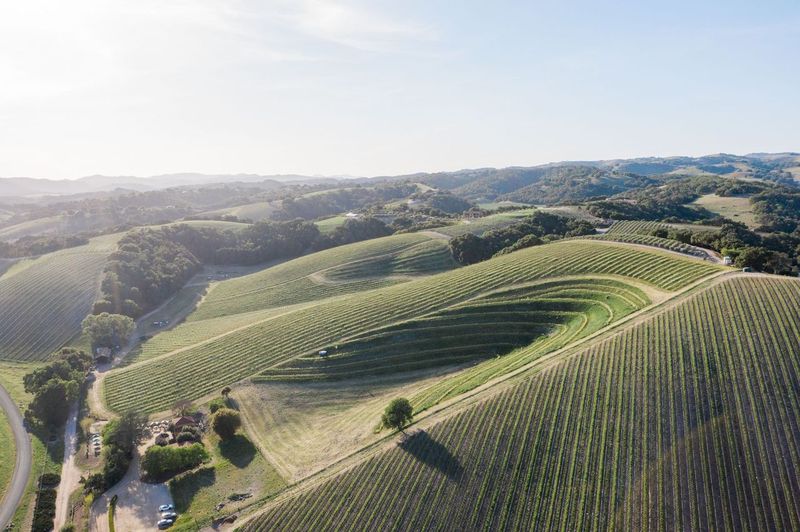
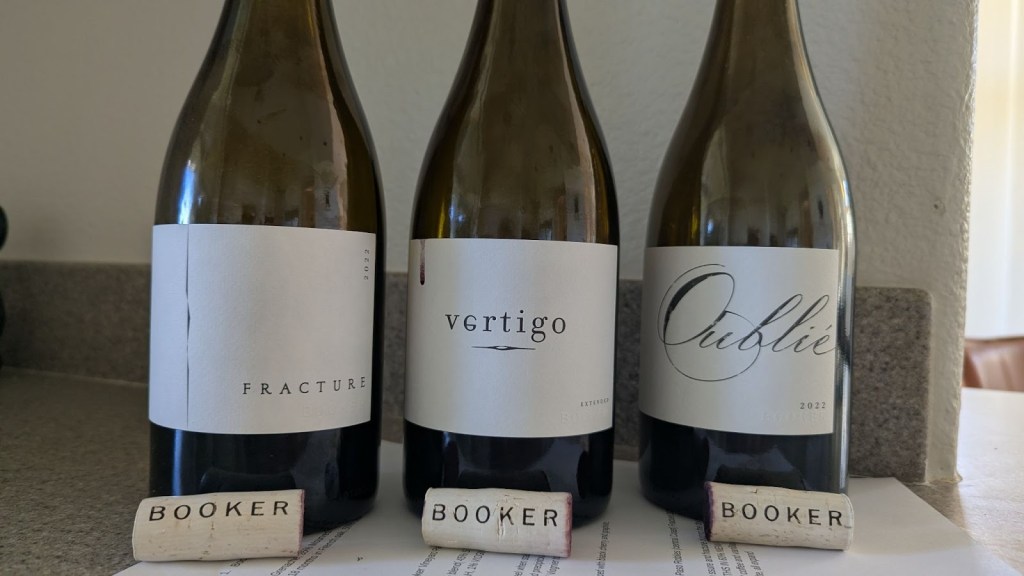
Since I don’t do lists, the wine is the 2022 Vertigo made by Booker Vineyard in Paso Robles. A 2022 Rhone blend that favored Syrah and Mourvedre with Grenache as a supporting actor, “Vertigo” owes its name to the steep slopes where the components are grown in the estate vineyards.
Since its first vintage in 2005, Booker Vineyard has amassed an impressive track record for wines from Rhone varietals. Along with Saxum and Denner, it brought the wine world’s attention to Paso Robles as home to cutting edge Rhone wines. Founder Eric Jensen who describes himself as the “Farmer-Winemaker,” accrued so many high scores from Parker and The Wine Spectator over its first ten vintages that Booker earned cult wine status.
The other 2022 Booker wines recently tasted provided proof positive that the winery is still functioning at the top of its game. Here are the reviews:
2022 Booker Vineyard Paso Robles (Central Coast) Vertigo $85
The “Vertigo” name is the winery’s way to emphasize the steep slopes of the estate vineyard. This 2022 is also a dizzying, intricate blend of 45% Syrah, 27% Mourvedre, 10% Grenache, 10% Tannat, 7% Petite Sirah, and 1% Viognier. In contrast to the Oublie, it is Syrah-driven with Grenache in the background and is distinctly different. All the pieces work beautifully together in this extraordinary rendition of a Rhone blend. It captures your attention immediately with lovely plum and raspberry aromas, with a hint of lavender. Plum and berry flavors are joined by an exotic hint of espresso and spice as it aerates in the glass. It was aged for 18 months in 50% new French oak, but both oak and tannin are minor players contributing to a lively, delicious finish. Enjoy now but it will reward cellaring for 3-5 years. 95
2022 Booker Vineyard Paso Robles (Central Coast) Oublie $85
“Oublie” refers to the Rhone varieties that were once forgotten, and the wine is usually Grenache dominated. In 2022 the blend was 40% Grenache, 35% Mourvedre, and 25% Syrah, and the wine was aged for 18 months in 50% new French oak. The aroma is action packed with fresh blueberries and cherry with bright floral notes. Full-bodied and lively with plum and berry flavors. Seamless with tannin hidden away and a touch of acidity in the finish. A fruit forward crowd-pleaser that’s so plush, smooth and integrated you never are aware of the high alcohol content. 93
2022 Booker Vineyard Paso Robles (central Coast) Fracture 2022 $98
This is 100% Syrah, and “Fracture” highlights the fact that during the summer months the mineral, limestone soils fracture and contribute to the slow ripening process. Aging was in French oak (60% new) for 18 months, and despite the warm vintage conditions, this wine shows intense fruit purity rarely seen from Syrah. It opens gradually to reveal blackberry-blueberry fruit with floral and clove or green tea nuances. The palate feel is dense and compact as the flavors unfold with black fruit and cassis in the forefront and cloves, tea and light spice in the background. Firm and concentrated, it finishes with integrated tannins. Nothing funky here, just rich, intense Syrah that should reward lengthy cellaring. 96
But it was not just the actual wines that had my head spinning: it was also the ownership. I learned that the year before, 2021, Booker was purchased by Constellation Brands, a large corporation that along with Treasury Estates bought and sold so many wineries over the last decade that, yes, one’s head keeps spinning trying to keep track.
Now that I’ve beaten that vertigo-spinning metaphor almost to death, let’s move on to an update of Booker Vineyards. What’s it like from the inside when a cult winery becomes part of a large corporate portfolio?
A Team Huddle
A few questions were tossed its way and Pete Turrone fielded them. He’s the general manager for Booker who is also part of the winemaking team. His role is this:
“I oversee all three brands as GM, Director of Winemaking and Viticulture. Molly Lonborg is the Sr. Winemaker in charge of everything made at the Booker facility. That is 100% of Booker wines, 100% of the Vineyard Designate wines for “My Favorite Neighbor,” a good portion of the My Favorite Neighbor Cab and a smaller portion of the Harvey & Harriet wines.”
When asked about founder Eric Jensen’s role today, Pete had this to say: “As Founder, he is on the road a lot promoting the brands. We talk on the phone often while he is travelling and his main residence remains on the property. He acts as mentor and guru for many of us on the team, including myself.”
Eric and Lisa Jensen live close to the winery and hospitality center and retain something like 35 acres. The hospitality center was a major project. It was, Peter explains:
“The amazing hospitality center and cave system that we enjoy was entirely conceived of, built, and debuted under the direction of Eric and Lisa Jensen prior to the sale to Constellation Brands. It was their passion project to bring to Paso some of the opulent luxury you might find in Bordeaux or Napa but marry it with the easy, laid back vibes of the Central Coast. Working with top notch architects, designers and contractors, every decision was routed through them. Lisa has an innate knack for design and was instrumental in creating comfortable spaces with calm, confident and inviting luxury. Eric got to build the dream cave, wine library, and elevated tasting lounges that were able to rise to meet the quality of his wines.”
After the sale, what did change at Booker was behind the scenes. “There was more support for infrastructure, staffing, and long-term planning. “We didn’t have to cut corners anymore,” Peter says. “We could double down on what we were already doing well.”
One of the first changes was winemaker Molly Lonborg’s project to get Booker wines labeled ”Made with Organic Grapes,” a subtle change that signals a big message.”
From The Winemaker’s Point of View
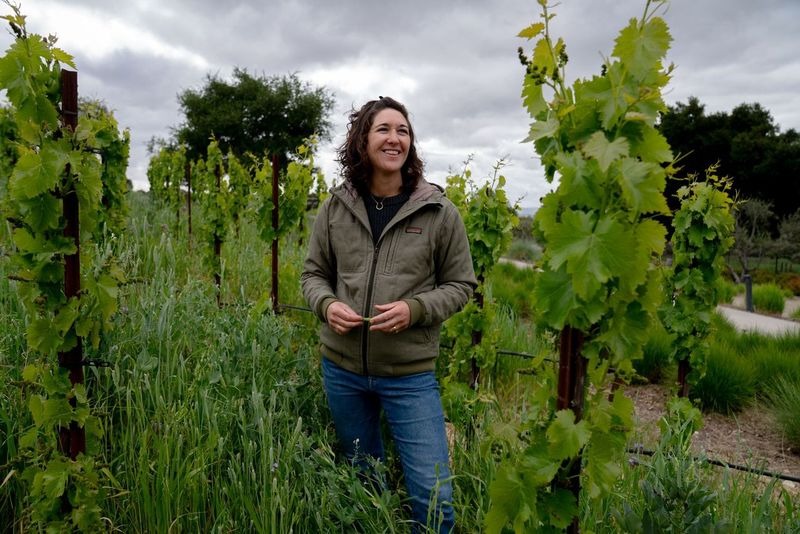
To learn more about wines like Vertigo and its estate grown stablemates, I asked Molly a few questions. Molly, a graduate of Cal Poly in San Luis Obispo, gained experience at two local wineries. She joined Halter Ranch in Paso Robles in 2011 and rose through the ranks to the position of Associate Winemaker. In 2020, Lonborg took the head winemaker position at Alta Colina Vineyard & Winery in Paso Robles. Now with Booker, she focuses on Booker wines and assists with General Manager Peter Turrone, and works closely with him and Senior Vineyard Manager Hilary Graves.
I first wanted to know more about the wines under the two other labels. “My Favorite Neighbor” Cab is sourced from very special sites throughout the West Side of Paso Robles, primarily the sub AVA’s of Willow Creek, Adelaida and the regions of the Templeton Gap that are west of Hwy 101. “Harvey & Harriet” Reds are from the greater Paso Robles region. The whites from both programs are sourced from Edna Valley and the SLO Coast AVA, with a little coming from Paso as well.
Q. Since you work with several, what sets Willow Creek apart from other AVAs in Paso Robles?
“From a winemaker’s perspective, it stands apart because of its unique combination of climate and soils. The coastal influence of the Templeton Gap brings meaningful cooling, resulting in lower daytime highs and fewer cumulative heat hours than many other parts of Paso. Cool ocean air often begins moving into the AVA while other areas are just reaching their hottest point of the day.
That moderation, paired with pockets of high-calcareous soils, creates wines with remarkable depth and intensity without sacrificing freshness. The vineyards are often tucked into hillsides and interspersed with native oak trees, giving the area a sense of intimacy — smaller sites with distinct personalities. Our Vineyard Manager, HilaryGraves, often notes a signature “jasmine tea” character in Willow Creek wines, a beautiful aromatic marker that I’ve come to recognize and love.
Q. Is limestone the key to the “natural intensity” of the fruit you talk about? Or just how does the soil composition come into play in your sites?
Limestone and high-calcareous soils play a significant role in the natural intensity of our fruit. The Willow Creek District was once under the ocean floor millions of years ago and tectonic activity lifted those marine sediments to form the coastal mountain range.
Those calcareous rocks serve as the parent material for our soils. These soils often have pH levels in the high 7s to low 8s. Interestingly, more basic soils tend to correlate with greater natural acidity in the resulting wines.
High-calcareous soils also moderate vine vigor, encouraging roots to work harder and naturally limiting excessive growth. When paired with controlled water stress, this can lead to smaller berries with concentrated color, texture, and depth. Our estate includes both calcareous and siliceous soils, but we consistently see themost intense fruit coming from the diagonal band of calcareous soils that runs throughthe property. Soil composition is not the only factor, but it is foundational to the expression of our site.
Q. What are the white varieties you enjoy working with and is the Edna Valley favored over Paso for white varieties?
I personally love making white wines, particularly white Rhône varieties. At Booker, we grow Chenin Blanc, Viognier, Roussanne, and Marsanne, varieties that thrive in our warm, sun-driven climate while retaining texture and character.
Paso Robles can be too warm for certain varieties like Chardonnay and more aromatic whites such as Riesling, Grüner Veltliner, or Gewürztraminer. Regions like Edna Valleyand the SLO Coast AVA, with their stronger marine influence and cooler overall conditions are especially well-suited to those styles.
Q. How does farming by Regenerative organic practices impact the vine and the wine?
Regenerative Organic farming begins with the soil. We view the soil as a living ecosystem, and our goal is to nurture it so that it can, in turn, support healthy, balanced vines. When soil biology is thriving, vines develop stronger immune systems, greater resilience to heat and pest pressure, and the capacity to produce high-quality fruit consistently over time.
Detailed vine nutrition, combined with regenerative practices, creates plants that are balanced rather than forced; capable of withstanding challenging growing conditionswhile maintaining integrity and longevity.
Regenerative farming also encompasses the human element. It prioritizes the well-being of everyone who works on and interacts with the property. When the people caring for the vines feel respected, valued, and purposeful, that intention carries through from vineyard to bottle.
Q. On your blends: how and when do you decide to include Chardonnay in the White and, say, how much Syrah or Mourvedre goes into the final red blend? And are there wide differences from vintage to vintage?
“Over time, our approach to Booker White has evolved to more fully reflect our estateand farming philosophy. Today, we rely on estate-grown Chenin Blanc to bring the weight and texture that Chardonnay once contributed. Chenin thrives in our site and climate, and it allows the wine to feel both structured and vibrant while remaining true to our property.
Beginning with the 2025 vintage, the entire Booker portfolio will carry “Made with Organic Grapes” on the label, along with CCOF and Regenerative Organic Certified(ROC) designations which is an important milestone for us.
For our red blends: “Oublie” (Grenache, Syrah, Mourvèdre) and “Vertigo” (Syrah,Grenache, Mourvèdre, along with select blending components), we don’t begin with predetermined percentages. Instead, we blend toward balance and deliciousness. While we often hope “Oublie” will lean heavily on Grenache; we allow the vintage and the wines themselves to guide the final composition. These blends can be the most challenging and rewarding to craft because we are working with many potential components, it’s like assembling a complex puzzle.
Vintage variation absolutely plays a role. For example, 2022 was the hottest vintage on record and one of the earliest harvests of my career, followed by 2023, one of the coolest and latest since 2011. The wines naturally express those differences in texture, structure,and aromatic profile. Neither is better, they simply reflect their growing season.
Because we work exclusively with estate-grown fruit, there is continuity in our wines from year to year. Often there are specific blocks that make it into specific wines year over year. At the same time, those blocks can surprise us, expressing themselves differently depending on the vintage and sometimes finding a better home in a different blend.
These are truly terroir-driven wines, and subtle variation is part of their authenticity.
Q. And how does barrel aging program work with the emphasis on terroir?
At Booker Vineyard, we’ve developed a somewhat unconventional approach to barrel aging that’s really become part of our identity. Each year we produce five core red wines, and for each one we bottle two separate expressions: one after 18 months in barrel and another after 22 months. The latter bottling is labeled “Extended.”
It’s a thoughtful way to let both us and our members experience how additional time in barrel shapes the same wine. Coming into this role, I assumed I might consistently prefer the 18-month bottling for its freshness and precision. What I’ve learned, though, is that it truly depends on the vintage. In some years, that extra four months allows the tannins to knit together more seamlessly, creating a broader, more polished texture. In other vintages, the earlier bottling preserves a vibrancy and aromatic lift that feels more aligned with the wine’s personality.
With extended aging, tannin integration is usually the most noticeable shift. The additional time can soften and harmonize structure, but it also increases the imprint of oak, so we’re careful with barrel selection and toast level to ensure the fruit remains at the forefront. Ultimately, the goal isn’t to make one “better” than the other, but to explore dimension, showcasing both the diversity and the evolution that our site can offer.
The Corporate Message
So turning back to Peter and asking about any other changes under new ownership.
In the early years Booker sold grapes to Saxum and other neighbors, but not in recent years. “The only exception is that we recently purchased an adjacent property previously owned by Carl Bowker (Caliza). Part of the agreement was to sell him back some fruit for a limited number of years.”
There is a new GSM wine to the roster, PERL, which is all about finding gems, or what Eric calls “pearls, at other vineyards. It gives us the freedom to bring some of our favorite local vineyard blocks into the Booker fold.”
Otherwise, the Booker Vineyard team was “given one clear directive from above—don’t mess it up.”
And my advice to Corporate
Don’t mess it up!!

 Norm Roby's Unfiltered Guide to Savvy Wine Shopping