In January of 2024 record-setting frosts damaged many vineyards in British Columbia’s Okanagan Valley and pretty much wiped out the vintage. Having visited the B.C. region recently,
I published an article last month about how winemakers there are coping with the frost damage and the steps taken to see them through the rough spell this year.
The article, entitled “Climate Change, Border Crossings, and Dual Citizen Wines,” was posted at www.winereviewonline.com Spoiler alert: it was all about wine, not political.
The Okanagans had to chart an entire new course to have wines to sell from 2024. And they did, with most going across the border to Washington and Oregon. So far, many of the vineyards have recovered and the 2025 harvest is underway in Okanagan Valley.
I also realized since posting that article that wines from Canada’s British Columbia, particularly the Okanagan region, are not well known outside of Canada. A few wine scholars may think of Canada as the home of hybrid varietals and Ice Wine. But that’s Eastern Canada.The Okanagan Valley sits above Washington State. It is a relatively young region and almost half of the wines made are sold direct from its wineries.
My interest in Canadian wine is more personal, and to be upfront, I’m a dual citizen. Until recently that was no big deal. But now? Anyway, in normal years, the wines from Okanagan Valley are quite distinctive in a fruit-forward, food-friendly style. I’ve enjoyed a number of them and am happy to share what I’ve learned.
So British Columbia today has about 14,000 acres of vineyards and around 350 wineries, with 90% of the vineyards in the Okanagan Valley. That makes it fairly comparable in size to Mendocino County and slightly larger than the Sierra Foothills wine regions.
As a vinifera wine region, the Okanagan Valley in Canada came to life in 1990 with the formation of the British Columbia Wine Institute. Several events occurred earlier to start turning things around. In 1974 when most vineyards were planted to hybrids, the BC government imported 4,000 vinifera vines and between 1977 and 1982 conducted experiments in 18 different sites. As a result, some 33 vinifera varieties made the cut by demonstrating an ability to ripen and produce quality wines in the Okanagan.
Also in 1990, the BC Vintners Quality Alliance was formed and the VQA designation which guaranteed authenticity became a rallying cry. Displayed on labels, “BC VQA” means the wine
was made 100% from BC grapes. Not exactly complicated or detailed, but this was enough to spark major growth.
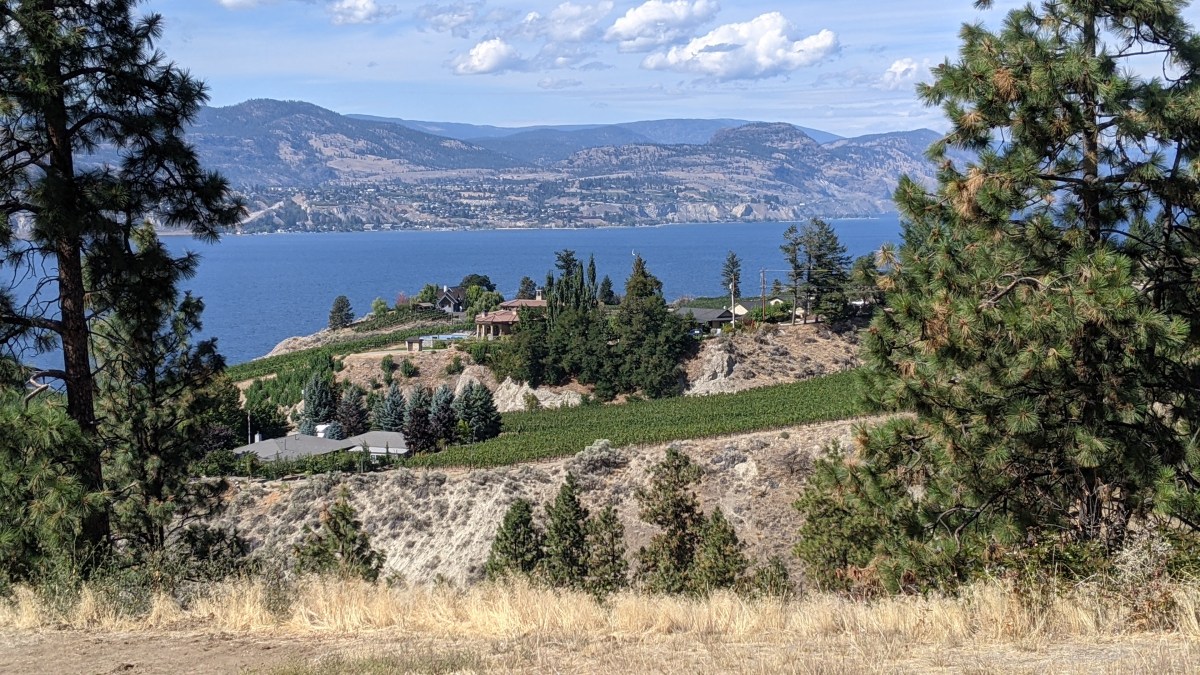
Most wines are labeled “Okanagan Valley, BC VQA” as their origin, but within that area are over a dozen sub-regions. But within each sub-region, the growing conditions vary widely due to elevation, aspect, proximity to a lake or a river, and soil types. For instance, the east side of Lake Okanagan is much warmer than the west side of the Valley because it receives hot afternoon sun well into the evening. There can be ripening differences of as much as two weeks for the same variety at the same latitude depending on which side of the valley it is planted.
Kelowna and Penticton are cities that contain two major sub-regions. Located at the southern end of the Lake, Penticton is a lively village and some 85 wineries are within a 20 minute drive.
The lake is, of course, the Okanagan Lake, a deep one gouged out by glaciers that is 85 miles long and 3 miles wide. It seems omnipresent but as you drive around the steep hillsides seeing lava rocks here and there you also sense the presence of Mt. Boucherie, a once active volcano.
While most wine regions claim to be unique in some way, the Okanagan Valley with its history of glaciers and volcanoes is unquestionably unusual, arguably unique. Then factor in the location, the 49th parallel east of the mountains in British Columbia, and it is a kind of high desert made semi-arid as the mountains keep annual rainfall totals low.
When compared to Napa Valley, the Okanagan enjoys at least 2 extra hours of daylight from July through the harvest. That’s according to winemakers who add that the season is short as budbreak occurs much later. In other words, different from any other wine region.
Kelowna
The Kelowna area stretching from Peachland up to the north end of the Okanagan Valley has the coolest climate. This makes it an area well suited to earlier ripening varieties. Tantalus won me over with its Chardonnays and neighbor Spearhead Vineyards is a bona fide Pinot Noir specialist. Pinot Noir dominates here with 27% of the acreage while Chardonnay, Pinot Gris and Riesling together cover another 40%.
Summerland, a lakeside village south of Peachland, is home base for two dozen wineries, including one of my favorites, Dirty Laundry. Evolve Cellars is another quality-minded winery.
Naramata Bench
Many wineries can be found on the Naramata Bench as you travel along the eastern side of the lake from Penticton north to the tiny village of Naramata. Several wineries here, such as Da Silva, Hillside Winery and Popular Grove, are also classy bistros with excellent food to go with the fine wine. The west-facing vineyards of Naramata Bench and Skaha Bench can ripen later ripening varieties in their warmer sites. Merlot, Pinot Gris, Pinot Noir, Chardonnay and Gewürztraminer are the most widely planted varieties there.
One fascinating new-ish region is the hard to say Similkameen Valley. A little northwest of Osoyoos, this region now has 17 wineries located along the river.The current vineyard acreage is 768, with Merlot, Cabernet and Cabernet Franc leading the way. Chardonnay and Riesling are the primary white varieties. I didn’t get there, but two wineries making terrific wines are Orofino and Corcelettes Estate Winery. Both, interestingly enough, make high quality Syrah. The 2019 Syrah from Corcelettes was a stunning, rich, and flavorful version.
The Golden Mile
Then there is The Golden Mile sub-region located within the larger Okanagan Valley Geographical Indication (GI). It is British Columbia’s first sub-GI having gained its status as a recognized sub-region in 2015. It is situated just south of Oliver and consists of four creeks, each with their own alluvial fan. One of the four creeks is Hester Creek, which runs along the south side of the Hester Creek Estate Winery. The total acres under vine is just over 800. Two of the leading wineries, Tinhorn Creek Vineyards and Hester Creek, have enjoyed success with Viognier, Syrah, and Cabernet Franc.
With so many outstanding wineries along the route, you can easily spend 4-5 days exploring the diverse regions along and near Lake Okanagan and the Similkameen Valley.
As is true of most wine regions, vintage ratings are vague buying tools at best. And since 2024 was a wipe out and most wines are from Washington and Oregon grapes, it was an odd year. The previous year, 2023, was good overall and just about every region was celebrating the 2022 harvest. Many red wines from 2022 are now on the market.
The notes that follow include wines from recent vintages and will, I hope, give you some insights into what Okanagan wines are all about as you browse through them. My general takeaway is that both the whites and reds share a food-friendly style and are not trying to knock your socks off or whatever cliche applies. The prices quoted are Canadian dollars.
Wild Goose Vineyards Okanagan Valley, British Columbia (Canada) Pinot Gris 2023 $22.
After its founders established a solid track record for white wines, the Wyse family of Burrowing Owl Vineyards acquired the winery and vineyards in 2021. Happily for fans, its winning streak with Pinot Gris continued with this 2023. The aroma is a pleasing mix of ripe pear and apricot, and the flavors are lively. Smooth in texture, it is medium bodied and finishes with good length thanks to some citrus notes. Solid, all-purpose version that rises above the crowd.
91
Hester Creek Estate Winery Pinot Gris Viognier Columbia Valley (Washington) 2024 $20
Part of the winery’s Columbia Valley Collection created when its home vineyard in Okanagan suffered severe frost damage, this wine is a blend of 70% Pinot Gris and 30% Viognier. Both varieties were hand harvested and transported in refrigerated containers across the border the same day to the winery. Once there, the two varieties were crushed and fermented separately and blended afterwards. It is a lively, smooth and refreshing white with bright lemon and nectarine on the nose.The flavors combine citrus and peach along with a touch of minerality in the aftertaste. With airing a floral background emerges for added interest. Quite a successful
quaffable white on its own, but more impressive given the behind the scenes challenges.
90
Blasted Church Vineyards Washington State Hartfield’s Fuse 2024 $18
To replicate its popular white blend, Okanagan’s Blasted Church sourced grapes from the Certified Sustainable Andrews Family Vineyards in Washington’s Horse Heaven Hills AVA. The final blend is a mix of Pinot Gris, Riesling and Viognier, and the initial aroma shows a definite Riesling floral component with a touch of citrus. Medium bodied and smooth on the palate, it has more peach like flavors and seems to have a touch of sweetness. But then the acidity perks up and balances the finish. 88
Spearhead Winery (Okanagan Valley) Pinot Noir “Cuvée” 2019 ($42)
This is the winemaker’s best cuvée selected from barrels, and the final blend is a mix of Dijon clones plus the Mt. Eden and Pommard Pinot clones. The wine was fermented in the traditional approach as were the 3 vineyard Pinots, but with the difference that this was aged in more (40%) new French oak. It is full of ripe black cherry, rose petal and spice along with a hint of toasty oak. This is a very integrated and velvety smooth Pinot with some refined tannins. But as was true of all these Pinots, there’s an underlying layer of vibrancy which is associated with the wine’s natural acidity and low pH. 430 cases made. 94
Spearhead Winery (Okanagan Valley) Pinot Noir “Coyote” 2019 $36
This is sourced from a vineyard in West Kelowna with highly volcanic soil and situated at 1,300 ft elevation. It is planted entirely to the Dijon #115 clone, which is said to be one of the few clones that can stand alone. A few winemakers in Santa Barbara believe in it. At Spearhead, the winemaking is Burgundian with de-stemming, cold soaking and fermenting with native yeasts. This one was aged 13 months in French oak, 25% new. It comes across with light cherry and forest floor earthiness, and is medium-bodied. Very lively on the palate. It has a long finish that accentuates its cherry, herbal side and also shows definite tannins. 350 cases made. 90
Black Sage Vineyard Okanagan Valley, British Columbia (Canada) Cabernet Franc 2022 $28
The winery makes this Cab Franc from 25 year old vines grown in southern Okanagan where the variety has enjoyed good success. It was aged for 12 months in French and American oak. The aroma is simply amazing with black tea, plum and tobacco leaf coming at you. Full-bodied, It has flavors that are at once earthy and berry-like with a hint of bell pepper. With light tannins, this is one to aerate and enjoy now or lay it away for a few years. 93
Gray Monk Cellars BC VGA Okanagan Valley Monk’s Blend 2022 $18
This blend of Syrah and Cabernet was introduced in 2019 and the ‘22 is made from grapes grown in Okanagan & Similkameen. It was aged in French and American oak for 18 months.
Deep in color, it offers a lovely aroma of plum and black fruits and from there on impresses as an approachable, food-friendly, and solid rendition. With subtle black olive, pepper and soft tannin coming through on the palate, it finishes on a youthful note. It is a good example of blended red wines that are made to please, rather than overwhelm.
Burrowing Owl Estate Winery Okanagan Valley (British Columbia, Canada) Cabernet Franc 2021 $35
Located in the town of Oliver in the South Okanagan Valley, Burrowing Owl was founded in 1997 by the Wyse family. Since then it has shown the way in Canada for Bordeaux-inspired wines, particularly Merlot. In 2021, said to be a warm vintage, it came up with an impressive, concentrated and complex Cab Franc. It was aged for 16 months in a combination of French, Hungarian and American oak. The aroma offers plum and cassis with light tobacco and dried herbs notes. Big and smooth on the palate, it comes across with lovely ripe berry and plum flavors, light oak and spice. The tannins are gentle, providing structure and adding length. Excellent now and should drink well over the next several years. 93
Dirty laundry Vineyard Okanagan Valley, (British Columbia, Canada) Merlot 2022
Based in Summerland, this small winery was a fun, laid back place to visit. Its ‘22 Merlot was aged 18 months in small oak and comes across as a rich, round wine ready to drink. It has a generous aroma of ripe black plum with a hint of tea and dried herbs. The texture is smooth and plush, and the fruit-forward flavors are complemented by light tannin. The rich palate is especially appealing. 90

 Norm Roby's Unfiltered Guide to Savvy Wine Shopping