In 1988, Steve Edmunds, one of the original Rhone Rangers, was looking for new sources of Mourvedre and Syrah for his Edmunds St. John winery. He was referred to Richard Bush, owner of El Dorado County’s pioneering Madrona Vineyards, who introduced him to a nearby grower. And soon Edmunds St. John was making an El Dorado Syrah. It was and remains one of the finest. More recently, his Edmunds St. John Gamay from El Dorado is a beauty.
Steve, who was responsible for the clever Rhone Ranger designation, summarized his experiences: “ Over the years the Barsotti Vineyard in El Dorado planted, at my request, or urging/suggestion: Syrah, Grenache, Gamay, Mourvedre, Vermentino, Grenache Blanc, Pinot Gris, Cabernet Franc. Each has performed admirably, and in some cases, spectacularly.”
That’s certainly high praise and in fact from my recent experience, a great case can be made that El Dorado, still a well kept secret, may be the mother lode of terroir driven wines. Well, at least it checks most of the boxes.
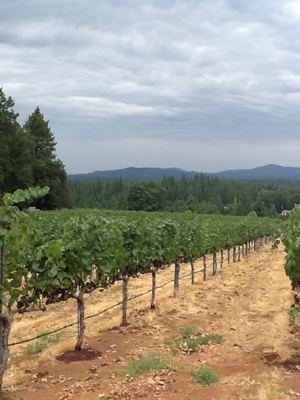
Unusual location? Check. It is one of the few U.S. appellations defined entirely by elevation, which ranges from 1,200ft-3,500ft. The region’s elevation and proximity to the alpine terrain of the Sierra Nevada Mountain strongly influences the grapes and wine.
Special soils? Check. The majority of the vineyards in El Dorado are planted in young volcanic, granitic, and slate soils. The soils are thin and lack a permanent water table allowing growers to control the availability of water during the growing season. Vine roots extend deep below the surface which many experts feel is a key to terroir.
Different growing conditions? Check. Budbreak is 2-4 weeks later than Coastal regions. Heat spikes are rare. Vines enjoy longer daylight hours. Harvest is under cool conditions in late September into October.
High quality wines? Check. But El Dorado remains under the radar for now. But not for long.
Now with over 80 varieties being cultivated, there’s much more than Zinfandel in these ther hills. In recent years, winemakers looking for special wine have discovered El Dorado. A few like Marco Capelli, long time Swanson winemaker, and Joe Norman from Heitz Cellars have settled in. Recently, more and more outsiders like Helen Keplinger, Donkey & Goat, Jolie-Laide, Belong Wine, Tank Garage Winery, Rombauer for Zinfandel and Edmunds St. John, to name only a few, regularly source El Dorado varieties that offer something not found in their home area.
A Little Background
Gold was discovered in 1848 and those old mining towns later remained alive as vineyards caught on and grew to over 2,000 acres. Then Prohibition came along. Vineyards were abandoned and its wine history buried.
El Dorado, 40 miles or so east of Sacramento and within driving range of Lake Tahoe and Reno, remained flatlined during the 1960s when California wine was re-born. It started its comeback In 1972 when Boeger Winery became the first modern-day winery in the El Dorado AVA. Greg Boeger became a pioneer by experimenting with lesser known varieties such as Barbera, Carignane, Refosco, Charbono, and Aglianico, just to name a few of the over thirty varietals that the winery grows today.
In 1980 Madrona Vineyards settled in to offer several El Dorado grown wines, including remarkable vintages of Riesling and Gewurztraminer. Today Maggie and Paul Bush, the second generation, continue with their winery’s outstanding Rieslings, but now cultivate 25 varieties at their 3,000 foot elevation vineyards.
Setting the Gold Standard Today for Terroir Wines
As the region slowly came back to life, these pioneers set the tone for taking the less traveled road. Both remain family owned, and today Barbera is Boeger’s flagship wine and it sets the bar high for first rate Barbera. Meanwhile, Madrona offers a Grenache and Syrah that are at the top of their class. With their help, the El Dorado A.V.A. was established in 1983 and has since grown to encompass over 2,000 acres of grapes and is now home to over 70 wineries.
Attracting mavericks making wines from unsung or obscure varieties at high elevation sites in a remote corner of California is only a part of the El Dorado story. But If you seek out wineries that are specialists and happen to love Rhone wines, then a newcomer, Holly Hill’s Vineyard, merits your full attention. Within its full range of Rhones, this winery is going all out to explore Mourvedre. Right now, Holly Hill’s offers six wines made entirely or in part from Mourvedre, including a Vin Doux dessert wine. The real attention getter is its 2020 “Patriarche,” a GSM blend that is 41% Mourvedre.
However, in my review of El Dorado, the most important box checked is high quality, distinct wines. When tasting through a selection of El Dorado wines, I kept noting the balance, solid structure, and concentration. The varietal wines came across as ideal benchmark wines. Boeger’s Barbera, Miaflores Malbec, Lava Cap’s Cabernet Sauvignon, Madrona’s Grenache, Element 79’s Syrah, and Cedarville’s Viognier…all true to type, unmanipulated wines loaded with old fashion varietal character.
With El Dorado, I rediscovered wines that, well, taste like wine. Powerful, but well-mannered. Wines that are not trophy culty wines but rather beg to be enjoyed with food.
Regarding the uniqueness of El Dorado wines, several winemakers suggest that the mountain elevations result in Increased exposure to UV radiation which leads to lower berry size, and a higher ratio of skin to juice in red wine. “This combination of hours and intensity of sunshine leads to ripening conditions unique to El Dorado, and are critical in shaping the character of the wine.”
Paul Bush of Madrona draws from his family’s 40 years of experience and sees the soils as another key. He explains, “The Aiken Clay soil is a volcanic decomposition soil that is relatively fertile and drains beautifully. This soil series for us has a pH level of between 5.7 to 6.2. My understanding is that high pH soils give more mouthfeel. Low pH soils give more elegance and varietal focus. And since we have the sun, we generally already have the tool for working with mouthfeel. I’ll take elegance and varietal focus.”
And he continues: “But once we get into fall, the days shorten, our temperatures are often cooler than other regions during the day, but our nights aren’t so cool that the vines shut down. All in all, it’s perfect (in my humble opinion).”
Whatever the underlying factors may be, El Dorado wines have, in my not so humble opinion, their own distinct and engaging personality.
Current Wines: All Terroir Driven
2020 Holly’s Hill Vineyards El Dorado “Patriarche” $38
For its GSM Châteauneuf-du-Pape rendition, the winery makes Mourvedre the lead with 41% followed by Syrah at 38%, with 11% Grenache and 10% Cournoise. And the winemaker is said to get first dibs on each to assemble this blend. The wine is aged for 10 months in neutral French oak. Well, this wine is enormously appealing with lots of spice, cranberry, black pepper and savory flavors. Medium full bodied, it has a solid core of ripe fruit that is vibrant and persistent. It unfolds with each sip, showing a slight earthiness and smooth tannin. It is
much more complex and refined than most GSM wines. 95 points
2020 Cedarville Vineyards El Dorado Estate Bottled Viognier $25
Offering a mix of wines, Cedarville organically farms 15 acres and was the first to plant Viognier in the area. With twenty vintages now under its belt and working with Viognier on the coldest, north facing site, it has learned to harvest on the earlier side of ripeness. And the end result is a distinct, and full bodied style. The primary fermentation is finished in barrels and with lees stirring, the wine is bottled unfiltered. In the glass it shows a bright, light yellow color and its aroma displays meyer lemon, lemon zest and lychee nut along with a floral note. But on the palate, this is full throttle with round, mouth filling pear & citrus flavors that are lively yet viscous. And it surprises with its lovely rich texture and a slight fresh lime and acid tingle in the finish. 92 points
2019 Boeger Winery El Dorado Estate Barbera 2019 $30
From the pioneering winery, Barbera is made in several versions with the Estate being the standard bearer.
From 3 high elevation sites, the Barbera is harvested as late as mid-October, and is blended with 9% Cabernet. Aged for 14 months in neutral French and American oak, it is a big mouthful of a wine that has an amazing structure and somehow remains vibrant and refreshing. With a little airing, it displays the lovely blackcurrant, dark berry and spice side of Barbera with nicely layered flavors that are surrounded by fine grained tannins. It can be aged for many years, but I found it appealing now with its solid core of fruit and rich texture. 94 points
2020 Edio Vineyards at Delfino Farms Estate “Robyn’s Blend,” El Dorado $32
Highly regarded for their apple orchards and bakery, the Delfino family have been farming in El Dorado for 60 years. After studying at Cal Poly and gaining wine experience in San Luis Obispo, the third Delfino generation (2 brothers and a sister) planted vines in 2007 and named the winery after their grandfather, Edio. In 2017 they ventured into winemaking, and based upon this wine, they are super talented and Edio could well be a rising star. Robyn’s blend is 75% Viognier and 25% Roussanne, co-fermented in barrels and aged in French oak (10% new) for 5 months. It has a lovely aroma of fresh sliced pear and honeysuckle, and its flavors pick up a touch of peach, citrus and oak spice. Smooth and viscous, it has a good touch of acidity to keep it lively right through the aftertaste. Holds up well to chilling 93 points
2017 Element 79 Vineyards Fair Play, El Dorado County Syrah $40
As some of you may recall from your high school chem class (and to save others from embarrassment) element 79 is gold. In 2016 Les and Sharon Heinsen purchased property and an established 32 acre vineyard in El Dorado County. The 2017 vintage was a few weeks early with the Syrah picked on October 5th. Consulting winemaker Scott Johnson harvested some Viognier on the same day and the field blend was fermented in open top tanks. With 2% Viognier, the wine was aged for 20 months in French oak, 44% new. Dark in color with beautiful upfront black fruit aromas of blueberry and plum and, with some airing, a hint of lavender pokes through. It is silky smooth in texture and the flavors expand to showcase berry, dried herbs and spice with refined tannins in the finish. Despite the declared alcohol of 14.5% it comes across as youthful, vibrant and charming. It should develop even more complexity with short-term cellaring. 94 points
2019 Starfield Vineyards El Dorado, Cinsaut $32
Seldom bottled as a varietal, Cinsaut, also spelled Cinsault, is more often found in a Rose. It is used as a blender for red wines in the Rhone and elsewhere. But Starfield and several neighbors in El Dorado are giving it a fresh look on its own. From its 31 acre vineyard, Starfield produces several Rhone wines as well as others in its “Mountain Mediterraneans” program. Fresh picked strawberry and cranberry juice dominate the expansive aroma in this medium light-bodied red. Without any noticeable tannin, iit really turns on the charm as its lively flavors expand across the midpalate with fresh berry and spice and red fruit that all persist well into the aftertaste. More than a summer sipper, this is a versatile food companion. And delicious. 91 points
2019 Holly’s Hill Vineyards El Dorado Fenaughty Old Vines Syrah $27
This new Rhone-centric winery is on a hot streak, especially with Mourvedre and Syrah. This old vine Syrah is concentrated and focused. Dark garnet, almost black in color, it displays spicy, earthy, some leathery aromatics along with black olive. On the palate it is dense, with savory ripe black fruits and dried herbs with a hint of pepper, all with light tannin as a backdrop. But everything is under control and the wine opens up beautifully over time. Give it at least a year or two, and you’ll be thrilled. 93 points
For more specific wines, see all the El Dorado reviews at winereviewonline.com

 Norm Roby's Unfiltered Guide to Savvy Wine Shopping
thanks…and enjoyed reading your articles
LikeLike