The Rogue Valley’s Diverse Wines

Exploring the Diverse Wines of the Rogue Valley 

Seeking out unusual wine regions for their great diversity seems to be high on the must-do lists for today’s sommeliers. At least, the hard working SOMMS.  Makes sense because discovering new wines and/new regions pretty much validates their jobs. Recently the head of sommselect.com singled out the Santa Cruz Mountains AVA for its success with Pinot Noir and Syrah among others. He ended by praising Santa Cruz as “one of the few regions anywhere in the world hospitable to such a diverse range of varieties.” 

Really? Now that “diverse range of varieties” phrase struck a chord. Coincidentally over the last 2 years, I’ve been interested in the same subject.  Well, as much as I enjoy wines from Santa Cruz, there are other regions working with a far wider range of varieties that make Santa Cruz seem normal. 

Santa Clara County, for example, has all of the mainstays, all of the Rhones, and, thanks to Guglielmo,  some unusual Italian varieties. An even wider range of varieties was encountered during my visit to the Okanagan Valley. Not just a few remaining hybrids, but there’s an exciting diversity there including many obscure vinifera grapes like Chasselas and Pinot Auxerrois, both made into impressive wines.

What also ties these two regions together is neither has what could be called a signature wine. A wine that consumers automatically equate with that place, like Napa Cabs or Amador Zins.

So this lack of a signature wine leads us to another region where winemakers actually seem to enjoy working with a diverse range of varieties: the Rogue Valley in Southern Oregon. Because it has so little in common with the Willamette Valley, winemakers get a little touchy if you refer to it as “The other Oregon” wine region. 

Yes, Pinot Noir and Chardonnay are grown here, but so too are Cabernet, Zinfandel along with Spanish, Italian, and the full range of French grapes. And one or two Portuguese.

How Do you Define Diverse?

 In the Rogue Valley, it is common to grow a dozen or more varieties within a small estate. Established in 2004, Quady North has 15 acres under vine and grows 12 different varieties. Most are Rhone grapes, but it also farms Cabernet and Cabernet Franc. On its 40 acre estate vineyards, Schmidt Family Vineyards in Applegate Valley grows 14 varieties, and produces 6,700 cases a year. It also makes 25 different wines in a given year.

Its neighbor, Wooldridge Creek, one of the oldest wineries, has 56 acres planted to twelve varieties: Cabernet Sauvignon, Merlot, Cabernet Franc, Syrah, Chardonnay, Pinot Noir, Viognier, Sangiovese, Zinfandel, Malbec, Petit Verdot and Tempranillo. And a similar wild assortment is seen in many, many other wineries across the entire Rogue Valley. The Weisinger Family, on the eastern edge in Ashland is said to specialize in Tempranillo, Pinot Noir, Rhone and Bordeaux varietals, as well as proprietary blends. Quite diverse for a 3,000 case annual output.

But are these wineries growing a dozen or more varieties like the proverbial jack of all trades, master of none? It seems crazy for small vineyards to grow grapes from Bordeaux and Burgundy, along with the Rhones. Then add a few from Spain and Italy and it seems way beyond normal. 

At Belle Fiore Winery, where 56 acres are planted to such a wide mix which includes many unusual Italian varieties, the owners have identified what they call “16 micro-blocks” based upon soil types and elevation. Two-Hawks’ winemaker, Kiley Evans, has singled out several blocks based on soil types led by a Darow Series of wine grown in one predominant soil. So the soils and sites are indeed diverse.

NOT THE WILLAMETTE VALLEY

Taking its name from the Rogue River, the Rogue Valley wine region wears that rogue title well. Approved as an AVA in 1991, the Rogue Valley is the southernmost growing wine region of Oregon and the Valley is 70 miles wide by 60 miles long. The area runs from Ashland in the southeast through the north and south sides of Medford and stretches to Grants Pass in the west. 

Today, this high elevation (1,000-2,300 foot level) generally mountainous growing area is home to 100 wineries. While most of these wineries started after 2000, the Rogue Valley is Oregon’s oldest wine region, with first vineyards planted in the 1850s. And it is home to the State’s first operating winery opened in 1873. 

Vineyards have been expanding recently and now cover around 5,000 acres, growing no fewer than 70 varieties. Yes, from Albarino to Zinfandel, the roster includes the obligatory Chardonnay and Cabernet and, no surprise, Pinot Noir. But with vineyards planted at different elevations with different aspects, the Rogue is no Willamette.

Because most of today’s vineyards were developed after 2000, many wines, Rhones, Spanish, or Italian, are likely made from relatively new vines. Typically, vineyards are densely planted and organically grown with “sustainable” a popular theme.

Dancin is one of a handful on wineries making a Pinot Noir, but as owner Dan Marca explains,

“ Our site was created for Pinot Noir and Chardonnay with its north, northeast facing aspect, 1800 foot average elevation and shade occurring beginning at 5:45pm (depending on the Block) throughout the growing season. We are finding that we can produce delicious Pinot Noir with great flavors and balance at alcohol levels in the mid to upper 12’s to the very low 13’s. Our wide diurnal swings allow for flavors and ripeness to occur during the day with acids retained during the overnight hours. We can see daytime highs to overnight lows vary by 40 degrees!” 

And he adds that the same Pinot Noir clones ripen later at his site than they do in McMinnville or Dundee.

Dancin’s vineyards are in the mid-section of the Rogue Valley, just outside Jacksonville. Far to the west is the The Applegate Valley AVA which was established in 2000 as a sub-region within the Rogue. With over 700 acres under vine, the Applegate Valley “has a warm-summer Mediterranean climate, like much of coastal California. However, it has four very distinct seasons, a relatively short growing season, and fog is not a factor. Winter is cold, with occasional snow. That allows the vines to go into full hibernation. Half of the area’s annual 20-30” of precipitation arrives in winter.”

Because the growing season is on the short side and features cold nights and wide diurnal swings, the Applegate Valley AVA is best-suited to  grapes which ripen quickly or are pleasing at low levels of ripeness. Here, veteran viticulturist Herb Quady who manages many vineyards in addition to his own for Quady North, is a strong advocate of Rhone varieties. He is joined by the founders of Cowhorn Vineyard who planted 25 acres to the Rhones.  He explained his choice this way:“While our latitude is a bit lower than the Rhône, and our growing season is shorter, other qualities are similar, especially to Châteauneuf-du-Pape: river-side bench-land with little rain, hot summers, and rocky soils that don’t hold much water.”

But even in this corner, the Rogue Valley is not the exclusive Rhone Zone. A few miles away from Cowhorn, Red Lily Vineyards has emphasized Tempranillo planted along benchlands of the Applegate River and has vines located on three distinct sites.  Winemaker/owner Rachael Martin tells us her “newest vineyard site planted to Tempranillo “has a predominantly northern aspect on a varying slope surrounding a knoll, and sits at an average elevation of 1500 feet.” And another vineyard site “has a predominantly western aspect on a 12% average slope that rises to an elevation of 1630 feet.” She makes Tempranillo in three styles, including a Rose.

As specialists, Dancin and Red Lily are rare in this region where it is more common to grow a dozen or more varieties within an estate.  But, looking closer, Dancin makes 4 distinct Chardonnays, 4 Pinots from different blocks or different clones. It also makes a Syrah and a Barbera. Its kindred spirit near Ashland is Irvine & Robert Vineyards. Also specializing in Chardonnay and Pinot Noir, it typically bottles 3 of each varietal, all small batches identified by clone or vineyard block. And, no surprise, makes a rare Pinot Meunier.

However they go about it, Rogue Valley winemakers are making most wines in small batches based upon some unique condition, be it soil, micro-climate, clone, or block by block. 

And this is how I read the situation after talking to winemakers at Peter William, Weisinger, 2-Hawk, Quady North, Goldback, and Schmidt Family: winemakers revel in the diversity. Making a wide variety of small batch wine is what being a winemaker is all about. Hands on winemakers: they can be creative and make decisions that they were trained to do. They dont have to be told what to make and how to make it from the sales team, the bosses, and the market or some focus group.

 But since consumers naturally like to have reliable information and advice, the question of what is the Rogue Valley’s signature wine needs to be addressed. Not long ago, W. Blake Gray writing for winesearcher.com made a case for Malbec as the region’s best. He included wines from the Umpqua Valley but highlighted the Malbecs from Weisinger Family and 2-Hawk. 

Though I share his enthusiasm for those Malbecs, his argument largely based upon grape prices failed to convince Malbec is it. On my first few visits,  I thought the star was Syrah, but then I tasted a stunning Grenache from 2-Hawk, a beautiful Viognier from Quady North, Cabernet Franc from several wineries, and more recently Tempranillo from Peter William Vineyard and others. And then there are creative blends such as Tempranillo and Syrah.

In fact one could easily argue that the standout Rogue Valley wine is Cabernet Franc. While admittedly being on the Cab Franc bandwagon, I draw support from the excellent medium bodied versions made in Applegate by Quady North, Schmidt Family, and Wooldridge Cellars and then head south east to Ashland and add Cab Francs from Belle Fiore and Weisinger Family. Here’s a tip: when released in the Spring of ‘22, Weisinger’s 2019 Cabernet Franc will rank as one of the best made in the West Coast. 

Tempranillo, the third most widely planted variety in the world, has not yet established a beachhead anywhere in the USA. Given the Spanish heritage, that’s odd.  But there’s more new acreage being developed in the Rogue Valley.  Today, close to 100 wineries offer one in their tasting room. 


Winemakers, Not Rock Stars

Giving the great diversity of varieties that can be successfully grown, the Rogue Valley is attracting young, creative winemakers. Goldback is a new winery launched in 2016 by Andy Myer. In an interview, he explains: 

“Wine had always been of some interest to me, but the big moment happened after I moved to Oregon from Pennsylvania in 2006.  I was transferring to Willamette University in Salem and was looking for a summer job.  I answered a craigslist ad for a tasting room job for the summer, which just happened to be for Cristom Vineyards.  Within 15 minutes of driving up the driveway for the interview, a lightning bolt struck.  I knew that working in wine was what I wanted to do for the rest of my life.”

From there, he gained experience by working at William Selyem and Hirsh in Sonoma, Felton Road in New Zealand, back up to Wahington at Mark Ryan and then to Cape Mentelle in Western Australia.

From these experiences, he came to favor “a minimalist approach to winemaking and aims to preserve natural acidity in whites and tannin integration in reds.” After wandering the wine globe, his search for a region took him to the Rogue Valley. 

The region’s diversity fits in perfectly with Myer’s view of wine:

“Wine itself is irreducibly complex.  The fact that you could spend your entire life working one piece of land with one type of grape and never quite figure it all out, because there are thousands of variables every year in growing grapes, and about the same in making wine.  That it’s impossible to make the same wine twice… and that every vintage everywhere is completely different.”  

For detailed reviews of Goldback and other Rogue Valley wineries, see my reviews at

winereviewonline.com 
Best Winery Direct Holiday Sale

Winery Direct Holiday Sale

The Clos LaChance End of the Year Sale is HERE! Enjoy amazing prices on delicious wines – no coupon code required, simply shop online, or visit the Tasting Room. Supplies are limited, so don’t wait to take advantage of these great deals!

Truly, this is an amazing opportunity to stock up on wines for the holidays.

Check this out: 50% off of solid, high quality wines.

The deal is on for the month of December.

I’ve visited the winery on numerous occasions when living in the area.

It is family owned and managed. No corporate bs.

Authentic wines made from their own vineyards. Not private labels.

My favs are the Sauvignon Blanc and the Cabernet.

Clos LaChance has vineyards in the Santa Clara Valley, and Cabernet Sauvignon has thrived here for decades. Insider truth: the Cabs are every bit as good as Napa Valley’s. Honest!

Clos LaChance is a favorite hangout of the Silicon Valley crowd. 

Here’s a little more background:

Clos LaChance Vineyards

www.clos.com

Family owned, now in the hands of the second Murphy generation. Clos LaChance began in 1982. The family vineyard gradually grew to its current 150 acres. Today, it is a vastly popular wine destination with a very active and loyal wine club membership. The tasting room overlooks the valley and a private golf course, and has a well deserved reputation for both its food and its many musical events. 

Cabernet and Chardonnay are the mainstays, but I’m also a big fan of the Sauvignon Blanc and the red blend, Pirates 22.

Dont hesitate.

You can thank me later.

WALLA WALLA: Recent Notes & Updates

Walla Walla is unusual in many, many ways. First it is a rare AVA falling within two states, Washington and Oregon. About 60% is within Washington. Defined by the Blue Mountains to the southeast, the Palouse to the north, and the Columbia River to the west, Walla Walla is said to be the size of Napa but contains only 3,000 vineyard acres. 

But, for surprise #2,  there now are about 120 wineries calling Walla Walla home. Nothing much happened vineyard-wise after Repeal as the region expanded its orchards and wheat growing. Then In 1974, Gary Figgins planted a small vineyard and by 1978 his Leonetti Cellars was the first new winery. Figgins who was interested in Italian reds like Sangiovese made a 1978 Cabernet that by the early 1980s won so many awards and earned so many high ratings that it was being talked about as a cult wine. Walla Walla had awakened with a bang.

As its reputation spread, Figgins responded to his new found success and high demand by announcing release dates for subsequent vintages. The wines sold out quickly over a weekend in May.

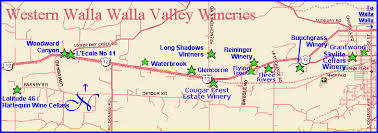
Leonetti’s success, it is fair to say, kick-started Walla Walla as a special wine region which until then was better known for its onions, apples, and wheat. Selling wine to visitors from out of town caught the attention of Marty Clubb, who founded the nearby family winery, L’Ecole No 41 in 1984. Clubb was soon offering his attention-getting Merlot, Semillon and Cabernet on the same day Leonetti scheduled its open house. Not surprising, there were traffic jams caused by wine lovers coming from Portland and Seattle.  Adding to the evolving wine scene, Rick Small who planted a vineyard in the late 70s converted a machine shop into a winery in 1981. His Woodward Canyon Winery was yet another reason to hit the road to Walla Walla.

To be frank, Walla Walla is in the proverbial middle of nowhere. Portland is 250 miles west, Seattle around 275 miles away, and otherwise, nothing but farmlands and magnificent rock formations. The area is beautiful and the town of Walla Walla with its brick buildings is absolutely charming, home to Whitman College and more bike trails than you thought existed.

My first visit to Walla Walla was in 1996 and during that time I was welcomed by the owners of Leonetti, L’Ecole, and Woodward Canyon. Two wineries had tasting rooms downtown, Seven Hills and Canoe Ridge. My hosts were the owners of a new vineyard named Pepper Bridge who were at the time also major apple growers shipping their product worldwide. All three wineries remain family owned and Pepper Bridge, owned by Ginnie and Norm McKibben, is now both a winery and a major grower selling to dozens of  wineries.

But to return to my list of what makes Walla Walla unusual, #3 is the fact that in the little town there are presently 32 winery tasting rooms open to the public and to wine club members. That’s almost a third which is amazing. As I was packing up to leave on the most recent trip, a local stopped to ask what I thought of Walla Walla. After mentioning I first visited years ago, she noted,  “Yes, the wineries saved the town and brought it back to life.”

But what really sets Walla Walla apart from most AVA is that 95% of the grapes grown are red. Cabernet, Merlot and Syrah combine for 70% of the total. On the Oregon side, The Rocks District sub-appellation, approved in 2015 and known for its distinctive gravel, cobblestone soil,  Syrah edges out Cabernet and Merlot is a distant third.

While it is fairly clear that Syrah is the rockstar of The Rocks, Cabernet faces some stiff competition from Merlot and Bordeaux blends as the signature wine of Walla Walla Valley. And Syrah is gaining some steam with new wineries like Valdemar Estate raising the bar. 

From the revisit, I left with the belief that Walla Walla is just gaining momentum and is on track to become a leading voice for many red wines. Currently, there are excellent Cabs and Merlots but it is easy to get excited about the Bordeaux blends, especially those with a good dose of Cabernet Franc. 

5 Best Representatives: All have wine clubs

Northstar Winery “Red Blend,” Walla Walla Valley 2016 $60

Pepper Bridge Winery Merlot, Walla Walla Valley 2018 $55

Amavi Cellars Cabernet Sauvignon, Walla Walla Valley 2018 $36.00

Valdemar Estate Syrah, Walla Walla Valley  2019 $65

Saviah Cellars 2018 Cabernet Franc Walla Walla Valley, 2018 $35

Merlot

L’Ecole No 41 remains a leader with both its regular and Estate Merlot. Northstar has 14 acres planted to Merlot but uses the Columbia Valley AVA.  Northstar’s 2013 Merlot, with 23% Cabernet, is a gorgeous, concentrated berry-infused, lightly oaked version for $41. Northstar’s limited production 2017 Premier Merlot, is as big and beautiful as Merlot gets. Loaded with flavors, It only needs cellaring. The retail price is $100.

Pepper Bridge Winery Merlot, Walla Walla Valley 2018 $55

With 13% Cab Franc, this Merlot made from Seven Hills and the estate vineyard, this is a perfect example of what Walla Walla offers. It displays ripe cherry, raspberry and light herbal aromas with a touch of oak spice. On the palace it is medium-full bodied with ripe fruit, an earthy streak and good acidity to accompany the tannins. Concentrated, textured, and balanced, it begs to be cellared 3-5 years. While owning both Pepper Bridge and Seven Hills Vineyard, the winery produces only 8,000 cases a year. Dozens of wineries buy grapes from Pepper Bridge, including Leonetti which bottles a vineyard designated Cabernet. All Pepper Bridge wines were excellent. One reason why the winery is not better known is that it sells almost all direct to wine club members. But if there were one club I would join , this would be it.

Cabernet Sauvignon

A recent taste of a 2002 Leonetti Cabernet confirmed that this winery remains in the forefront with its signature balance and longevity. Woodward Canyon with its Estate Reserve Cab also remains in top form. The 2016 Northstar Walla Walla Cab ($60) offered beautiful aromas with light tannin and was presented in an attractive elegant style. Offered through its wine club,the 2016 Pepper Bridge Cabernet ($56), blended with the four other Bordeaux grapes, is a classic, ripe, structured version with bright fruit and rich tannin that will drink beautifully for many years.

Amavi Cellars Cabernet Sauvignon, Walla Walla Valley 2018 $36.00

A vintage that was warm in July and threatened by smoke, 2018 turned out to be fine thanks to the ultra-long growing season that is a hallmark of the region. The last Cab was picked in mid-October. Made from 76% Cabernet and equal portions of the usual suspects, it was aged primarily in neutral French oak. With cherry, sweet spices and black currant fruit, it is medium bodied, nicely balanced with hints of anise and dusty tannins. As an estate wine that is sustainably grown, Amavi’s Cabernet has been consistent over recent vintages and is attractively priced. A little over 5,000 cases were made in 2018.

Bordeaux Blends

Here as elsewhere, what to label traditional Bordeaux blends remains a problem. Meritage never caught on as a useful moniker. One of the early proponents of Bordeaux blends in Walla Walla, Reininger which began in 1997 finally decided by the 2017 vintage to label the wine “BDX Red Wine.” A relative newcomer to the scene, Va Piano labeled its attractive blend, “Uniti.”  “Trine” is a name newly adopted for Pepper Bridge’s Bordeaux blend.  “Night Owl” is used by Amaurice Cellars for its red blend.  Oh well, one that stood out was Northstar’s “Red Blend.”

Northstar Winery “Red Blend,” Walla Walla Valley 2016 $60

Northstar’s first vintage was in 1994 and the state-of-the-art winery was built in 2002.

In its earliest years, Northstar was guided by  California’s well-known winemaker, Jed Steele. It is part of the Ste. Michelle portfolio which was recently sold. The 2028 Red Blend is made from 51% Merlot, 47% Cabernet Sauvignon, and 2% Cabernet Franc. The barrel regime consisted of 100% French oak with 38% new barrels for 18 months. It is definitely not shy with wide open aromas of herbs and ripe dark cherries, and is rich and silky smooth on the palate. Beautifully textured, it finishes long with sweet, toasty oak notes. It does throw some sediment, so decanting is recommended.

Another standout Bordeaux blend:

Va Piano Vineyards, Walla Walla Valley “Uniti”, Estate Grown 2018 ($85): 

Born and raised in Walla Walla, winemaker/owner Justin Wylie started Va Piano in 2003.  A year in Florence encouraged the “va piano” name from an Italian proverb that means go slow and take it one step at a time.  For a wide range of red wines led by Cabernet and Syrah, he relies on grapes from his 20-acres in mid-Walla Walla and the high elevation Octave Vineyard on the Oregon side.  A top-of-the line blend, the 2018 Uniti is 30% Cabernet, 30% Cab Franc, 28% Merlot and 12% Malbec.  The winery has a tasting room in Bend.

Syrah

Although I didn’t taste many Syrah on this trip, one caught my attention: 2019 Valdemar Estates from Walla Walla. This new winery is simply amazing! Founded by the 6th generation Bujuda family who also own Bodegas Valdemar in Rioja.  It is both a restaurant, featuring tapas, and a state of the art winery. To date, the investment is said to be well over $10 million. It is run by Jesus Bujuda who attended the University of Washington and fell in love with Walla Walla on a visit. The mantra heard in the tasting room is that “we are here to help put Walla Walla on the international wine map.” An attractive lineup of Rioja wines are also offered in the tasting room and are for sale. The 2012 Conde Valdemar Reserva is delightful for $30 and there’s a selection of older library vintages going back to 1985. As good as the Grenache was, the Walla Walla Syrah was a standout.

Valdemar Estate Syrah, Walla Walla Valley  2019 $65

A little under 200 cases were made, and the fruit was sourced from Stoney Vine Vineyard located south of Walla Walla with its rocky terroir. The Syrah is the old style head-training method for vine management. Blended with 5% Grenache, the wine was aged 16 months in 25% new and 75% 2-year-old, French oak. It’s dark and vibrant, loaded with dark blackberry fruit, anise, and a slight earthy streak. The flavors are ripe and concentrated but are under control with light tannin leading to a balanced finish.

Cabernet Franc:

As another writer finding more to like these days with Cabernet Franc, I was happy to see several wineries offering a varietal version. Saviah’s is a splendid example.

Saviah Cellars, Walla Walla Valley Cabernet Franc 2016 ($35): 

Founded in 2000, Saviah Cellars offers an extremely wide range of limited production wines including the only Barbera from Walla Walla, an attractive Nebbiolo, and this extremely well-made Cabernet Franc.  It was sourced from three vineyards: Watermill Vineyard which is located in The Rocks District, Dugger Creek Vineyard and the Summit View Vineyard.  It is a textbook example of the varietal with aromas of ripe berry, spice, tobacco and anise.  Medium bodied, it has similar flavors with highlights of dried herbs and raspberry fruit.  It has a slightly fleshy palate feel and no rough edges as it finishes long and smooth.